










PYRAMID TECHNOPLAST LIMITED: debt rose as asset turnover fell
Key highlights
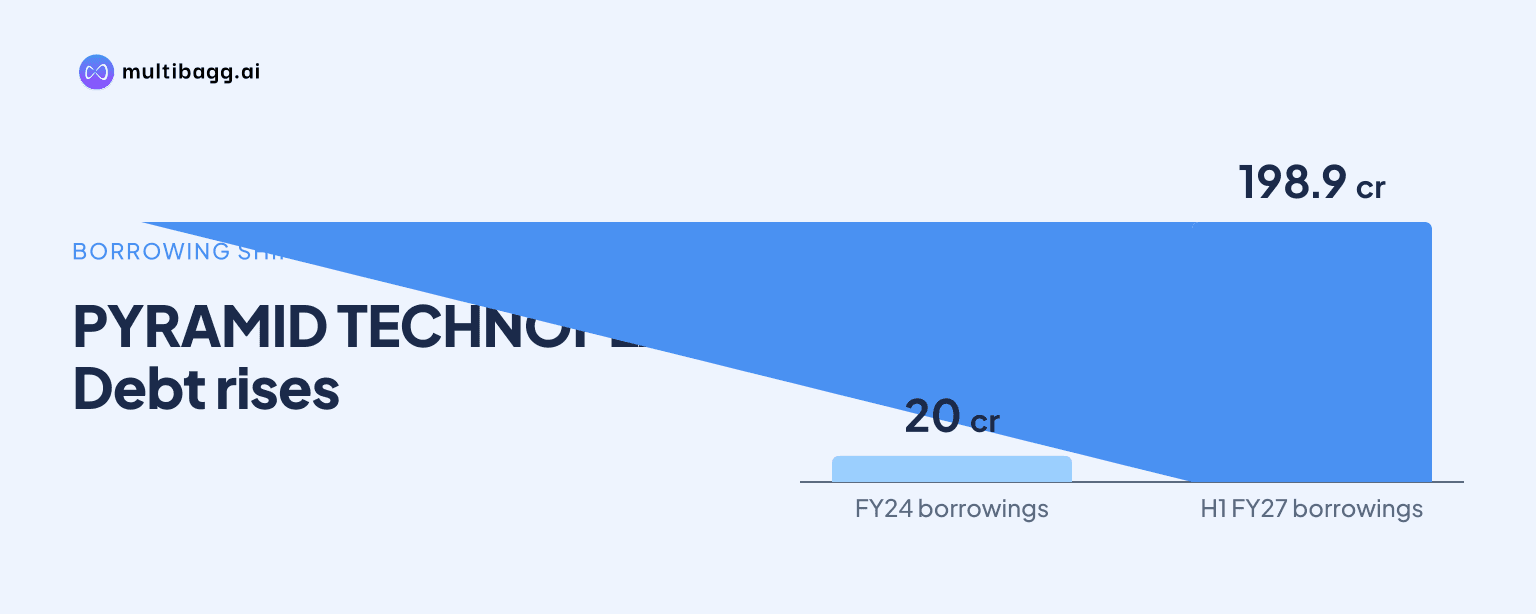
- PYRAMID Technoplast Ltd.’s total borrowings reached Rs 198.9 crore in H1FY27, versus Rs 20 crore in FY24.
- PYRAMID Technoplast Ltd.’s fixed-asset turnover fell to 2.9 times in FY26 from 7.7 times in FY23.
- PYRAMID Technoplast Ltd.’s trade receivables reached Rs 176.4 crore in H1FY27, up from Rs 143 crore in FY26.
- PYRAMID Technoplast Ltd. reported 78 inventory days in FY26, compared with 50 days in FY25.
powered by IRIS
PYRAMID Technoplast Ltd.’s fixed-asset turnover fell to 2.9 times in FY26 from 7.7 times in FY23, while total borrowings reached Rs 198.9 crore in H1FY27. Fixed assets expanded to Rs 232.6 crore in FY26, receivables reached Rs 176.4 crore in H1FY27, and cash and bank balance fell to Rs 10 lakh.
Know Pyramid Technoplast inside out
Results, valuation, peers and who's buying, in one view.
Why did PYRAMID Technoplast Ltd.’s borrowings rise?
PYRAMID Technoplast Ltd.’s total borrowings rose to Rs 198.9 crore in H1FY27, comprising Rs 83.4 crore of long-term borrowing and Rs 115.5 crore of short-term borrowing. This compares with Rs 183.4 crore in FY26 and Rs 20 crore in FY24, based on the respective long-term and short-term borrowing balances.
The increase occurred alongside a multi-year capex programme for incremental capacity and operational efficiency. Capex rose from Rs 18 crore in FY23 to Rs 37 crore in FY24, Rs 70 crore in FY25 and Rs 90 crore in FY26. Management said planned FY27 capex was about Rs 20 crore to Rs 25 crore, primarily for the Kutch expansion.
Management said it intends to fund capex through internal accruals and cash balance, while flagging a marginal increase in debt for captive solar power plant capex. The company’s timeline records that Wada unit operations commenced in 2025, followed by production at Wada and operations at solar power and recycling plants in 2026.
How did capacity expansion affect PYRAMID Technoplast Ltd.’s asset use?
PYRAMID Technoplast Ltd.’s fixed-asset turnover ratio declined to 2.9 times in FY26 from 4.4 times in FY25, 5.8 times in FY24 and 7.7 times in FY23. The presentation defines fixed-asset turnover as revenue from operations divided by average total fixed assets.
Revenue from operations increased to Rs 680.9 crore in FY26 from Rs 480 crore in FY23, but fixed assets rose more quickly, to Rs 232.6 crore from Rs 69.2 crore. Fixed assets also increased from Rs 157.9 crore in FY25, while revenue rose from Rs 591.3 crore over the same period.
The source does not provide an H1FY27 fixed-asset turnover ratio, although fixed assets remained at Rs 232.6 crore at H1FY27. Management’s stated operational priorities include increasing automation and metal-drum capacity, increasing the share of intermediate bulk containers, or IBCs, and optimising production at each site.
What changed in PYRAMID Technoplast Ltd.’s working capital?
PYRAMID Technoplast Ltd.’s trade receivables rose to Rs 176.4 crore in H1FY27 from Rs 143 crore in FY26 and Rs 99.3 crore in FY24. Inventories were Rs 105.2 crore in H1FY27, marginally below Rs 107.1 crore in FY26 but above Rs 58.8 crore in FY24.
Receivables and inventories together were Rs 281.6 crore in H1FY27, compared with Rs 250.1 crore in FY26 and Rs 158.1 crore in FY24. The H1FY27 increase was driven by receivables, which rose Rs 33.4 crore from the FY26 balance, while inventory declined Rs 1.9 crore.
The FY26 working-capital cycle also showed higher stockholding and collection periods. Inventory days rose to 78 from 50 in FY25, while debtor days increased to 77 from 71. Creditor days declined to 31 from 35, indicating fewer days of supplier credit than in FY25.
Got a follow-up? Ask IRIS
How did PYRAMID Technoplast Ltd.’s liquidity and leverage measures move?
PYRAMID Technoplast Ltd.’s net debt-to-equity ratio increased to 0.6 times in FY26 from 0.2 times in FY25 and zero in FY24. The presentation defines net debt using cash, bank balances and current investments, although it does not give a separate net-debt amount.
The current ratio declined to 1.7 times in FY26 from 2.3 times in FY25 and 2.6 times in FY24. Current assets increased to Rs 280.6 crore in FY26 from Rs 190.3 crore in FY25, but current liabilities rose more sharply to Rs 162.5 crore from Rs 81.4 crore.
Cash and bank balance then declined to Rs 10 lakh at H1FY27 from Rs 5.9 crore in FY26. At H1FY27, current assets were Rs 292.2 crore and current liabilities were Rs 143.4 crore; trade payables were Rs 18.9 crore, down from Rs 42.3 crore at FY26.
Did FY26 earnings grow with PYRAMID Technoplast Ltd.’s asset base?
PYRAMID Technoplast Ltd.’s revenue from operations increased Rs 89.6 crore to Rs 680.9 crore in FY26, while earnings before interest, tax, depreciation and amortisation, or EBITDA, increased Rs 12.1 crore to Rs 58.9 crore. EBITDA margin rose to 8.6% from 7.9% in FY25.
Profit after tax increased to Rs 28.8 crore in FY26 from Rs 26.7 crore in FY25, while net profit margin declined to 4.2% from 4.5%. Interest expense rose to Rs 7.5 crore from Rs 2.7 crore, and depreciation increased to Rs 11.9 crore from Rs 8 crore.
Interest coverage declined to 6.2 times in FY26 from 14.4 times in FY25 and 18.1 times in FY24. Separately, the Q2FY27 EBITDA bridge reported EBITDA of Rs 20.3 crore, compared with Rs 12.6 crore in Q2FY26, with a Rs 77.3 crore total-income impact partly offset by Rs 65.3 crore of cost of goods sold.
Conclusion
PYRAMID Technoplast Ltd.’s financial data show that the capacity build-out coincided with a larger fixed-asset base, higher borrowings and more capital tied up in receivables and inventories. FY26 revenue and EBITDA increased, but fixed-asset turnover, current ratio and interest coverage declined from earlier reported levels as debt, depreciation and working-capital balances increased.
The next disclosed item to watch is management’s FY27 capex plan of about Rs 20 crore to Rs 25 crore, principally for Kutch expansion. Management expects to use internal accruals and cash balance, while noting a marginal debt increase for captive solar power plant capex; the movement in H1FY27 receivables of Rs 176.4 crore and cash of Rs 10 lakh remains an unresolved balance-sheet consideration.