










Pyramid Technoplast Reports 48% Q2 Revenue Growth to ₹238 Crore
Key highlights
- Pyramid Technoplast reported Q2 FY27 revenue of ₹238 crore, up 48% year-on-year.
- Q2 FY27 EBITDA rose 61% year-on-year to ₹20.3 crore, with margin improving to 8.5% from 7.8%.
- Profit after tax increased 54% year-on-year to ₹9.5 crore in Q2 FY27.
- Pyramid Technoplast retained its FY27 objectives of about 15% revenue growth and 11% to 12% EBITDA margin.
powered by IRIS
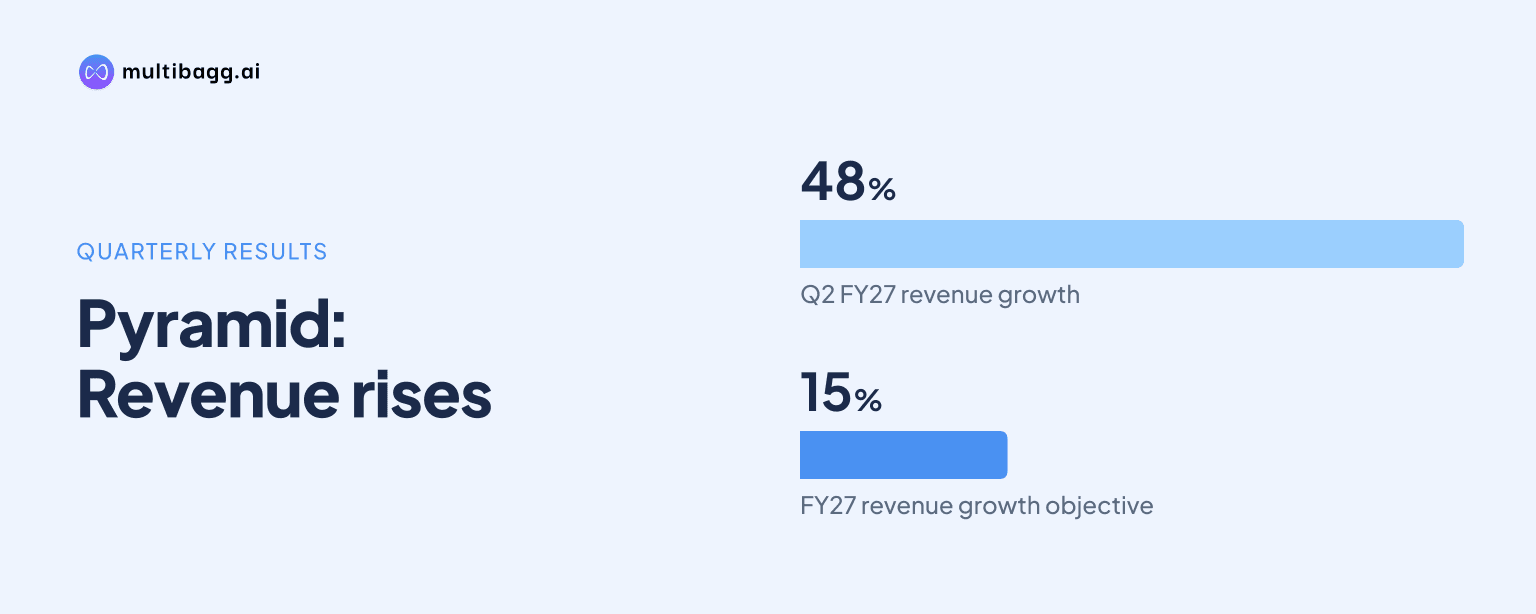
Pyramid Technoplast Limited reported 48% year-on-year revenue growth to ₹238 crore in Q2 FY27, while EBITDA rose 61% to ₹20.3 crore and its EBITDA margin reached 8.5%, up from 7.8% a year earlier, for the quarter ended September 30, 2026, according to the company presentation.
Know Pyramid Technoplast inside out
Results, valuation, peers and who's buying, in one view.
What did Pyramid Technoplast report for Q2 FY27?
Pyramid Technoplast reported revenue from operations of ₹238 crore for Q2 FY27, compared with a lower base in the corresponding quarter of the previous year. The company said EBITDA increased to ₹20.3 crore, translating into an 8.5% margin. Profit after tax rose 54% year-on-year to ₹9.5 crore.
The reported revenue increase was supported by both higher volumes and realisations. Management disclosed volume growth of 21% and realisation growth of 22% for the quarter. The company also reported that revenue for the first half of FY27 rose 42% year-on-year to ₹460.5 crore.
What drove Pyramid Technoplast's revenue increase?
Higher realisations were the larger disclosed contributor to Pyramid Technoplast's quarterly revenue growth. Of the ₹77 crore year-on-year increase in revenue, price contributed ₹43.6 crore, according to the earnings-call summary. This indicates that pricing accounted for more than half of the increase in reported quarterly revenue.
Volume growth nevertheless remained relevant to the quarter's performance. Pyramid Technoplast reported a 21% rise in volume, alongside the 22% improvement in realisations. The combination lifted revenue by 48%, but the disclosed breakdown shows that the movement in realisations had a larger effect on the absolute revenue gain.
This distinction matters when assessing the quality of growth. Revenue growth driven partly by realisations can strengthen reported sales during a period of improved pricing, while sustained volume growth indicates customer demand and operating throughput. The company did not provide a product-wise or customer-wise revenue split in the material provided.
Can Pyramid Technoplast reach its FY27 margin guidance?
Pyramid Technoplast has retained its FY27 objective of approximately 15% revenue growth and an EBITDA margin of 11% to 12%. Its Q2 EBITDA margin was 8.5%, while the earnings-call summary placed the H1 FY27 margin at about 9%.
Based on that H1 margin, reaching the stated 11% to 12% full-year range would require an expansion of roughly 2 to 3 percentage points over the remaining period. Management directed questions on the sustainability of margins towards per-ton metrics, rather than providing a detailed explanation of the factors needed to deliver the full-year target.
The Q2 margin was 70 basis points above the 7.8% level reported in Q2 FY26. EBITDA growth of 61% also exceeded revenue growth of 48%, which supported the quarterly margin improvement. However, the company’s full-year guidance remains higher than the margin reported for both Q2 and the first half.
Got a follow-up? Ask IRIS
What are Pyramid Technoplast's expansion and capital-spending plans?
Pyramid Technoplast has outlined FY27 capital expenditure of ₹20 crore to ₹25 crore. Management also referred to a Kutch plant project with indicated spending of ₹22 crore to ₹25 crore and a targeted commissioning date of March 2027.
The company said the Kutch facility is intended to strengthen its presence in Kutch and western India. Management cited lower freight costs, faster deliveries and improved customer service as the operational benefits expected from the location. It also referred to reduced plastic waste and the facility's alignment with its sustainability agenda.
The disclosed Kutch project range broadly overlaps with the company’s overall FY27 capex indication. The materials provided do not give a detailed project-wise allocation, current construction status, or the volume capacity that the new facility will add. These details will be relevant for investors tracking execution against the March 2027 commissioning plan.
How does the Q2 performance affect investors and operations?
For investors, the quarter provides evidence of strong reported revenue and profit growth, but it also highlights the importance of realisations in the result. Pricing contributed ₹43.6 crore of the ₹77 crore increase in quarterly revenue, making future realisation trends material to the pace of sales growth.
Margin delivery is another key operating measure. Pyramid Technoplast's 8.5% Q2 margin and approximately 9% H1 margin remain below its FY27 target range of 11% to 12%. The company has communicated the target, but the earnings-call material did not set out a quantified bridge covering the expected contribution from pricing, product mix, costs or capacity utilisation.
The Kutch project could affect distribution operations in western India through shorter freight distances and faster deliveries if commissioned as planned. No share-price movement, revised earnings estimate, customer contract, or capacity addition figure was provided in the source material, so the market impact cannot be quantified from the disclosed information.
Conclusion
Pyramid Technoplast delivered a quarter of faster revenue, EBITDA and profit growth in Q2 FY27. Revenue reached ₹238 crore, aided by 21% volume growth and 22% realisation growth, while EBITDA margin improved to 8.5%. The result also shows that price accounted for a substantial portion of the revenue increase.
Investors will next watch whether the company can move from an approximately 9% H1 EBITDA margin towards its 11% to 12% FY27 objective. Progress on the Kutch plant, which management has targeted for commissioning by March 2027, and clarity on the capex allocation will also remain important disclosed milestones.