










Pyramid Technoplast Kutch plant due by March 2027 with 10,000 IBCs
Key highlights
- Pyramid Technoplast expects to commission a 10,000-IBC-a-month Kutch plant by March 2027.
- Pyramid Technoplast plans Rs 20 crore to Rs 25 crore of demand-linked spending for the Kutch project.
- Q2 FY27 volume rose 21% year on year to about 14,798 metric tonnes, with utilisation reaching about 70%.
- IBC products contributed about 32% of Pyramid Technoplast's Q2 FY27 revenue.
powered by IRIS
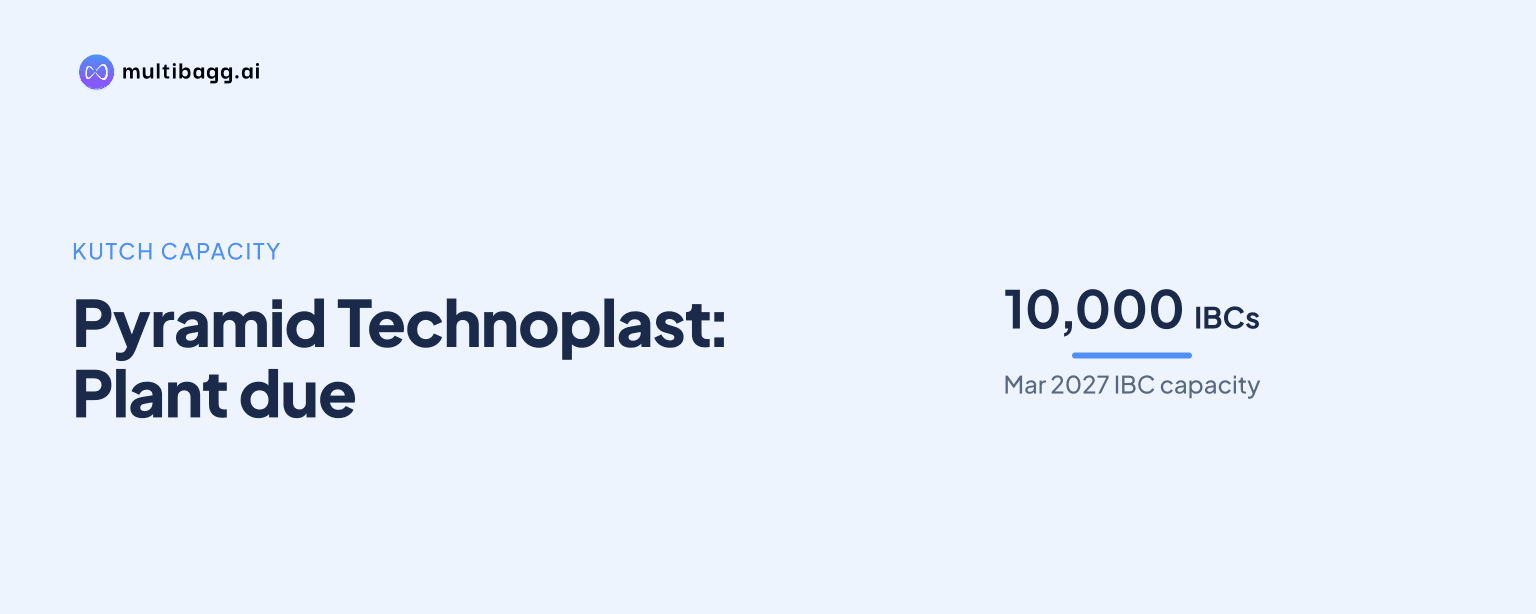
Pyramid Technoplast Limited expects to commission a Kutch plant with capacity of about 10,000 intermediate bulk containers, or IBCs, a month by March 2027, backed by Rs 20 crore to Rs 25 crore of demand-linked capital expenditure. Management said the western India facility is intended to lower freight costs, accelerate deliveries and improve customer service.
Know Pyramid Technoplast inside out
Results, valuation, peers and who's buying, in one view.
When will Pyramid Technoplast commission the Kutch plant?
Pyramid Technoplast expects to commission the Kutch plant by March 2027, with planned output of about 10,000 IBCs a month. Management provided the target on its November 6, 2026 earnings call for the second quarter of financial year 2027, or Q2 FY27, and said the project was progressing as planned.
The company did not disclose a specific date within March 2027, a production ramp-up schedule or expected first-year utilisation. Management said the plant would strengthen Pyramid Technoplast's presence in Kutch and western India and add operating leverage to its existing network after commissioning, but did not provide a Kutch-specific revenue or earnings forecast.
Why is Pyramid Technoplast building an IBC plant in Kutch?
Pyramid Technoplast is building the Kutch unit to locate IBC capacity closer to western India customers, which management expects to reduce freight costs, shorten delivery times and improve service. The plan follows higher transport spending as the company sought customers on longer routes, including dispatches to southern markets from its existing manufacturing network.
Management said about Rs 2 per kilogram of the increase in Q2 FY27 other expenses was attributable to higher transportation costs. It also said transport is included in customer quotations, meaning the company seeks to pass freight through in pricing; Kutch is intended to lower the underlying transport requirement rather than rely only on recovery from customers.
The logistical case comes as the IBC business accounted for about 32% of Q2 FY27 revenue. Pyramid Technoplast reported more than 500 customers, with the largest customer representing about 6% of revenue and the top 10 customers representing about 29%, although the call did not identify customers or contracts allocated to the Kutch site.
How much will Pyramid Technoplast spend on the Kutch expansion?
Pyramid Technoplast plans to invest about Rs 20 crore to Rs 25 crore in Kutch and says the capital will be deployed in line with actual demand. That range is also its planned capital expenditure, or CAPEX, for FY27, compared with about Rs 90 crore in FY26, when it made broader investments in capacity, solar power and recycling.
Management described the lower FY27 CAPEX as reflecting that the major phase of capacity and efficiency investment was behind the company. It separately disclosed government subsidy approvals of about Rs 35 crore for Wada and Bharuch, comprising Rs 24.9 crore for Wada over 10 years and Rs 10.5 crore for Bharuch; these approvals do not relate to Kutch.
Pyramid Technoplast expects the Wada subsidy sanction by March 2027 and said the Bharuch application would be filed in the next phase. In a later call response, management said Wada could contribute around Rs 2.5 crore annually and Bharuch around Rs 1 crore to Rs 1.5 crore annually after sanction, with the incentives spread over 10 years.
Got a follow-up? Ask IRIS
What demand and utilisation support Pyramid Technoplast's Kutch plan?
Pyramid Technoplast reported Q2 FY27 volumes of about 14,798 metric tonnes, up 21% year on year and 14% from Q1 FY27, while capacity utilisation reached about 70%. This compares with 62% in Q1 FY27 and 62% in Q2 FY26, indicating that volumes improved at the existing network before the proposed Kutch plant is due to start.
For the first half of FY27, or H1 FY27, volume totalled 27,789 metric tonnes at average utilisation of about 66%. Polymer-drum tonnage rose 5% year on year in Q2, IBC units grew 17%, and mild-steel, or MS, drum tonnage increased 73%, showing volume growth across all three reported product categories.
Management said chemical-industry volumes were improving and that customers were increasing purchases of packaging products. This was management's assessment rather than a formal market forecast, and the transcript did not disclose whether Kutch capacity will serve a particular chemical segment or how much of its planned 10,000-IBC monthly output will be incremental demand.
How does Kutch fit Pyramid Technoplast's FY27 earnings plan?
Pyramid Technoplast said the Kutch plant should add operating leverage once it is commissioned, while its current focus is to raise utilisation at existing sites. Management expects overall utilisation at Wada to reach around 80% during FY27 across steel-plastic composite drums, IBCs and MS drums, compared with the group average of about 66% in H1 FY27.
Q2 FY27 revenue rose 48% year on year to Rs 238 crore, supported by a 22% increase in average realisation to about Rs 1.61 lakh per tonne and 21% volume growth. Earnings before interest, tax, depreciation and amortisation, or EBITDA, rose 61% to Rs 20.3 crore, while EBITDA per tonne increased 33% to about Rs 13,718.
The Q2 EBITDA margin was 8.5%, compared with 7.8% in Q2 FY26, and H1 FY27 margin was 9%, compared with 8.2% a year earlier. Management's FY27 objective is approximately 15% revenue growth and an EBITDA margin of 11% to 12%; it attributed possible second-half improvement to higher utilisation, solar savings, recycling, operating leverage and product mix rather than to a quantified Kutch contribution.
Pyramid Technoplast reported about Rs 3.89 crore of solar savings in H1 FY27 and expects its full 14.25-megawatt solar capacity to generate around Rs 15 crore in annual savings. Its recycling plant generated Rs 33 lakh of EBITDA in Q2 FY27, and management estimates about Rs 2 crore of FY27 EBITDA from that unit, but neither saving was assigned to the Kutch project.
Conclusion
Pyramid Technoplast's Kutch project is a targeted IBC expansion, with 10,000 units of monthly capacity planned by March 2027 and Rs 20 crore to Rs 25 crore of demand-linked spending. The principal rationale is logistical: management aims to reduce the transport cost that contributed about Rs 2 per kilogram to higher Q2 FY27 other expenses while improving delivery times in western India.
The next disclosed milestones are Kutch commissioning and the expected Wada subsidy sanction, both by March 2027. Investors can also watch demand-led CAPEX deployment, progress toward around 80% utilisation at Wada, and whether solar, recycling and higher utilisation support management's stated FY27 EBITDA-margin objective of 11% to 12%.