










Pyramid Technoplast says receivables drove H1 cash outflow
Key highlights
- Pyramid said debtors rose Rs 10 crore, from Rs 23 crore to Rs 33 crore, during H1.
- Pyramid said 80% of purchases shifted to local sourcing after imports stopped following the Hormuz issue.
- Management attributed about Rs 2 crore of a roughly Rs 4 crore sequential rise in other expenses to long-distance transport.
- Pyramid plans FY27 capital expenditure of about Rs 20 crore to Rs 25 crore, versus about Rs 90 crore in FY26.
powered by IRIS
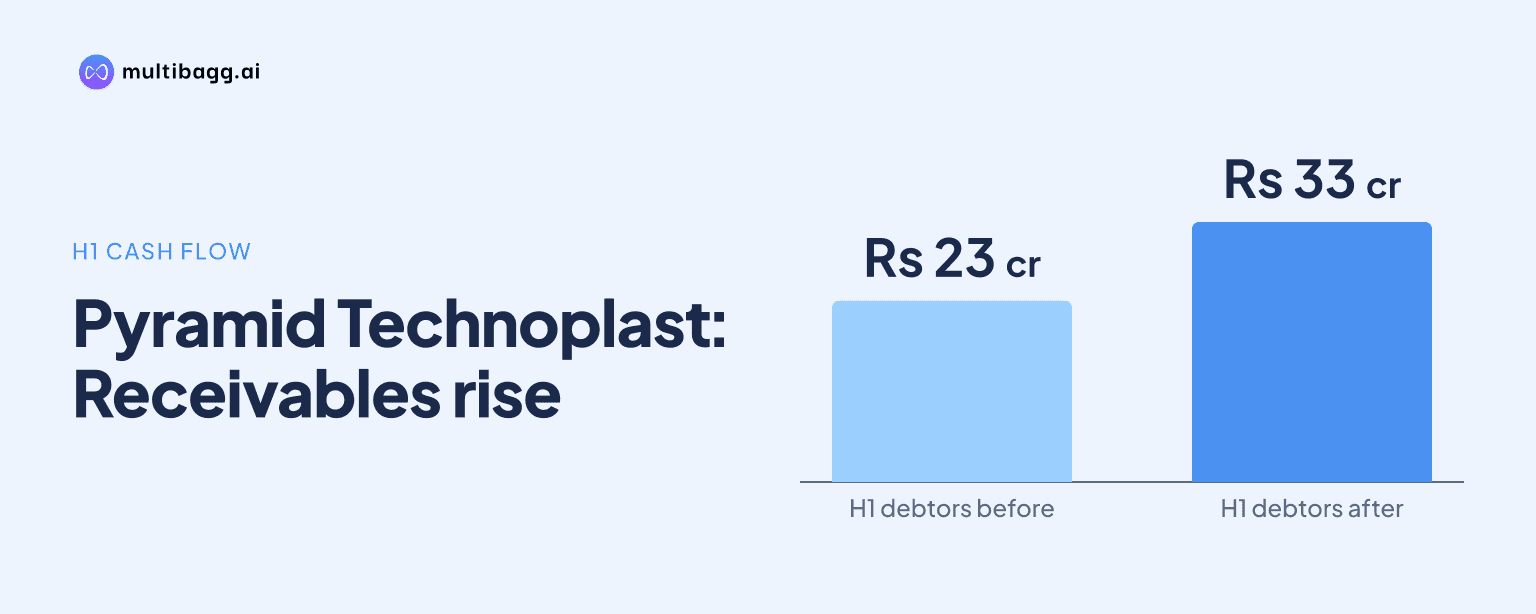
Pyramid Technoplast said negative H1 cash flow reflected debtors rising by Rs 10 crore to Rs 33 crore as sales increased, alongside a shift to 80% local purchases after imports stopped. Management described the cash deployment as investment in the business, while leaving the detailed reconciliation of supplier payments, interest and tax unresolved.
Know Pyramid Technoplast inside out
Results, valuation, peers and who's buying, in one view.
Why was Pyramid's H1 cash flow negative?
Pyramid attributed negative H1 cash flow chiefly to higher working capital: debtors rose from Rs 23 crore to Rs 33 crore, while sales increased. Management said the additional Rs 10 crore in receivables represented cash invested in the business rather than a deterioration in its stated operating performance.
The company also said it had changed its procurement pattern after the Hormuz issue, moving 80% of purchases to local sources after buying imported material until March. Management cited both the sourcing transition and larger debtors in response to an analyst's question on why H1 cash flow was negative for a second consecutive year.
The transcript does not provide debtor days, inventory values, collection targets or a full operating-cash-flow bridge. Management referred to creditors of Rs 23 crore, but the comparative creditor number was not stated clearly, so the precise contribution of payables to the H1 cash-flow result cannot be calculated from the call.
How did local sourcing affect Pyramid's working capital?
Pyramid said imports had continued until March, but the company stopped importing after the Hormuz issue and shifted 80% of total purchases to local procurement. It did not disclose the value of imported purchases, the cost of local purchases, or supplier payment terms before and after the change.
Management's explanation indicates that the timing of procurement payments changed at the same time as receivables increased by Rs 10 crore. However, it did not quantify whether local suppliers required faster payment than import suppliers, so the call does not establish how much of the negative H1 cash flow arose from sourcing rather than customer collections.
Pyramid also said polymer-price movements are generally passed through to customers. Management said that if polymer prices decline, the company buys and sells at lower rates, and it did not expect that mechanism alone to affect margins. That price pass-through does not remove the cash-conversion effect when revenue is recognised before customer payment is received.
Did rising sales explain Pyramid's larger receivable balance?
Pyramid said sales growth was the reason debtors increased to Rs 33 crore from Rs 23 crore. Management also said volume was rising in both the current and previous months, and described capacity utilisation as about 60% to 70% during the call.
The company said H1 revenue was 40% higher year on year, compared with its FY27 roadmap of 15% revenue growth. When asked whether the annual target was conservative in light of first-half growth, management said it tries to be conservative but did not revise the 15% guidance or disclose H1 revenue in rupees during the call.
Management expects utilisation to reach 75% to 80% and said it could add machines as demand expands. It also said its packaging products are supplied to chemical customers and that it sells to pharma, pharma ancillary and food-industry customers, although it did not provide a segment split of receivables or intermediate bulk container sales.
Got a follow-up? Ask IRIS
What other costs and disclosures matter for cash conversion?
Pyramid said about Rs 2 crore of a roughly Rs 4 crore sequential increase in other expenses came from transportation for long-distance dispatches. Management said the company had pursued customers on longer routes, including southern markets, and that the higher transport cost was linked to higher tonnage.
The company said freight is included when customer prices are quoted, but that does not establish when freight recovery is collected. Management said the proposed Kutch expansion is intended to bring production closer to customers and reduce transportation costs, though it did not disclose a commissioning date or capacity for that project in this exchange.
An analyst questioned why the cash-flow statement showed interest expense of Rs 3.46 crore when the analyst expected about Rs 7 crore. Management said it would check and respond within an hour, but no answer appears in the supplied transcript, leaving the interest classification or presentation unresolved.
A separate question concerned Rs 4.8 crore of tax payment. Management later said total advance tax was Rs 3.75 crore, comprising Rs 2.25 crore in September and Rs 1.5 crore earlier, but it did not reconcile that figure with the Rs 4.8 crore cited by the analyst. Management also said it would check the repayment schedule after being asked about long-term borrowings of more than Rs 10 crore in H1.
What management plans could affect Pyramid's future cash flows?
Pyramid said FY27 capital expenditure is planned at about Rs 20 crore to Rs 25 crore, down from about Rs 90 crore in FY26. Management said the spending would primarily support catch expansion and would be deployed in line with actual demand, reducing the planned capital outlay from the preceding year.
Management said the Wada subsidy could add about Rs 2.5 crore annually and the Bharuch subsidy about Rs 1 crore to Rs 1.5 crore annually. It expects the combined Rs 3 crore to Rs 4 crore annual benefit to be sanctioned around March and spread over 10 years.
Pyramid also said its recycling process had reached 25% progress, with the remaining 75% expected within three to four months. Management estimated that the recycling plant could generate Rs 2 crore of profit this year and Rs 4 crore to Rs 5 crore in the following financial year, which it identified as FY28.
Conclusion
Pyramid's stated reason for negative H1 cash flow is a working-capital build: debtors increased Rs 10 crore to Rs 33 crore as sales rose, while procurement shifted to 80% local sourcing after imports stopped. Higher long-distance freight also added about Rs 2 crore to other expenses, although management said transport is incorporated in customer pricing.
The next disclosures to watch are management's promised clarification on the Rs 3.46 crore interest-expense query, the repayment schedule for long-term borrowings above Rs 10 crore, and the tax-payment reconciliation. Management also expects subsidy sanction around March, plans FY27 capex of Rs 20 crore to Rs 25 crore, and targets completion of the remaining 75% of recycling progress within three to four months.