










Pyramid Technoplast forecasts FY28 recycling EBITDA of Rs 4-5 crore
Key highlights
- Pyramid Technoplast forecasts recycling EBITDA of Rs 4-5 crore in FY28, versus an estimated Rs 2 crore in FY27.
- The recycling plant generated Rs 33 lakh of EBITDA in Q2 FY27 and was operating at 25% utilisation in November 2026.
- Pyramid Technoplast reported H1 FY27 EBITDA of Rs 41.6 crore, and EBITDA margin improved to 9% from 8.2%.
- Pyramid Technoplast expects 14.25 megawatts of solar capacity to deliver about Rs 15 crore of annual savings.
powered by IRIS
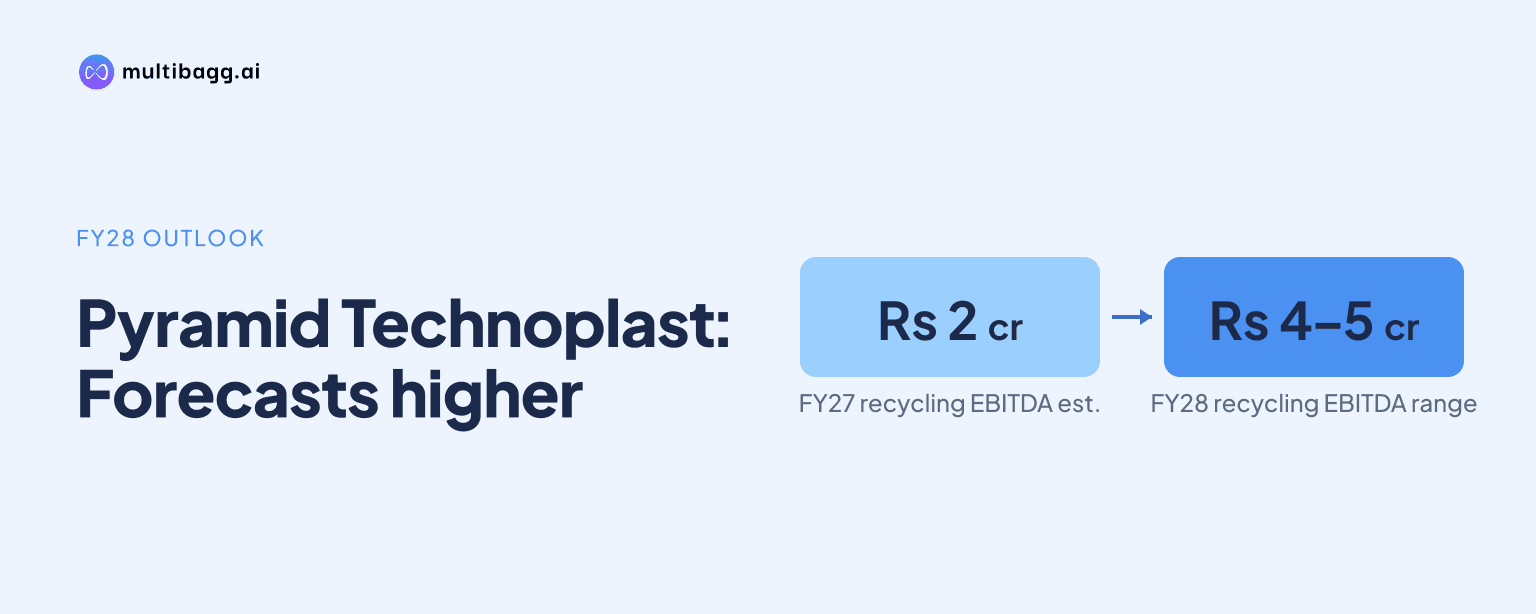
Pyramid Technoplast Limited expects its recycling plant to generate earnings before interest, tax, depreciation and amortisation (EBITDA) of Rs 4-5 crore in FY28, compared with an estimated Rs 2 crore in FY27, as utilisation rises from 25% and management targets the remaining scale-up within three to four months.
Know Pyramid Technoplast inside out
Results, valuation, peers and who's buying, in one view.
How much recycling EBITDA does Pyramid Technoplast forecast for FY28?
Pyramid Technoplast forecasts Rs 4-5 crore of recycling-plant EBITDA in FY28, versus its estimated Rs 2 crore contribution in FY27. Management gave the FY28 outlook on its November 6, 2026 earnings call after saying the facility had reached 25% utilisation.
The forecast implies an increase of Rs 2-3 crore from FY27, with the lower end representing a doubling of estimated plant EBITDA. The recycling operation generated Rs 33 lakh of EBITDA in Q2 FY27, the quarter ended September 30, 2026, giving a reported reference point for the planned full-year ramp.
Management said the unit was picking up demand and that it had increased quantity during Q2 FY27. It said the next step was to determine the ramp-up of the remaining 75% of capacity, which it expected could be reached within three to four months.
What has changed since Pyramid Technoplast commissioned the plant?
Pyramid Technoplast commissioned the recycling plant in October 2025 with investment of about Rs 8-10 crore and an estimated payback period of two to three years. By the November 2026 call, utilisation had reached 25%, while Q2 FY27 EBITDA was Rs 33 lakh.
The company’s Rs 2 crore FY27 EBITDA estimate is higher than the single-quarter Q2 contribution because management expects output to expand in subsequent periods. That is a management estimate, not reported FY27 performance, and depends on the stated capacity ramp and continuing demand.
The facility is one of four levers management cited for improving FY27 profitability, together with higher utilisation, a fuller contribution from solar savings, and operating leverage from product mix and the business model. In the first half, or H1, of FY27, Pyramid Technoplast reported EBITDA of Rs 41.6 crore and an EBITDA margin of 9%, compared with 8.2% in H1 FY26.
How does recycling fit Pyramid Technoplast’s FY27 margin plan?
Pyramid Technoplast said it expects about 9.5% EBITDA margin from the business in FY27 and a further 1.5 percentage points from subsidies, implying an expectation of about 11%. Its broader FY27 objective is an EBITDA margin of 11-12%, compared with 9% in H1 FY27.
Recycling is not the sole element of that margin bridge. Management said approved subsidies for its Wada and Bharuch facilities total about Rs 35 crore over time, including Rs 24.9 crore for Wada over 10 years and Rs 10.5 crore for Bharuch; it separately indicated annual bottom-line contributions of about Rs 2.5 crore from Wada and Rs 1-1.5 crore from Bharuch once applicable.
Core operating metrics had improved before the recycling plant reached full scale. Q2 FY27 EBITDA per tonne was Rs 13,718, up 33% from Rs 10,326 in Q2 FY26, while revenue increased 48% year on year to Rs 238 crore. Volume grew 21% and average realisation rose 22% to about Rs 1.61 lakh per tonne.
Margin expansion also faces costs from a broader delivery footprint. Management attributed about Rs 2 crore of the sequential increase in other expenses to transportation for long-distance dispatches, and said its planned Kutch facility is intended to lower freight costs by being closer to western Indian customers.
Got a follow-up? Ask IRIS
What demand and capacity trends support Pyramid Technoplast’s ramp-up?
Pyramid Technoplast reported Q2 FY27 capacity utilisation of about 70%, up from 62% in Q1 FY27 and 62% in Q2 FY26. H1 FY27 volume was 27,789 metric tonnes at average utilisation of about 66%, while management said volumes continued to rise in the current month.
Management expects overall utilisation at Wada to reach around 80% during FY27. The Wada facility produces small packaging drums, intermediate bulk containers (IBCs) and mild-steel drums, and management said its focus was on sustaining production and gaining operating leverage from infrastructure already created.
Growth was spread across the main product categories in Q2 FY27: polymer-drum tonnage rose 5% year on year, IBC units increased 17%, and mild-steel-drum tonnage grew 73%. IBCs accounted for about 32% of quarterly revenue, while the company served more than 500 customers and its largest customer accounted for about 6% of revenue.
Pyramid Technoplast plans capital spending of about Rs 20-25 crore in FY27, down from about Rs 90 crore in FY26. The spending is principally for a Kutch facility with planned capacity of about 10,000 IBCs a month, which management expects to commission by March 2027 and deploy in line with demand.
How does the recycling opportunity compare with solar savings?
Pyramid Technoplast said its solar projects generated savings of about Rs 3.89 crore in H1 FY27, and that its full 14.25-megawatt solar portfolio could deliver about Rs 15 crore of annual savings. This compares with estimated recycling EBITDA of Rs 2 crore in FY27 and the Rs 4-5 crore FY28 forecast.
The solar programme involved Rs 60 crore of investment and an estimated payback of about four years, while the recycling unit required about Rs 8-10 crore and had a projected two-to-three-year payback. The solar portfolio included 6 megawatts and 2.25 megawatts commissioned in Maharashtra in October 2025, followed by 5 megawatts at Bharuch in February 2026.
Management said installation and pre-charging of the remaining 1 megawatt at Bharuch were complete, with benefits expected to start in the month after the November 6 call. It also said the solar programme was delivering about 80-90% of its planned benefit, rather than 100%, making actual savings relevant to the FY27 margin outcome.
Conclusion
Pyramid Technoplast’s Rs 4-5 crore FY28 recycling EBITDA forecast describes a shift from a partially utilised new facility to a more meaningful earnings contributor. The Rs 33 lakh reported in Q2 FY27, the Rs 2 crore FY27 estimate and the FY28 range show the scale of management’s expected increase, although the wider business remains substantially larger with H1 FY27 EBITDA of Rs 41.6 crore.
The next points to watch are whether recycling utilisation reaches the remaining 75% within management’s three-to-four-month timeline, whether Wada reaches around 80% utilisation during FY27, and whether Kutch is commissioned by March 2027. Management also expects the final 1-megawatt Bharuch solar addition to begin contributing in the month after the call.