










Pyramid Technoplast targets 11% FY27 margin with subsidy
Key highlights
- Pyramid Technoplast reported a 9% EBITDA margin in H1 FY27, up from 8.2% in H1 FY26.
- Management expects about 9.5% FY27 margin from operations and 1.5 percentage points from subsidies.
- Wada and Bharuch subsidy approvals total about Rs 35 crore, with estimated annual benefit of Rs 3 crore to Rs 4 crore.
- Pyramid Technoplast indicated H2 FY27 EBITDA of around Rs 45 crore.
powered by IRIS
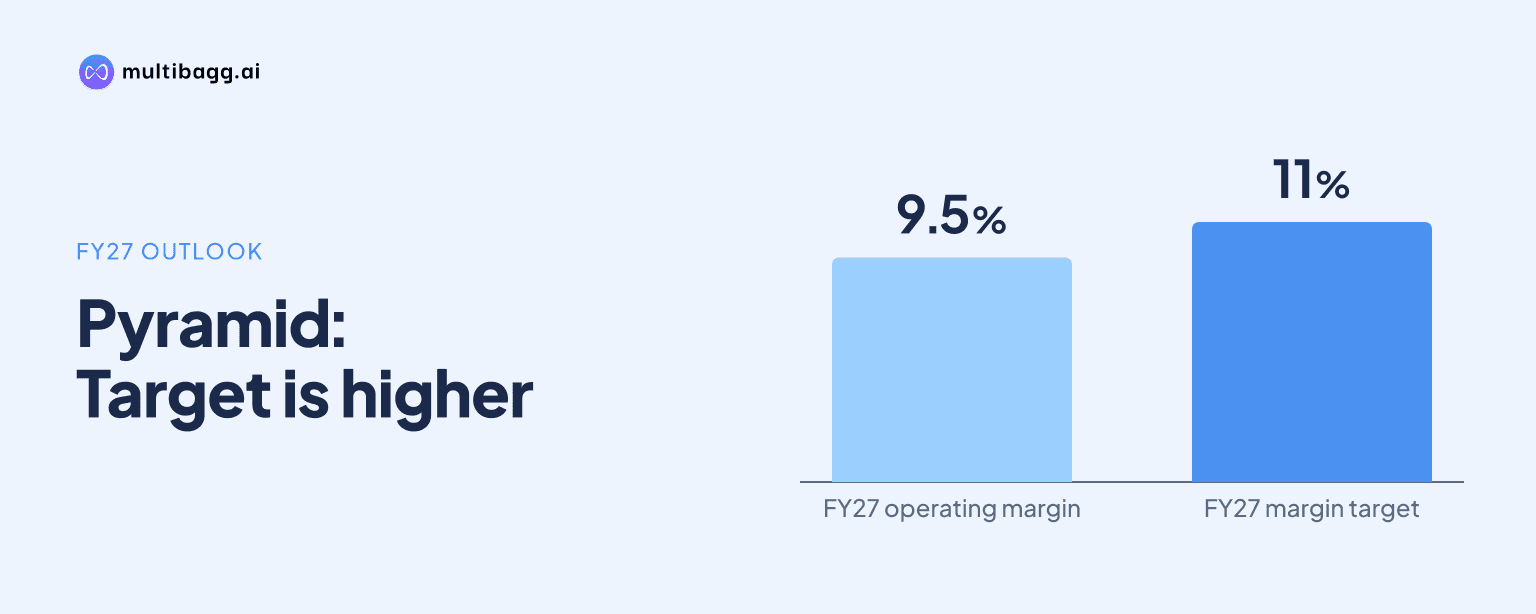
Pyramid Technoplast Limited expects roughly 11% earnings before interest, tax, depreciation and amortisation (EBITDA) margin in financial year 2027 (FY27), with management attributing about 1.5 percentage points to subsidies and about 9.5% to operations, against the 9% EBITDA margin reported in the first half of FY27 (H1 FY27).
Know Pyramid Technoplast inside out
Results, valuation, peers and who's buying, in one view.
How does Pyramid Technoplast expect to reach an 11% FY27 EBITDA margin?
Pyramid Technoplast expects about 9.5% FY27 EBITDA margin from its business and another 1.5 percentage points from subsidies, taking the expected outcome to around 11%, management said during the November 6, 2026 earnings call. In prepared remarks, management had set an objective of improving FY27 EBITDA margin towards 11% to 12%, but later gave the more specific 9.5%-plus-1.5% bridge.
The core-business bridge implies an improvement of about 0.5 percentage points from the 9% reported in H1 FY27. Management cited higher capacity utilisation, the full benefit of solar savings, a larger recycling contribution, operating leverage and product mix as the operational mechanisms. It did not assign a separate margin contribution to each of those factors.
What were Pyramid Technoplast's H1 FY27 and Q2 FY27 results?
Pyramid Technoplast reported H1 FY27 revenue of Rs 460.5 crore, up 42% year on year, while EBITDA rose 55% to Rs 41.6 crore and margin improved to 9% from 8.2% in H1 FY26. The first-half result provides the reported starting point for management's 9.5% operational-margin expectation.
In the second quarter of FY27 (Q2 FY27), revenue increased 48% year on year to Rs 238 crore and EBITDA increased 61% to Rs 20.3 crore, producing an 8.5% margin versus 7.8% in Q2 FY26. Average realisation rose 22% to about Rs 1.61 lakh per ton and volume rose 21%, while EBITDA per ton increased 33% to about Rs 13,718 from Rs 10,326 in Q2 FY26.
Management told participants that EBITDA per ton is a useful measure because raw-material price changes are passed through to customers. Gross profit in Q2 FY27 rose 28% year on year to Rs 55.3 crore while gross margin remained at 23%, reflecting raw-material costs increasing alongside selling prices.
Which operating measures support Pyramid Technoplast's core margin plan?
Pyramid Technoplast is targeting higher utilisation after Q2 FY27 utilisation reached about 70%, compared with 62% in Q1 FY27 and 62% in Q2 FY26. H1 FY27 volume was 27,789 metric tons at average utilisation of about 66%, and management said it expects overall utilisation to reach around 80% during FY27.
Solar generation is a quantified cost-saving mechanism in the plan. The company said its 6-megawatt and 2.25-megawatt Maharashtra solar facilities were commissioned in October 2025, followed by a 5-megawatt Bharuch facility in February 2026. These assets delivered about Rs 3.89 crore of savings in H1 FY27, while the full 14.25-megawatt capacity is expected to provide around Rs 15 crore of annual savings.
The remaining 1-megawatt Bharuch solar installation had completed installation and pre-charging, with management expecting benefits to begin in the following month. Pyramid Technoplast has invested about Rs 60 crore in solar projects and estimated a payback of about four years, linking the projects to lower energy costs rather than to a separately disclosed EBITDA-margin contribution.
Recycling is also expected to add to operating earnings. The recycling plant, commissioned in October 2025 with investment of about Rs 8 crore to Rs 10 crore, generated Rs 33 lakh of EBITDA in Q2 FY27. Management expects about Rs 2 crore of EBITDA from the plant in FY27 and said the operation had reached 25% of its intended process, with the remaining 75% expected within three to four months.
Got a follow-up? Ask IRIS
When will Pyramid Technoplast receive the subsidy benefit?
Pyramid Technoplast has received subsidy approvals of about Rs 35 crore in total, comprising Rs 24.9 crore for Wada over 10 years and Rs 10.5 crore for Bharuch. Management expects the Wada sanction by March 2027, while the Bharuch application for sanction is planned in the next phase.
Management said Wada could contribute around Rs 2.5 crore annually and Bharuch around Rs 1 crore to Rs 1.5 crore, for a combined annual contribution of about Rs 3 crore to Rs 4 crore directly to the bottom line. It also said the subsidy would be added to profit at the end of the year and would be spread over 10 years.
The timing of recognition is therefore important to the FY27 margin outcome. The call did not specify an accounting treatment, a precise FY27 recognition date or a separately quantified FY27 subsidy amount, beyond management's annual estimate of Rs 3 crore to Rs 4 crore and its 1.5-percentage-point margin bridge.
What could affect Pyramid Technoplast's FY27 margin delivery?
Pyramid Technoplast reported higher freight-related costs as it expanded long-distance dispatches in Q2 FY27. Management attributed about Rs 2 crore of the increase in other expenses to transportation costs and said it includes transport costs when quoting customer prices, although it did not provide a timetable for reducing transport cost per ton.
The planned Kutch facility is intended to address freight and delivery distance. Pyramid Technoplast plans capital expenditure of about Rs 20 crore to Rs 25 crore for a facility with capacity of about 10,000 intermediate bulk containers, or IBCs, per month, expected to be commissioned by March 2027. Management said the site would support Kutch and western India through lower freight costs, faster deliveries and improved customer service.
Product mix and utilisation remain relevant to the operational portion of the target. Value-added IBCs contributed about 32% of Q2 FY27 revenue, while IBC units grew 17% year on year, polymer-drum tonnage grew 5% and mild-steel drum tonnage grew 73%. Management also indicated H2 FY27 EBITDA of around Rs 45 crore, compared with Rs 41.6 crore in H1 FY27.
Conclusion
Pyramid Technoplast's stated FY27 margin bridge makes subsidies material to its roughly 11% expectation: management expects about 9.5% from operations and 1.5 percentage points from incentives. The reported H1 FY27 margin of 9%, Rs 3.89 crore of solar savings and Rs 33 lakh of Q2 recycling EBITDA show the identified operating levers, but the company has not quantified each lever's individual effect on margin.
The next disclosures to watch are the expected Wada subsidy sanction by March 2027, the Bharuch application, benefits from the remaining 1-megawatt solar installation and progress in recycling toward the remaining 75% of its planned process. Management's indicated H2 FY27 EBITDA of about Rs 45 crore and its annual subsidy estimate of Rs 3 crore to Rs 4 crore should show how much of the FY27 result comes from operations and incentives.