










Remsons targets up to Rs 1,000 crore revenue by FY30 from FY26
Key highlights
- Remsons targets FY30 revenue of Rs 900-1,000 crore, while its FY30E chart shows Rs 950 crore.
- Remsons reported FY26 revenue of Rs 468.7 crore and H1FY27 revenue of Rs 255.2 crore, up 19% year on year.
- Passenger cars represented 38% of Remsons’ Q2FY27 revenue, ahead of two- and three-wheelers at 34%.
- Remsons disclosed a Rs 300 crore Stellantis control-cables order running for seven years.
powered by IRIS
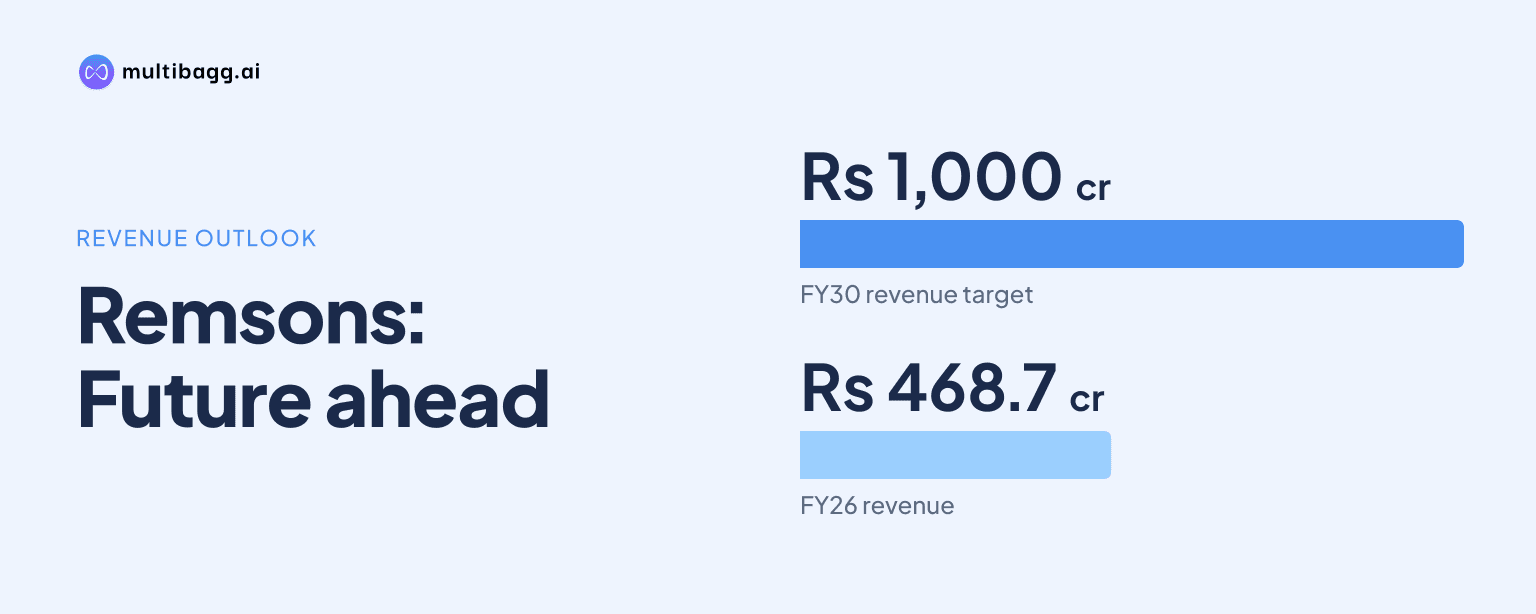
Remsons Industries Limited is targeting FY30 revenue of Rs 900-1,000 crore, compared with Rs 468.7 crore in FY26, and its FY30E chart shows Rs 950 crore. Management links the target to next-generation products, higher-value lines, broader sector coverage and growth through joint ventures, collaborations and acquisitions.
Know Remsons Industries inside out
Results, valuation, peers and who's buying, in one view.
What revenue is Remsons targeting by FY30?
Remsons is targeting Rs 900-1,000 crore of revenue in FY30, according to Chairman and Managing Director Krishna Kejriwal’s H1FY27 commentary. The company’s FY30E revenue chart shows Rs 950 crore, which is the midpoint of management’s stated range and represents an increase of Rs 481.3 crore from FY26 revenue.
The Rs 950 crore FY30E figure is 2.03 times the Rs 468.7 crore reported in FY26. The presentation also describes a “3X jump in revenue projected over the next three years,” but it does not disclose a separate revenue base or calculation for that statement. It further cites estimated revenue compound annual growth rate, or CAGR, of about 20% by FY29.
How has Remsons’ revenue base changed before FY30?
Remsons increased revenue by Rs 319.3 crore from Rs 149.4 crore in FY19 to Rs 468.7 crore in FY26. The progression included a decline of Rs 0.5 crore from Rs 312.8 crore in FY23 to Rs 312.3 crore in FY24, followed by increases to Rs 376.6 crore in FY25 and Rs 468.7 crore in FY26.
For H1FY27, Remsons reported revenue of Rs 255.2 crore, up 19% year on year. Earnings before interest, taxes, depreciation and amortisation, or EBITDA, were Rs 22.7 crore, while net profit after tax, or PAT, was Rs 7.6 crore; the reported EBITDA margin was 9% and PAT margin was 3%.
Remsons presents its 2019-to-2026 transformation as the base for its growth strategy. Its 2019 snapshot showed a mechanical-only portfolio, four Indian manufacturing plants and sector concentration that was largely in two-wheelers, while the 2026 snapshot lists five portfolio areas, eight plants across India and the United Kingdom, and exposure to two-wheelers, three-wheelers, passenger cars, commercial vehicles, off-highway vehicles and rail.
Which products and segments underpin Remsons’ growth plan?
Remsons says its plan is based on expanding into next-generation offerings and moving up the value chain through higher-margin product lines. Its product platform spans mechanical systems, sensors and lighting, alongside locomotive and defence offerings, compared with mechanical products only in the 2019 snapshot.
The mechanical portfolio includes push-pull cables, gear shifters, brake, clutch and throttle cables, pedal boxes, accelerator modules, winches and screw-type jacks. The sensors platform includes more than 100 stock-keeping units, or SKUs, such as position, speed, pressure and temperature sensors, while lighting includes LED head and tail lamps, daytime running lamps and interior lighting programmes.
Passenger cars accounted for 38% of Q2FY27 revenue, making them the largest disclosed segment. Two- and three-wheelers represented 34%, commercial vehicles 19%, farm 7% and other segments 2%; the mix contrasts with the company’s 2019 description of a business focused largely on two-wheelers.
Got a follow-up? Ask IRIS
How do overseas sales and customer channels fit Remsons’ plan?
Remsons generated 31% of Q2FY27 revenue from the rest of the world and 69% from India. The company says it serves more than 20 countries and has manufacturing locations in Pardi, Gurgaon, Daman and Pune in India, as well as Stourport and Redditch in the United Kingdom.
Original equipment manufacturer, or OEM, deliveries represented 94% of Q2FY27 revenue, compared with 6% for the aftermarket. Remsons states that it serves more than 20 tier-1 OEMs globally, while its product coverage extends across passenger vehicles, commercial vehicles, off-highway applications, rail and defence.
Management identifies joint ventures, collaborations and mergers and acquisitions, or M&A, as accelerators of growth. The 2026 snapshot lists more than four joint ventures and acquisitions, whereas the 2019 snapshot listed no strategic alliances; the presentation does not quantify expected revenue contributions from individual transactions or collaborations.
What disclosed orders and execution points matter for FY30?
Remsons has disclosed orders and programmes that extend across several years, although the presentation does not state their FY30 revenue recognition. The company secured a Rs 300 crore, seven-year order from Stellantis N.V. for control cables and a Rs 30 crore hood-rods order from a global commercial-vehicle OEM to be executed over six years.
Remsons Automotive Ltd. (UK) was nominated for a 10-year pedal-box programme by a global commercial-vehicle OEM, with production scheduled to start in Q4 calendar year 2028. The programme has an estimated lifetime value of about Rs 160 crore, while BEE Lighting Ltd secured a Rs 12 crore order from a global multinational OEM for exterior-vehicle-lighting design and development.
Leadership changes and a joint-venture exit are part of the current execution context. Rahul Desai became chief executive officer on 3 August 2026, Shivani Kejriwal became whole-time director on 16 October 2026, and the board approved an exit from the Aircom Remsons Automotive Private Limited joint-venture agreement.
The presentation gives two different profitability datapoints without reconciling them. Its 2026 transformation snapshot shows EBITDA margin of 11%, while H1FY27 EBITDA margin was 9%; net debt to equity was 0.44 times as at March 2026, and no FY30 profitability or capital-spending target is disclosed.
Conclusion
Remsons’ FY30 aspiration of Rs 900-1,000 crore is set against Rs 468.7 crore of FY26 revenue, with Rs 950 crore used in its FY30E chart. The company’s stated route combines a wider mechanical, sensors and lighting platform with greater passenger-car and commercial-vehicle exposure, 31% rest-of-world revenue in Q2FY27, and collaborations, joint ventures and acquisitions.
The next items to watch are execution of the Rs 300 crore Stellantis programme, the Rs 30 crore hood-rods order and the UK pedal-box programme scheduled to begin production in Q4 calendar year 2028. Management’s unchanged priorities under the new leadership, alongside progress in H1FY27 revenue growth of 19% and the difference between the 9% reported H1FY27 EBITDA margin and the 11% 2026 snapshot, remain relevant to the FY30 plan.