










Rentomojo says core cities provide 90%-91% of its growth
Key highlights
- Rentomojo said 90%-91% of its growth still comes from major core cities.
- Rentomojo said EBITDA margin remained near 40%-41% after reinvestment in growth costs.
- Rentomojo reported H1 capex of Rs 170 crore-Rs 175 crore, matching the entire previous year.
- Rentomojo said occupancy increased to 86% from 83%.
powered by IRIS
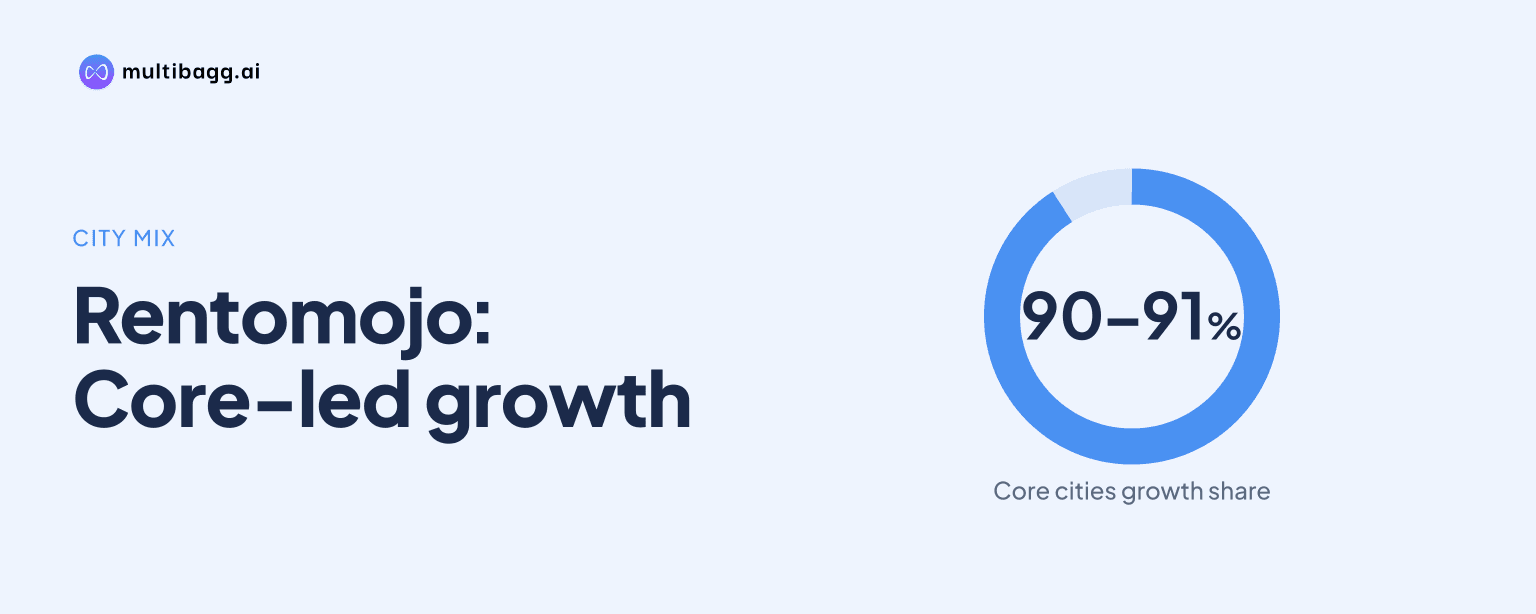
In the earnings call, Rentomojo Limited said 90%-91% of its growth came from major core cities, while EBITDA margin remained near 40%-41% despite reinvestment in expansion. Management said newer cities contribute less today, meaning current growth is principally supported by established markets rather than recent city launches.
Know Rentomojo inside out
Results, valuation, peers and who's buying, in one view.
How much of Rentomojo growth comes from core cities?
Rentomojo said around 90%-91% of its growth still comes from major core cities. Management made the disclosure while discussing whether entry into newer markets, which can carry higher customer acquisition costs, or CAC, could affect margins. It said new cities contribute less today and that growth is not dependent on those launches.
The 90%-91% figure refers to growth, not total revenue, subscriber count or assets. Rentomojo did not name the core cities, provide a city-level revenue split, or quantify growth from newer markets. Its stated position was that the lower present contribution from new cities limits their effect on company-wide CAC and profitability.
Rentomojo also said capital expenditure, or capex, in the reported first half, or H1, matched the amount purchased during the entire previous year at Rs 170 crore-Rs 175 crore. Management described the spending as front-loaded and said occupancy rose to 86% from 83%, while clarifying that it did not intentionally seek to raise occupancy.
Why is Rentomojo expanding beyond its core cities?
Rentomojo is expanding because management said the market has depth and that continued execution can unlock more growth levers. It cited a historical progression of growth measures of 35%-38%, 40%, about 45%, 50% and about 52%, and said it would continue investing while seeking appropriate returns on capital.
Management said its earlier conversations with market participants had referred to revenue growth of around 30%-35%, while the company delivered growth of more than 50%. It described its expansion intentions as aggressive and said cash on the balance sheet, alongside business accruals, provides capacity to support faster growth. Those remarks were management commentary rather than a formal forward revenue target.
Subscriber additions are the biggest current growth driver, according to Rentomojo. Responding to an analyst's observation of about 42% growth in subscriber additions, management said traffic was almost 50% higher year on year and that distribution channels and subcategories were broadly performing well.
Rentomojo said revenue per item could normalise on an annualised basis and may dip in the second half, or H2, as the air-conditioner season recedes. An analyst calculated implied value per item of about Rs 11,700 in the current Q2, compared with about Rs 10,600 in the prior-year Q2; management attributed the increase to product mix, including air conditioners, sofas and other higher-capex categories.
Got a follow-up? Ask IRIS
Can Rentomojo maintain EBITDA margins as it expands?
Rentomojo said EBITDA, or earnings before interest, tax, depreciation and amortisation, margin remained close to 40%-41% despite reinvesting operating leverage in growth costs. Management did not provide a future margin target, but said it had flexibility to reduce some experience investments if it needed additional margin buffer.
Management said CAC can be higher in new cities and channels, but argued that these operations do not materially affect the overall margin because their contribution remains small. Rentomojo did not disclose the difference in CAC between core and newer cities, the cost of a city launch, or the amount of the spending flexibility it described.
The chief financial officer said the historical H1-H2 margin difference reflects deployment timing. Costs are linked to items deployed, while subscription revenue is cumulative because items delivered in earlier months continue to earn revenue without equivalent incremental deployment costs.
This operating model means H1 usually has greater item deployment, whereas H2 has less deployment and has historically been somewhat more margin-accretive and cash-flow-generative. An analyst referred to H1 margin of around 40%-41% and H2 margin of around 42%-43% in the previous year, but management declined to predict that the same pattern would recur.
What operating trends underpin Rentomojo's growth plan?
Rentomojo said its subscription model makes quarterly revenue different from a transactional business because each quarter begins with an existing subscriber base. Revenue has historically continued to rise even when quarter-on-quarter growth rates slowed, so seasonality may affect growth pace rather than cause a sequential revenue decline.
Average customer life has remained at about 18 months, Rentomojo said. Management said that measure had earlier been about 16 months before rising to 18 months, where it has stayed stable; the call did not disclose current-period churn, renewal rates or customer-cohort data.
Air-conditioner demand between April and June or July affected H1 asset deployment. The chief financial officer said capex per air-conditioner item is almost three to four times normal capex per item, influencing both purchase-displacement and item-order measures during the period.
Management cautioned against directly linking items ordered in H1 with reported revenue, because revenue also comes from items delivered in the previous H2. It said marketing spending had been quite stable over the last couple of quarters, but did not disclose an amount or a split between brand and performance marketing.
Conclusion
Rentomojo's growth remains concentrated in established markets, with management putting the core-city contribution at 90%-91% even as it funds expansion into newer locations. The company linked its ability to retain EBITDA margin near 40%-41% to the limited current weight of new cities, cumulative subscription revenue and an occupancy increase from 83% to 86%.
The next issue to watch is whether the Rs 170 crore-Rs 175 crore of reported H1 capex converts into the historically more cash-generative H2. Management also flagged potential H2 normalisation in revenue per item after air-conditioner seasonality, while leaving unresolved the size of the CAC gap between new and established cities and its eventual effect on margins.