










Rentomojo says H2 margins benefit after heavier H1 deployments
Key highlights
- Rentomojo said heavier H1 deployments create costs before subscriptions from delivered items continue generating revenue in H2.
- An analyst cited Rentomojo EBITDA margins of about 40% to 41% in H1 last year versus about 42% to 43% in H2.
- Rentomojo said H1 capex was about Rs 170 crore to Rs 175 crore, comparable with about Rs 170 crore to Rs 175 crore for the entire previous year.
- Rentomojo said occupancy increased from 83% to 86%, while about 90% to 91% of business came from core cities.
powered by IRIS
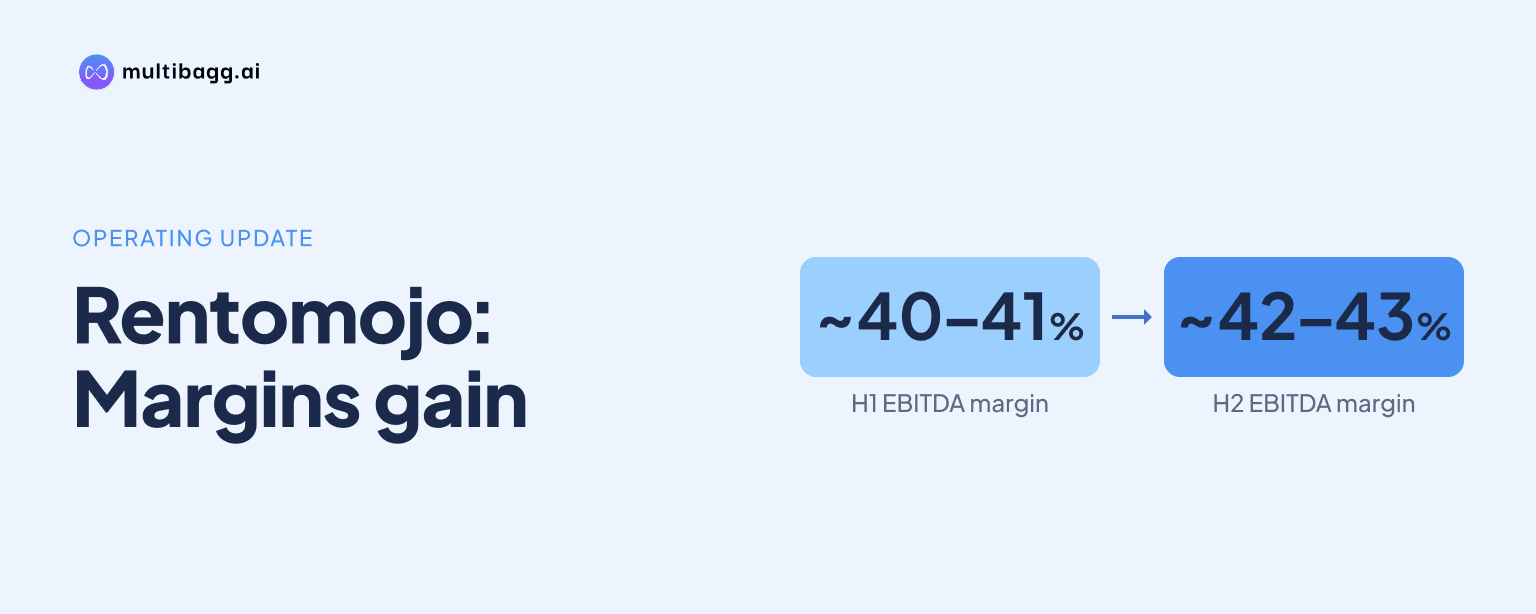
Rentomojo says its historically better second-half (H2) margin and cash-generation pattern follows heavier first-half (H1) item deployments, which carry deployment-linked costs before subscription revenue from delivered items continues to accumulate. An analyst cited earnings before interest, tax, depreciation and amortisation (EBITDA) margins of about 40% to 41% in H1 last year versus about 42% to 43% in H2.
Know Rentomojo inside out
Results, valuation, peers and who's buying, in one view.
Why has Rentomojo historically earned higher margins in H2?
Rentomojo says H2 has historically been slightly better because H1 typically has more item deployments and the related costs. Chief Financial Officer Hakim Ujjainwala said the model differs from a transactional business because its costs are linked to items deployed, rather than directly to revenue recorded in the same period.
An item delivered in an earlier month keeps generating subscription revenue without an incremental deployment cost in a later month. That timing difference means revenue and deployment costs do not necessarily match within one half-year. The comparison raised on the call was about 40% to 41% EBITDA margin in H1 last year and about 42% to 43% in H2.
Rentomojo did not provide H2 margin guidance. Chief Executive Officer Geetansh Bamania said he could rely only on historical data and would not state what would happen in the future solely on that basis. The explanation describes a historical operating pattern rather than a commitment to a particular H2 result.
Does Rentomojo expect revenue to fall in H2?
Rentomojo does not expect its seasonality to appear as an H2 revenue decline because every quarter begins with an existing subscriber base that is already producing revenue. Bamania said revenue has consistently risen, although historical quarter-on-quarter growth rates can be lower as the business scales.
This differs from a selling business, where quarterly demand may create clearer peaks and troughs in reported revenue. For Rentomojo, H1 deliveries establish future subscription streams, while H2 revenue also includes subscriptions from items delivered in the previous H2 and earlier periods. Management said H1 item orders offer some indication of future demand but should not be directly compared with current-period revenue growth.
The mix of deployed products can also affect interim metrics. Bamania said revenue per item may normalise on an annualised basis but could dip in H2 after the seasonal H1 deployment of air conditioners and other higher-capital-expenditure items. Rentomojo said it had not changed the methodology used to report these measures from that disclosed in its prospectus.
How front-loaded were Rentomojo's H1 deployments and capital expenditure?
Rentomojo said H1 capital expenditure, or capex, was heavily front-loaded at about Rs 170 crore to Rs 175 crore. Bamania compared that with about Rs 170 crore to Rs 175 crore of capex purchased during the entire previous year and said the H1 run rate could be used to assess the potential full-year pace.
Management linked the front-loaded investment to occupancy rising from 83% to 86%. Bamania said front-loaded capex should show up in occupancy, while adding that Rentomojo does not intentionally seek higher occupancy for that reason. The increase occurred alongside the company's heavier H1 deployment activity.
Air conditioners help explain why H1 can carry a higher deployment bill. Ujjainwala said April through June or July brings considerable air-conditioner volumes, and capex per air conditioner is about three to four times Rentomojo's normal capex per item. He said this seasonal product mix affects both purchase values and reported items ordered.
Got a follow-up? Ask IRIS
What explains Rentomojo's cash-generation profile?
Rentomojo says it operates with negative working capital and does not need working-capital borrowing. Bamania cited about 110% translation from EBITDA into cash flow, attributing that outcome to strong accruals and the subscription model's collection profile.
Management said its debt is all long-term debt rather than working-capital debt. Bamania said the latest debt was raised at about 8.65%, without encumbrance, and that Rentomojo was borrowing from large private- and public-sector banks. He also said Rentomojo was already rated by CRISIL and had started a further rating process.
Bamania said funding cost was not the business's most sensitive operating variable. He compared financing costs of 8.65%, 9.6% and 10% with occupancy at 85%, saying occupancy and useful life were more important factors. That distinction is consistent with management's emphasis on deployed assets and continuing subscription accruals in explaining cash generation.
What could affect Rentomojo's H1-to-H2 pattern?
Rentomojo's historical pattern depends partly on the scale and product mix of H1 deployments, including air conditioners, sofas and other categories with higher capex per item. Management said the value per deployed item can change with category mix and specifically identified air conditioners as a seasonal factor.
Growth investment is another consideration. Bamania said marketing and advertising as a share of revenue had increased over the last several quarters, though it remained within the company's intended limits. He also said newer cities and channels can have higher customer-acquisition costs, but they contribute less today, with about 90% to 91% of business coming from core cities.
Management said EBITDA margin remained close to 40% to 41% while Rentomojo reinvested operating leverage into growth and experience-related costs. Bamania said there was a buffer that could be adjusted, but he did not provide a numerical margin target. The eventual H2 outcome will therefore depend on deployment levels, product mix and the pace of reinvestment.
Conclusion
Rentomojo's explanation is that the H1-to-H2 pattern is structural to its subscription rental model: H1 carries more asset deployment costs, while H2 continues to receive revenue from the installed base with fewer new deployment-linked costs. The historical comparison of roughly 40% to 41% H1 EBITDA margin and 42% to 43% H2 margin illustrates that mechanism, but management has not forecast a repeat.
The next indicators to watch are deployment activity after H1 capex of about Rs 170 crore to Rs 175 crore, occupancy following its move from 83% to 86%, and the effect of air-conditioner seasonality on revenue per item in H2. Management also said it had begun a further CRISIL rating process, which may provide an update on its funding profile.