










Rentomojo Funds Most H1 Capex From Operating Cash Flow
Key highlights
- Rentomojo procured about Rs 192.3 crore of capex in H1 while CFO was roughly Rs 110 crore.
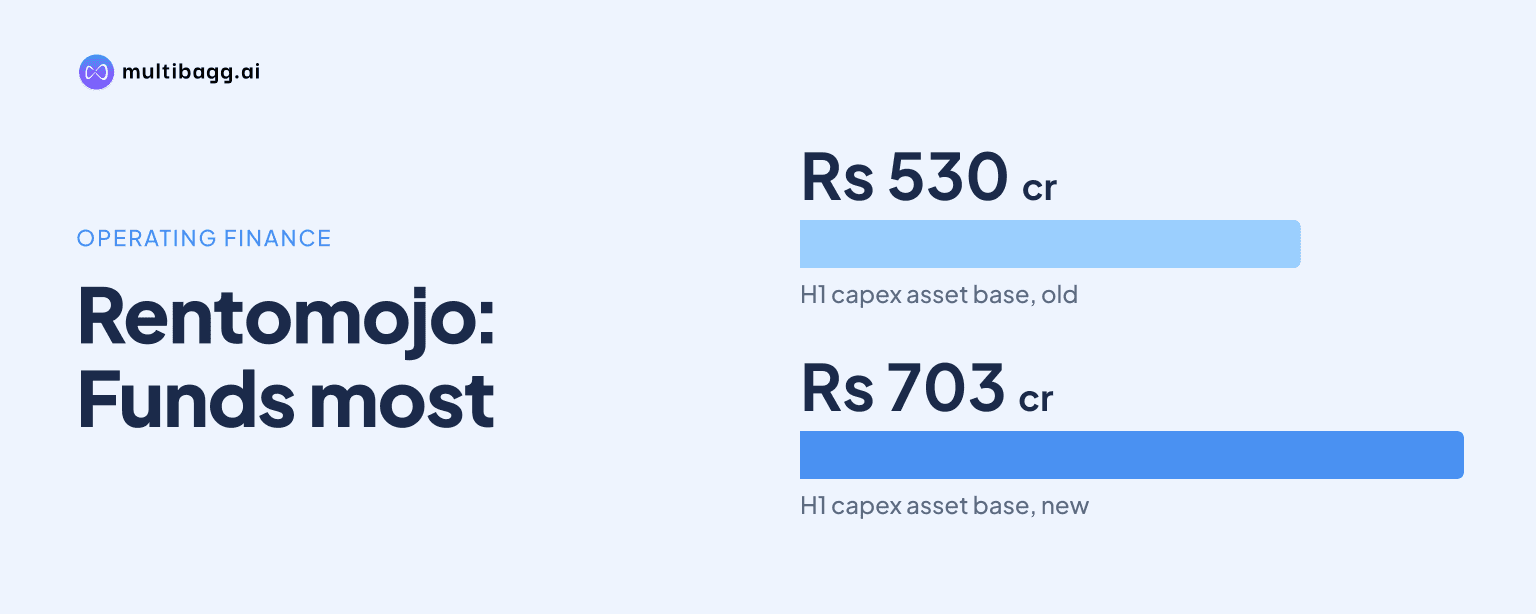
- Rentomojo's capex asset base increased from about Rs 530 crore to about Rs 703 crore in H1.
- Rentomojo reported net debt of about Rs 131 crore and net debt-to-equity of 0.28x in H1.
- Rentomojo said H1 capex grew 140.6%, compared with 52% growth in revenue from operations.
powered by IRIS
Rentomojo procured about Rs 192.3 crore of capital expenditure in H1, funding a large part through roughly Rs 110 crore of cash flow from operations while reporting net debt-to-equity of 0.28x. Gross debt rose to about Rs 232 crore, but management said internal accruals remained the first funding source for rental-asset expansion.
Know Rentomojo inside out
Results, valuation, peers and who's buying, in one view.
How did Rentomojo fund its H1 capital expenditure?
Rentomojo funded a large part of H1 capital expenditure from internal accruals and used external debt for a smaller portion. Management said it procured about Rs 192.3 crore of capex in H1, including some warehouse expenditure, while cash flow from operations, or CFO, was roughly Rs 110 crore. After warehouse capex and scrapped assets, newly purchased capex increased by about Rs 179.5 crore.
The funding pattern was similar to the prior year, when management said roughly Rs 173 crore of CFO supported about Rs 175 crore to Rs 177 crore of capex. Management said assets deployed from 2017-2018 have subsequently generated cash that can finance further asset purchases. It described this as a second phase in which dependence on debt is lower than during the company’s earlier expansion.
What changed in Rentomojo's balance sheet during H1?
Rentomojo increased its capex asset base from about Rs 530 crore to about Rs 703 crore in H1, while gross debt rose by about Rs 45 crore to roughly Rs 232 crore. Net fixed assets, after depreciation, increased from about Rs 426 crore to about Rs 566 crore. Management attributed the difference between Rs 192.3 crore procured and the Rs 179.5 crore purchase increase to warehouse capex and scrapped assets.
Rentomojo reported net debt of about Rs 131 crore after deducting cash and cash equivalents, producing net debt-to-equity of 0.28x. Management said the IPO proceeds increased net worth and therefore also affected the ratio. It separately reported debt-to-EBITDA, or earnings before interest, tax, depreciation and amortisation, of about 1.16x and net debt-to-EBITDA of about 0.65x.
The balance-sheet expansion accompanied 52% H1 growth in revenue from operations, according to management. Rentomojo said rental assets bought in earlier periods continue to produce revenue through contractual tenures, rather than generating all their revenue in the quarter of purchase. Contractual revenue tied in at the end of Quarter 2 was about Rs 690 crore.
Got a follow-up? Ask IRIS
How did operating cash conversion support Rentomojo's spending?
Rentomojo said H1 CFO was about 110% of reported EBITDA, indicating that operating cash generation exceeded reported EBITDA for the period. Management said this cash conversion enabled the company to expand rental assets without funding the full capex amount through borrowings. It also said the CFO-to-EBITDA trend had remained above about 109%.
Reported H1 EBITDA rose about 36.5%, while the reported EBITDA margin was about 37%, affected by a fire loss in Quarter 1. Management said the fire caused no human tragedy but affected reported profitability. It asked investors to consider normalised measures because reported results also reflected exceptional items, deferred-tax effects and IPO expenses.
H1 capex grew 140.6%, compared with 52% growth in revenue from operations, according to management. Rentomojo linked the faster asset expansion to future revenue capacity rather than immediate revenue recognition. Its H1 operating indicators included roughly 710,000 items ordered, about Rs 860 crore of purchase displacement, and a 44% rise in live items.
What is Rentomojo's plan for future capex funding?
Rentomojo plans to use internal accruals first and external debt second for future operating capex. Management did not disclose an annual capex figure for FY27 or a specific net debt-to-equity target. It said its current focus is on deepening CFO generation and converting EBITDA into cash, while free-cash-flow generation will become a larger focus in a few years.
Management said it seeks to operate with return on capital above 25% while pursuing growth, with net debt-to-equity serving as another constraint. In discussing potential leverage, management cited 0.5x and 1x as examples of levels on which stakeholders may hold different views, not as company targets. The reported H1 net debt-to-equity ratio was 0.28x.
The need for asset funding reflects growth in orders and operating capacity. Gross items ordered grew about 45% year on year, live subscribers increased about 42.5%, warehouse capacity rose about 51%, and store count increased about 43%, management said. Revenue per item was up about 6% in H1, while occupancy remained within Rentomojo's stated 83% to 85% target range.
Conclusion
Rentomojo's H1 disclosures show that operating cash generation funded much of a Rs 192.3 crore capex programme, while borrowings increased by about Rs 45 crore. The company added assets more rapidly than revenue grew, with the capex asset base reaching about Rs 703 crore and net debt-to-equity reported at 0.28x.
The next measure to watch is H2 cash generation, which management said has historically been higher for profit and CFO than H1. Rentomojo has not set an FY27 capex target or leverage ceiling, but management’s disclosed plan is to place accruals first, debt second, and assess growth against return-on-capital and balance-sheet constraints.