










Rentomojo says latest long-term borrowing cost fell to 8.65%
Key highlights
- Rentomojo said its latest unencumbered long-term borrowing cost was about 8.65%.
- Rentomojo reported net debt to equity of 0.28 times.
- Management said negative working capital supports roughly 110% EBITDA-to-cash-flow conversion.
- Rentomojo said occupancy rose to 86% from 83% after H1 capital expenditure of about Rs 170 crore to Rs 175 crore.
powered by IRIS
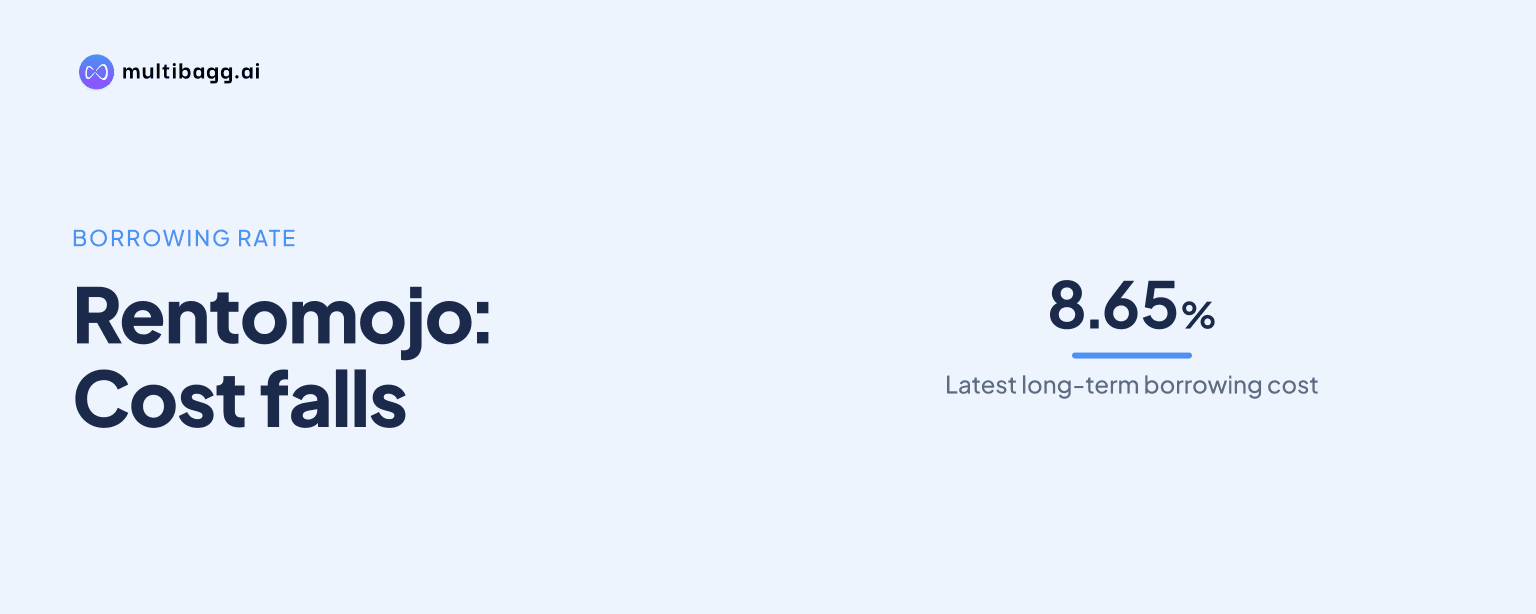
In the earnings call, Rentomojo said its latest long-term borrowing cost was about 8.65%, as access to private- and public-sector banks improved. Management linked the rate to the company’s cash flows and balance sheet, while saying its negative working-capital model translates roughly 110% of earnings before interest, tax, depreciation and amortisation (EBITDA) into cash flow.
Know Rentomojo inside out
Results, valuation, peers and who's buying, in one view.
What does Rentomojo’s 8.65% borrowing rate apply to?
Rentomojo said the approximately 8.65% rate applies to its latest long-term debt and that the borrowing carries no encumbrance. Management described it as the marginal cost of debt, meaning the rate on the latest incremental borrowing, rather than the average interest rate across all borrowings.
The call did not disclose the loan amount, maturity, individual lenders or the previous comparable rate. It therefore supports management’s statement that the marginal borrowing cost has fallen to about 8.65%, but not a calculation of the decline or of Rentomojo’s weighted average funding cost.
Management said Rentomojo is already rated by CRISIL and has restarted the rating process, with a revised rating hoped for soon. A revised rating was not disclosed as completed, and management gave neither a prospective rating level nor a quantified effect on the 8.65% borrowing rate.
How has Rentomojo’s access to bank debt changed?
Rentomojo said it is now raising debt from some of India’s largest private- and public-sector banks at rates close to 8.65%. Management presented this broader lender access as a result of its cash-flow record, balance-sheet position and CRISIL rating.
The company did not name the banks, disclose sanctioned facilities or state a total debt capacity. As a result, the call shows that Rentomojo has added bank relationships, but does not establish how much additional long-term debt it can draw.
Management also cited approximately Rs 110 crore of accruals in the first half (H1). It said H2 has historically generated more profit and cash flow than H1, so the Rs 110 crore figure should not be treated as a full-year forecast or as a disclosed annual cash-flow target.
Does Rentomojo use debt for working capital?
No. Rentomojo said it does not need working-capital borrowing because it operates with negative working capital, and management attributed roughly 110% EBITDA-to-cash-flow translation to that structure.
Management said all the debt discussed on the call was long-term debt. It described internal accruals as first in its funding waterfall and debt as second, meaning borrowings are used after operating cash generation rather than for routine working-capital requirements.
The distinction reflects the company’s asset-rental model, in which costs are linked to items deployed while revenue accumulates from items delivered in earlier months. The chief financial officer said H1 typically has higher deployment, whereas H2 has fewer deployments and can therefore be more profitable and cash-flow-generative.
Got a follow-up? Ask IRIS
What is Rentomojo’s current leverage position?
Rentomojo reported net debt to equity of 0.28 times. Management said this leaves room to support growth through both internal accruals and further borrowing, although it did not disclose the rupee value of net debt or equity behind that ratio.
Management compared the reported 0.28 times with a hypothetical 1 time net-debt-to-equity level, saying that 1 time could support faster growth. This was an illustration of financing capacity, not a stated leverage target, commitment or timetable.
The chief executive said growth would be pursued subject first to return on capital above about 25% and then to net debt to equity. Management’s capital-allocation framework therefore combines a return threshold with leverage considerations rather than setting a disclosed ceiling for debt.
Rentomojo also cited revenue-growth progression of roughly 35%, 40% and 45%, followed by 50% in Quarter 1 and 53% in Quarter 2. These historical figures explain management’s focus on funding expansion, but they do not constitute guidance for future revenue growth or borrowing.
Why does Rentomojo consider occupancy more important than debt cost?
Management said occupancy and useful life have greater influence on Rentomojo’s returns than changes in financing cost. It specifically said occupancy at 85% matters more than a borrowing-cost range of 8.65%, 9.6% or 10%.
That comparison does not mean interest rates have no effect. Management said a lower financing cost does improve return on capital and that it is not taking the issue lightly, but added that Rentomojo is not managing an interest-spread business where funding-rate movements are the main driver.
Rentomojo said occupancy had increased to 86% from 83% after capital expenditure was front-loaded. Management said it purchased about Rs 170 crore to Rs 175 crore of capital expenditure in H1, compared with about Rs 170 crore to Rs 175 crore for the entire previous year.
Management said it does not see a near-term possibility of borrowing costs reaching 12% to 13%, while declining to say the company would be unaffected at those levels. That is management’s view of interest-rate sensitivity, not guidance that the cost of debt will remain near 8.65%.
What could change Rentomojo’s funding profile next?
A revised CRISIL rating is the next specific funding-related development disclosed by Rentomojo. Management said it had restarted the process and hoped investors would see a revised rating soon, but provided no completion date or estimate of the resulting borrowing-cost effect.
Future funding will also depend on the balance between growth investment and internal cash generation. Management cited Rs 110 crore of H1 accruals, 0.28 times net debt to equity and a return-on-capital threshold above about 25%, but gave no target for debt outstanding or annual interest expense.
Conclusion
Rentomojo’s funding message is that its latest unencumbered long-term borrowing cost was about 8.65%, while its negative working-capital structure produced roughly 110% EBITDA-to-cash-flow translation. The company reported 0.28 times net debt to equity and said internal accruals take priority over debt in its funding waterfall.
The next items to watch are the outcome of the restarted CRISIL rating process, any future disclosure on long-term debt amounts or terms, and occupancy after it rose from 83% to 86%. Management’s disclosed plan is to pursue growth while maintaining return on capital above about 25%, rather than moving toward a stated leverage target.