










Repco Home Finance targets sub-2% GNPA by FY27 end after Q2
Key highlights
- Repco Home Finance's September 2026 loan book rose 9.2% year-on-year to ₹16,425 crore.
- Repco Home Finance reported Q2 FY27 standalone net profit of ₹115.86 crore and revenue from operations of ₹481.20 crore.
- Gross NPA declined to 2.4%, or ₹396 crore, and Repco Home Finance targets a ratio below 2% by FY27-end.
- Repco Home Finance expects FY27 profit of ₹480 crore to ₹490 crore and second-half disbursements of ₹3,000 crore to ₹3,050 crore.
powered by IRIS
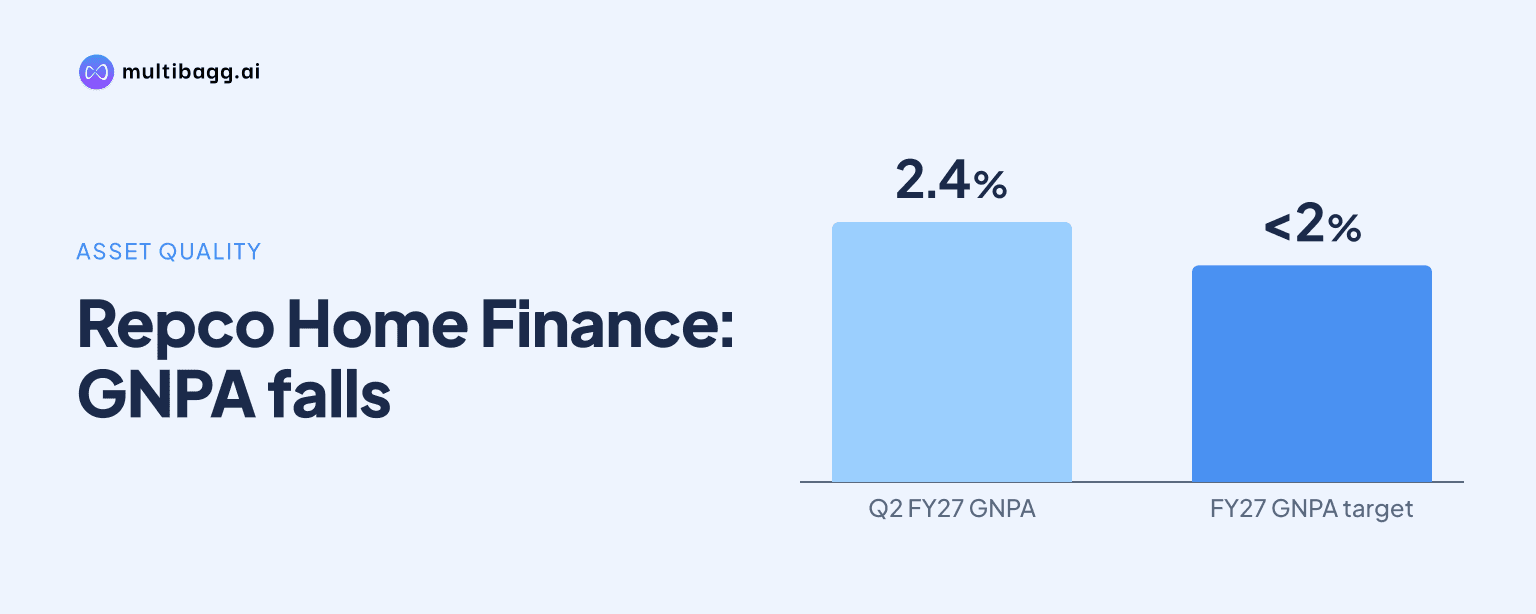
Repco Home Finance is targeting gross NPA below 2% by the end of FY27 after reporting a 2.4% gross NPA ratio in September 2026, its lowest level in 16 years. The housing finance company also reported Q2 FY27 net profit of ₹115.86 crore and a loan book of ₹16,425 crore.
Know Repco Home Finance inside out
Results, valuation, peers and who's buying, in one view.
What did Repco Home Finance report in Q2 FY27?
Repco Home Finance reported standalone revenue from operations of ₹481.20 crore in Q2 FY27, compared with ₹445.08 crore a year earlier. Net interest income rose 10% year-on-year to ₹220 crore, while standalone net profit increased to ₹115.86 crore from ₹107 crore in Q2 FY26.
For the first half of FY27, standalone revenue from operations was ₹948.90 crore, against ₹885.34 crore in the corresponding period of the previous year. Standalone profit after tax stood at ₹230.01 crore, while consolidated profit after tax, including associate earnings, was ₹240.71 crore. The company said its September 2026 loan book was ₹16,425 crore, up 9.2% year-on-year from ₹15,033 crore.
How does Repco Home Finance plan to improve asset quality?
Repco Home Finance plans to bring its gross NPA ratio below 2% by the end of FY27, from 2.4% as of September 2026. Gross NPA in value terms declined to ₹396 crore from ₹475 crore a year earlier, while Stage 2 assets fell to ₹1,154 crore from ₹1,324 crore.
Managing Director and Chief Executive Officer T. Karunakaran attributed the improvement to a more specialised collections structure. The company created a dedicated collections vertical, separated NPA accounts into soft and core categories with assigned responsibilities and targets, and strengthened its recovery team. Management also cited property sales under the SARFAESI process as a contributor to recoveries.
The 2.4% gross NPA ratio is the company’s lowest in 16 years, according to management. The year-end target will depend on continued collections, recoveries and control over fresh loan stress. The company did not provide a separate quarter-by-quarter asset-quality target beyond the stated FY27 objective.
What is Repco Home Finance's disbursement and profit outlook?
Repco Home Finance has guided for disbursements of ₹1,300 crore to ₹1,350 crore in Q3 FY27 and ₹1,650 crore to ₹1,700 crore in Q4 FY27. This implies planned second-half disbursements of about ₹3,000 crore to ₹3,050 crore, following Q2 disbursements of ₹1,205 crore.
Management expects FY27 profit to be around ₹480 crore to ₹490 crore, compared with ₹230.01 crore reported in the first half. For the remaining two quarters, management expects provisioning, or credit cost, of ₹5 crore to ₹6 crore in each quarter. It said the provision reversal arising from recoveries in Q2 was prudently appropriated to other NPA accounts rather than written back.
The guidance places importance on both loan growth and collection performance during the second half. Q2 sanctions were ₹1,359 crore, compared with ₹1,205 crore a year earlier, indicating that sanction activity remained ahead of disbursements during the quarter.
Got a follow-up? Ask IRIS
How could funding costs and spreads change for Repco Home Finance?
Repco Home Finance expects its cost of funds to rise by 10 to 15 basis points, with a corresponding pass-through to borrowers after about one quarter. Management said both its assets and most of its liabilities are floating-rate instruments, and loans typically reprice every three months.
The company expects spreads to moderate from 3.4% to around 3.2% to 3.25% over the next one to two quarters. Management said it may offer selective rate concessions to contain balance-transfer outflows, which can affect lending spreads even when higher funding costs are passed on to borrowers.
Banks account for about 86% of Repco Home Finance's funding, sourced from 19 to 20 lenders. National Housing Bank refinance accounts for 7.2%, while NCDs and pass-through certificates account for 0.7% and Repco Bank for 1%. National Housing Bank sanctioned ₹600 crore for FY27, of which ₹106 crore was drawn in Q1 and ₹125 crore in Q2. During Q2, the company raised ₹75 crore through commercial paper at 7.6% and ₹74 crore through pass-through certificates at about 7.9%.
What do the management and board updates mean for investors?
Repco Home Finance said the withdrawal of P.K. Vaidyanathan's deputation was an administrative decision because Repco Bank required his services. B. Kannan, who has experience in recovery and managing large branches, has replaced him. A company representative said Repco Home Finance remains professionally managed and that there is no promoter involvement in day-to-day operations.
The board approved an interim dividend of ₹5 per share on a face value of ₹10 per share. Management said the final dividend will be considered at the end of the financial year based on profitability, without committing to a specific payout ratio. For investors, the key disclosed measures remain the execution of second-half disbursement guidance, the move in gross NPA towards the sub-2% target, and the effect of funding costs on spreads.
Conclusion
Repco Home Finance entered the second half of FY27 with higher loan-book growth, improved asset quality and a stated profit outlook of ₹480 crore to ₹490 crore. The company’s gross NPA reduction to 2.4%, stronger recoveries and targeted provisioning are central to management’s effort to improve asset quality while expanding disbursements.
The next disclosures to watch are Q3 disbursements against the ₹1,300 crore to ₹1,350 crore guidance, changes in spreads as funding costs reprice, and progress towards the gross NPA target below 2% by FY27-end. The board’s final dividend decision will also depend on full-year profitability.