










Repco targets sub-2% gross NPA after 16-year low at 2.4%
Key highlights
- Repco reported gross NPA of 2.4% in September 2026, which management called a 16-year low.
- Management’s internal target is to reduce gross NPA below 2% by the March year-end.
- Repco said its gross NPA ratio had reached 8% after the November 2021 RBI circular.
- Repco has Rs 600 crore of NHB refinancing sanctioned and drew Rs 231 crore in the first two quarters.
powered by IRIS
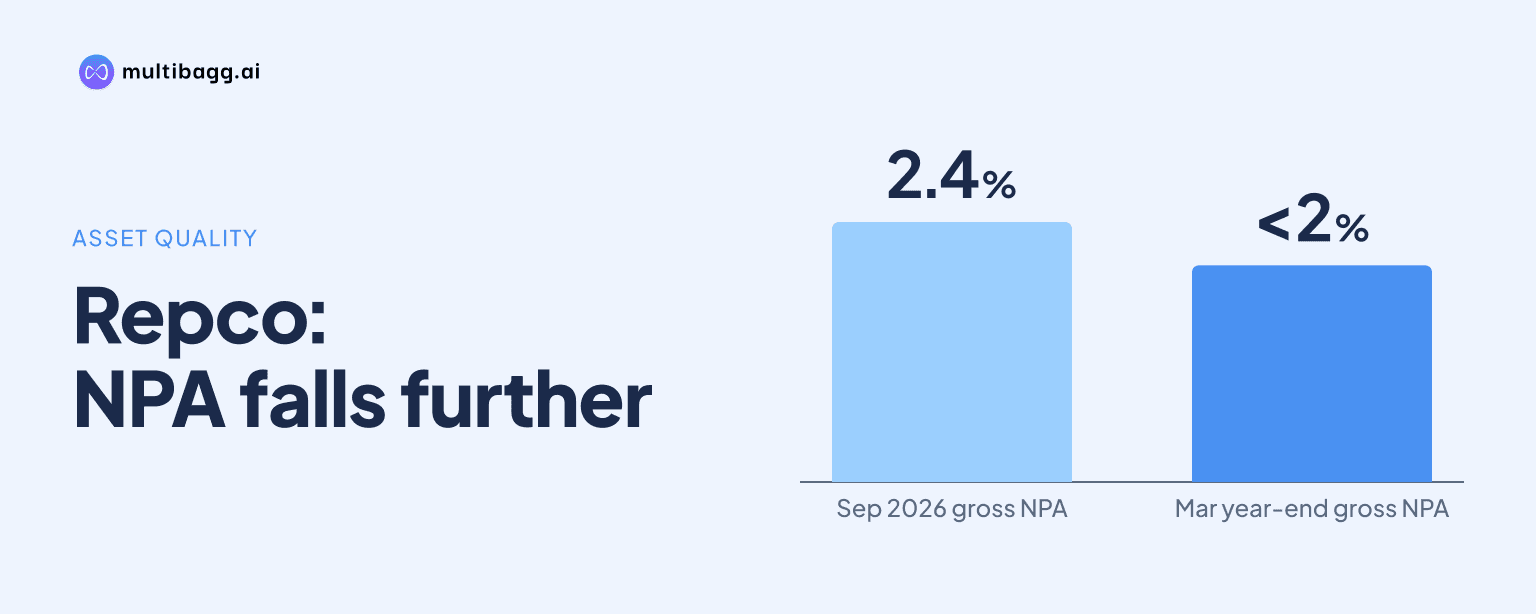
Repco Home Finance Limited reported a gross non-performing asset ratio of 2.4% at September 2026, its lowest level in about 16 years, and management aims to reduce it below 2% by the March year-end. Management attributed the improvement to specialised recovery teams, delinquent-account segmentation and property-sale actions under SARFAESI.
Know Repco Home Finance inside out
Results, valuation, peers and who's buying, in one view.
Can Repco cut gross NPA below 2% by March?
Repco’s internal target is to reduce gross non-performing assets, or gross NPA, below 2% by the March year-end from 2.4% at September 2026. Management described the reported ratio as a 16-year low and said it was confident that recoveries from NPA and other delinquent accounts would continue to improve through the remainder of the year.
The 2.4% ratio is 5.6 percentage points below the 8% level management said followed the Reserve Bank of India, or RBI, circular in November 2021. The remaining reduction to below 2% is smaller, but management said the threshold could be relevant to its expectation of a credit-rating upgrade. The target is management’s internal objective, not an action announced by a ratings agency.
Management also pointed to substantial Stage 2 improvement both quarter-on-quarter and year-on-year, without providing a Stage 2 ratio in the November 6, 2026 call. Stage 2 accounts are not included in the 2.4% gross NPA figure cited by management, but their reported improvement was presented as an indicator that recovery efforts extend beyond accounts already classified as non-performing.
What has reduced Repco’s gross NPA to 2.4%?
Repco said a verticalised recovery structure has reduced gross NPA to 2.4%. Management said it created separate teams for overdue collections and NPA accounts, then divided NPA work between soft-NPA and core-NPA accounts. It assigned roles, responsibilities and recovery targets to those teams as part of the process.
Management said NPA in absolute terms was almost Rs 125 crore in June and had subsequently fallen below the March level, though it did not disclose the later rupee amount. That comparison shows improvement in the NPA stock as well as in the 2.4% ratio, but the call did not provide enough data to calculate the percentage or rupee decline from June.
The recovery programme also includes a strengthened recovery team and property-sale actions under the Securitisation and Reconstruction of Financial Assets and Enforcement of Security Interest, or SARFAESI, process. Management said these measures were introduced after the NPA ratio reached 8% following the November 2021 RBI circular. The approach combines earlier-stage collection work with recovery action on established delinquent accounts.
Repco also said it recruited recovery personnel during the period, alongside branch sales managers. Salary costs rose partly because of that hiring, recovery and business incentives, and annual performance-linked increments of 5% to 10%. The cost increase therefore accompanied the recovery build-out that management linked to the fall in NPA and Stage 2 accounts.
Got a follow-up? Ask IRIS
Could a lower NPA ratio change Repco’s funding costs?
Repco management said a gross NPA ratio below 2% could support a rating upgrade and enable market borrowing at better pricing. This was management’s expectation conditional on meeting the March target, rather than a disclosed commitment by any rating agency. Management said lower funding rates would help if the company can access market borrowings at improved pricing.
The company also has Rs 600 crore of refinancing sanctioned by National Housing Bank, or NHB. Repco said it drew Rs 106 crore in the first quarter and Rs 125 crore in the second quarter, leaving the balance to be used according to funding requirements. The Rs 231 crore drawn across the first two quarters represented 38.5% of the sanctioned refinancing amount.
Repco said nearly all of its liabilities are floating-rate, except for a small amount under a special NHB scheme, while its assets are also floating-rate. It can reprice assets every three months and expects to pass higher funding costs to borrowers with about a one-quarter lag. Management said its spread could settle around 3.2% to 3.25% in one or two quarters, compared with the 3.47% half-year figure cited on the call.
What could affect Repco’s March NPA target?
Repco said it had not observed housing-loan stress in South India, including Karnataka, at the November 6, 2026 call. Management said Karnataka disbursements were slightly below normal in the first quarter but improved in the second quarter. It did not provide a Karnataka NPA ratio, so the assessment was based on management’s operating observations rather than a regional delinquency disclosure.
On potential drought exposure in Maharashtra and Karnataka, management said it had completed an assessment and had not identified a threat to asset quality or an increase in delinquencies. It said most branches and loans are located in urban areas or the peripheries of metro, Tier-1 and Tier-2 cities. Management also said cheque-return ratios remained broadly stable, with most returned-cheque cases recovered by month-end or early in the next month.
The March outcome nevertheless depends on continued execution by the recovery teams handling soft-NPA, core-NPA and overdue accounts. Management said it had set staff targets and was continuing recovery initiatives, while its reported NPA level had fallen from nearly Rs 125 crore in June. Any rating-related funding benefit remains dependent on both the sub-2% result and subsequent external rating action.
Conclusion
Repco’s 2.4% gross NPA ratio is meaningful because management calls it a 16-year low, compared with the 8% level cited after the November 2021 RBI circular. The reported reduction is tied to a more specialised collection and recovery structure, separate handling of delinquent-account categories, additional recovery staff and SARFAESI property-sale actions.
The next event to watch is the March year-end outcome against management’s below-2% NPA target. Investors can also track whether management draws more of the remaining Rs 369 crore NHB sanction, how the expected 10 to 15 basis-point funding-cost increase develops, and whether a lower NPA ratio is followed by the rating upgrade management expects.