










Salzer expects FY27 EBITDA margin of 7.5%-8% on pricing
Key highlights
- Salzer reported H1 FY27 EBITDA margin of 6.61%, down from 9.11% in H1 FY26.
- Q2 FY27 EBITDA margin improved sequentially to 6.89% from 6.29% in Q1 FY27.
- Management expects FY27 EBITDA margin of 7.5%-8%, subject to stable raw-material prices.
- Industrial Switchgear represented 56.39% of Q2 FY27 revenue and operated at about 80% capacity utilisation.
powered by IRIS
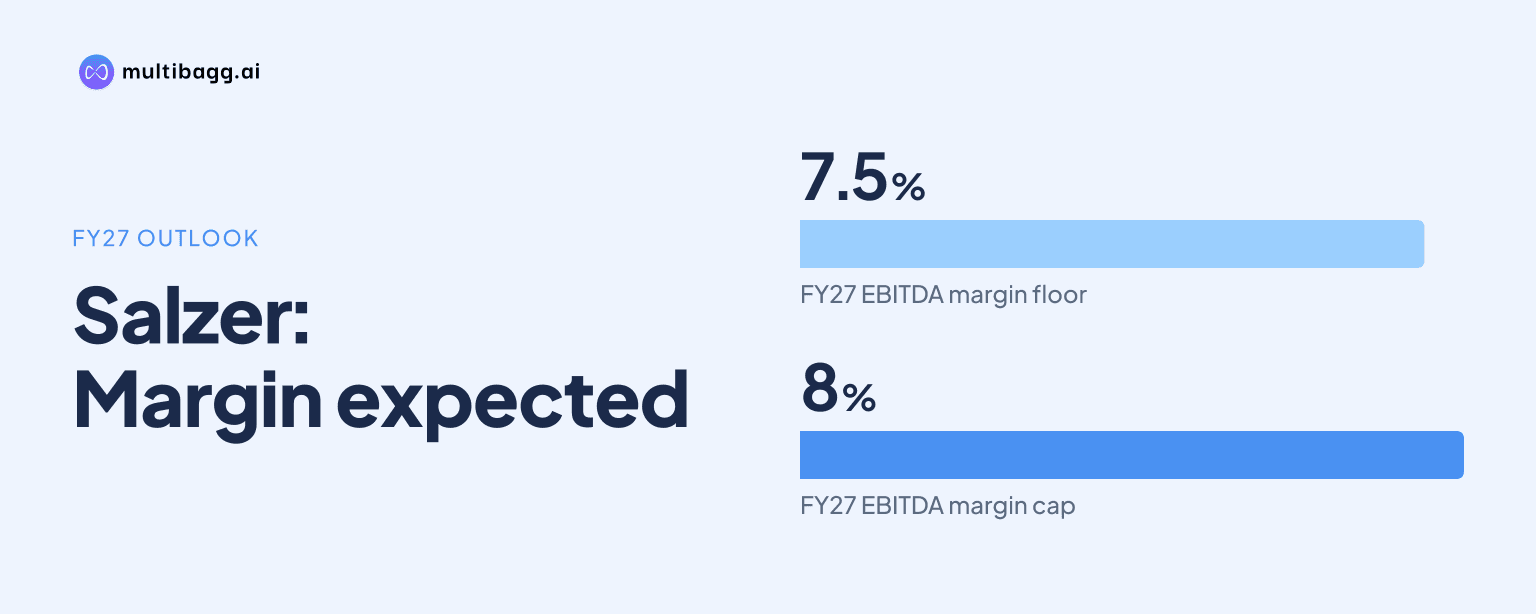
Salzer Electronics Limited expects FY27 EBITDA margin of 7.5%-8% after reporting a 6.61% margin in H1 FY27, down from 9.11% a year earlier, as price increases in its Switchgear business begin to affect orders during Q3 and Q4. Management said the outcome remains conditional on stable raw-material prices.
Know Salzer Electronics inside out
Results, valuation, peers and who's buying, in one view.
Why did Salzer's EBITDA margin decline in H1 FY27?
Salzer's H1 FY27 EBITDA margin declined because higher Switchgear input costs could not be passed through to customers immediately. Copper, aluminium, plastics, silver and other inputs increased in the previous quarter, while price changes apply only after already booked or executed orders are completed. Management described this timing gap as an industry-wide issue rather than one specific to Salzer.
The six months ended September 30, 2026 showed revenue growth without a matching rise in profitability. Revenue from operations increased 25.32% year on year to Rs 1,077.79 crore, but EBITDA excluding other income fell to Rs 71.26 crore from Rs 78.33 crore. EBITDA margin therefore declined by 2.50 percentage points from 9.11% in H1 FY26 to 6.61% in H1 FY27.
Profit after tax also declined despite the higher H1 revenue. Salzer reported H1 FY27 profit after tax of Rs 23.20 crore, compared with Rs 30.61 crore in H1 FY26, while the profit-after-tax margin fell to 2.15% from 3.56%. The result reflects the lag between higher input costs entering the income statement and the later effect of revised selling prices.
How did Salzer's Q2 FY27 margin compare with Q1 and last year?
Salzer's Q2 FY27 EBITDA margin improved from Q1 but remained below the prior-year quarter. The margin was 6.89% in Q2 FY27, compared with 6.29% in Q1 FY27 and 8.73% in Q2 FY26. Management cited the sequential improvement as evidence that its pricing actions were beginning to have a progressive effect despite continuing commodity-price volatility.
Q2 revenue grew much faster than EBITDA on a year-on-year basis. Revenue from operations reached Rs 579.77 crore, up 38.4% from Rs 418.92 crore in Q2 FY26 and above Rs 498.02 crore in Q1 FY27. EBITDA increased to Rs 39.95 crore from Rs 36.57 crore a year earlier, but the increase was below the revenue growth rate, resulting in the lower year-on-year margin.
Q2 FY27 profit after tax was Rs 14.87 crore, compared with Rs 13.39 crore in Q2 FY26, and the profit-after-tax margin narrowed to 2.56% from 3.20%. The 0.60-percentage-point EBITDA-margin increase from Q1 was reported before the full benefit of price revisions, which management expects to be realised over Q3 and Q4.
Which Salzer businesses are expected to support margin recovery?
Salzer expects Switchgear to be the principal driver of the recovery because that division absorbed most of the delayed raw-material cost pass-through. Management said Wire & Cable is largely run on a cost-plus basis with customers, keeping its margins relatively stable, whereas price-variation clauses in Switchgear do not provide an immediate recovery of higher input costs.
Industrial Switchgear accounted for 56.39% of Q2 FY27 revenue and reported an EBITDA margin of 8.26%. The division's revenue grew 23.79% year on year, and its revenue share increased from about 53.58% in Q1 FY27. Because it is Salzer's largest division and the main source of pricing pressure, its revised prices are expected to have the largest effect on consolidated margins.
Wire & Cable contributed 36.18% of Q2 FY27 revenue, grew 57.48% year on year and had an EBITDA margin of 5.05%. Building Products represented 7.43% of quarterly revenue and recorded year-on-year growth of 103.53%. These businesses supported sales growth, but management specifically identified Switchgear as the division where pricing changes are expected to alter the margin trajectory.
Got a follow-up? Ask IRIS
What needs to happen for Salzer to meet its FY27 margin target?
Salzer needs its already implemented price increases to flow through Q3 and Q4 orders while raw-material prices remain stable to achieve its 7.5%-8% FY27 EBITDA-margin expectation. Management said price actions taken in recent months would begin taking effect in the coming quarter and the following quarter, allowing a progressive normalisation in margins.
The H1 result implies a higher second-half margin requirement. During the November 13, 2026 call, management agreed that H2 margin would need to exceed 8% for the full-year outcome to reach at least 7.5%, given the 6.61% H1 margin. That is an arithmetic implication of reported H1 performance and the full-year range, rather than separate H2 guidance.
Management's outlook remains conditional on external and commercial factors. It said the pace and extent of recovery depend on commodity-price movements, customer acceptance of revised prices and the speed at which price measures take effect. Management also expects FY28 EBITDA margin of about 9%-10%, based on further normalisation of price pass-through rather than a fixed contractual outcome.
What operating actions support Salzer's profitability plan?
Salzer is combining its pricing measures with sourcing efficiencies, cost control and operational improvements. Switchgear capacity utilisation reached about 80% in Q2 FY27, which management said was sufficient to support its FY27 growth plans. Wire & Cable operated at about 65% utilisation, and management said it did not expect major capacity investment in that division in the near term.
Working-capital management is another stated priority because it can affect finance costs. Net working-capital days declined to 135 days in H1 FY27 from 153 days in March 2026, a reduction of 18 days. Salzer aims to hold working capital at about 25% of revenue while reducing finance costs and keeping FY27 capital expenditure modest beyond the Saudi Arabia plant investment and Hosur expansion.
Revenue execution will also influence cost absorption. Salzer retained its FY27 revenue guidance of around Rs 2,100 crore after reporting Rs 1,077.79 crore in H1 FY27. The company described Industrial Switchgear demand as healthy and expanded Building Products retail coverage into Jharkhand, Madhya Pradesh, Odisha and Chhattisgarh beyond its five southern-state base.
Conclusion
Salzer's first-half figures show that revenue growth of 25.32% did not offset the lag in recovering higher Switchgear input costs, leaving EBITDA lower in absolute terms at Rs 71.26 crore versus Rs 78.33 crore a year earlier. The Q2 sequential margin improvement to 6.89% from 6.29% in Q1 is the reported evidence management cited for its expectation of further progress as revised prices reach customers.
The next disclosed milestones are Q3 and Q4 realisation of Switchgear price revisions, progress toward around Rs 2,100 crore of FY27 revenue and the working-capital objective of about 25% of revenue. Salzer also plans to begin Saudi Arabia operations in April 2027 with cable ducts and terminal connectors, subject to regional uncertainties settling down.