










Salzer Electronics Limited Delays Saudi Plant Launch to April 2027
Key highlights
- Salzer shifted the Saudi Arabia plant launch from September or October 2026 to April 2027.
- Salzer estimates an initial all-inclusive Saudi project cost of about ₹15 crore over one year.
- Management targets about ₹20 crore of Saudi revenue in the first operating year and around ₹100 crore within three years.
- Exports were 21.3% of Salzer's H1 FY27 revenue, versus about 24% a year earlier, despite 11% absolute export growth.
powered by IRIS
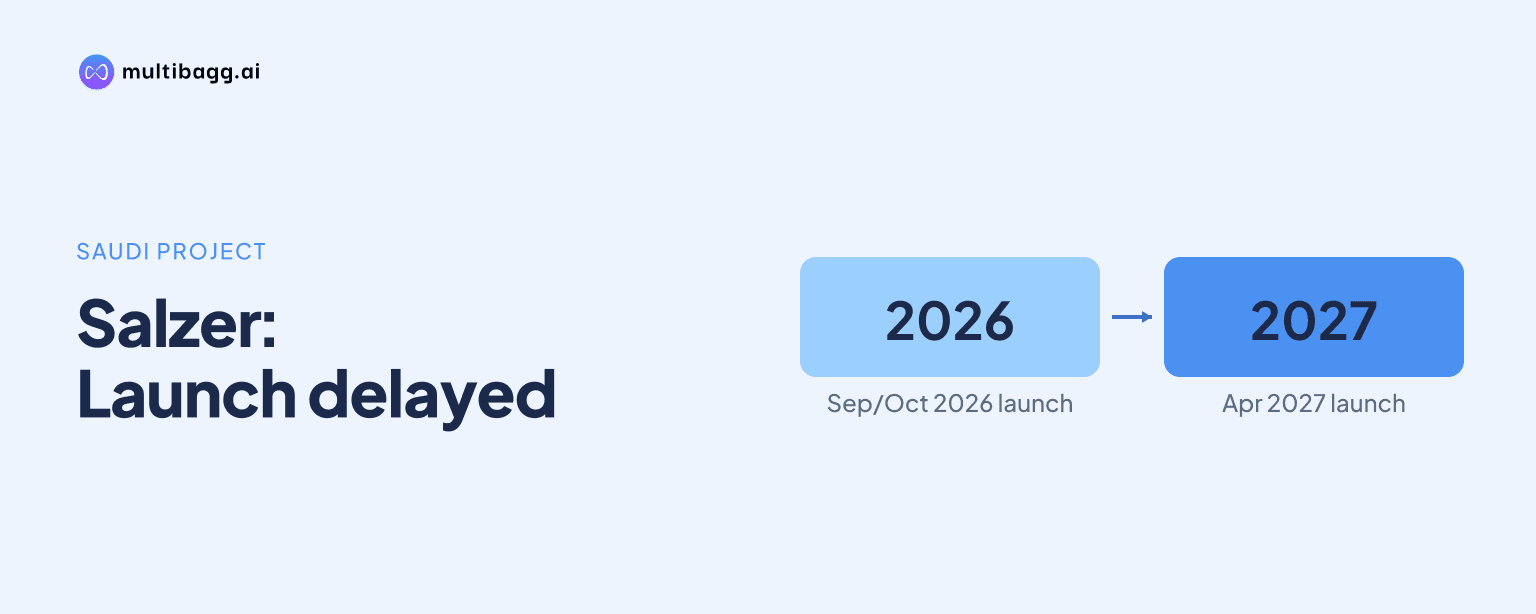
Salzer Electronics Limited has postponed the planned Saudi Arabia plant launch from September or October 2026 to April 2027 because regional conflict delayed machinery installation, while management targets about ₹20 crore of first-year revenue and around ₹100 crore within three years.
Know Salzer Electronics inside out
Results, valuation, peers and who's buying, in one view.
Why did Salzer delay its Saudi Arabia plant launch?
Salzer delayed the launch after what management described as an unforeseen escalation of war in the region, particularly in Saudi Arabia. The company had planned to begin operations in September or October 2026, with machinery installation scheduled for August and September 2026, but management said it consciously postponed that work.
Salzer now expects operations to start in April 2027, provided Middle East uncertainties settle as management expects. Management said it hopes to begin machinery installation in January 2027, making the installation schedule and regional conditions the immediate determinants of whether the revised launch date can be met.
The postponement moves the planned start beyond FY27, for which management retained revenue guidance of around ₹2,100 crore. Management did not provide a separate estimate of the effect of the Saudi delay on FY27 revenue, earnings before interest, tax, depreciation and amortisation, or EBITDA, or export revenue.
What will Salzer produce and invest in Saudi Arabia?
Salzer plans to start Saudi operations with cable ducts and terminal connectors, two products from its switchgear portfolio. Management said the initial product range will be limited to these two lines, with two more products potentially added after the company assesses the first year of operations.
Salzer estimates an all-inclusive initial project cost of about ₹15 crore, to be invested over one year. Management described the expansion as phased: the first-year operating outcome will guide subsequent product additions and any further investment in the Saudi operation.
Management said the current plan could produce asset turnover of about 3 to 3.5 times over three years. That estimate is a management expectation based on the proposed revenue ramp and ₹15 crore initial investment, rather than a reported operating result from the facility.
How much revenue does Salzer expect from the Saudi plant?
Salzer expects Saudi plant revenue of about ₹20 crore in its first operating year and around ₹100 crore within three years. These are management targets, not booked sales, and depend on the plant commencing operations in April 2027 after equipment installation can proceed.
Management expects the Saudi operation to break even in its second year. The call did not disclose a plant-level EBITDA margin target, a Saudi order book, or an annual revenue path between the approximately ₹20 crore first-year expectation and the ₹100 crore three-year target.
The targeted Saudi revenue is small beside Salzer's current Industrial Switchgear business but could add to the international business over time. Industrial Switchgear accounted for 55.09% of H1 FY27 revenue, or about ₹580 crore according to management, while the division operated at approximately 80% capacity utilisation in Q2 FY27.
Got a follow-up? Ask IRIS
How does the Saudi delay affect Salzer's export plans?
Salzer said the delay defers its planned Saudi production presence, but its medium-term objective remains to return export revenue to around 25% of total revenue. Exports contributed 23.6% of Q2 FY27 revenue and 21.3% of H1 FY27 revenue, compared with about 24% in both comparable periods a year earlier.
Absolute exports grew 11% in H1 FY27 even as their revenue share fell from about 24% to 21.3%. That comparison indicates that domestic revenue grew faster than export revenue during the first half, rather than showing an absolute decline in overseas sales.
Salzer identified the United States, the United Kingdom, Europe and the Middle East as markets for its engineered switchgear and electrical products. Management also said international expansion is affected by trade policies, tariffs, competition and changing customer requirements, factors that remain relevant alongside the Saudi project's regional uncertainty.
What other operating factors matter for Salzer's expansion?
Salzer's Switchgear division is expected to receive capacity-balancing expenditure in FY28 because utilisation was about 80% in Q2 FY27. Management said this would involve balancing equipment intended to debottleneck capacity by around 20% to 25%, rather than a major capital expenditure programme.
Salzer's Wires & Cable division operated at about 65% utilisation in Q2 FY27, and management said it did not expect major near-term capacity investment in that business. In the same quarter, Industrial Switchgear contributed 56.39% of revenue, Wires & Cable 36.18%, and Building Products 7.43%.
Group profitability is also relevant because management expects price increases to feed through progressively in Q3 and Q4 FY27. Salzer reported Q2 FY27 EBITDA margin of 6.89%, up from 6.29% in Q1 FY27, and management expects full-year FY27 EBITDA margin of around 7.5% to 8% after higher input costs affected Switchgear margins.
Conclusion
The Saudi project remains part of Salzer's international expansion plan, but its launch has moved by roughly six to seven months because machinery installation was postponed amid regional conflict. Management's stated plan is a ₹15 crore initial investment, two initial switchgear-related products, about ₹20 crore of first-year revenue, second-year break-even and a path to around ₹100 crore within three years.
The next event to watch is management's planned January 2027 machinery installation, followed by confirmation of an April 2027 operating start. Investors can also monitor whether Salzer raises export share from 21.3% in H1 FY27 toward its around-25% objective and whether it adds two Saudi products after the facility's first operating year.