










Satia Industries Limited completes PM3 upgrade for ramp-up
Key highlights
- SIL completed PM3 renovation and modernisation toward the end of September 2026.
- SIL has more than 2,00,000 MTPA of installed paper capacity across four paper machines.
- PM4 began commercial production in FY22 with capacity of 1,00,000 tonnes.
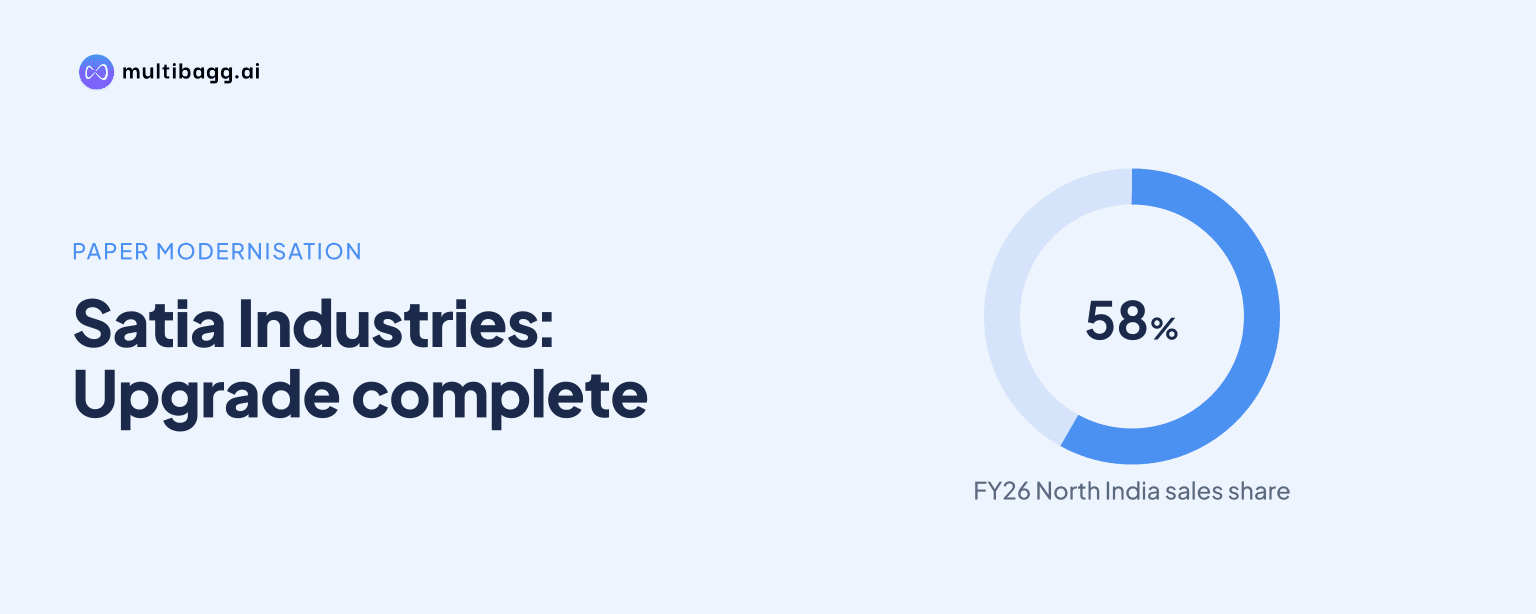
- North India represented 58% of SIL's FY26 regional sales.
powered by IRIS
Satia Industries Limited (SIL) completed the renovation and modernisation of Paper Machine 3, or PM3, toward the end of September 2026 in Q2 FY27, and management plans a calibrated production ramp-up from the upgraded machine. SIL expects the project over time to support higher output capacity, improved product quality and greater operating efficiency.
Know Satia Industries inside out
Results, valuation, peers and who's buying, in one view.
What did SIL complete in Q2 FY27?
SIL completed the PM3 renovation and modernisation toward the end of September 2026, making the upgraded machine operational only at the close of Q2 FY27. Management called the project a significant milestone during a quarter when paper realisations improved year on year while elevated raw-material costs continued to weigh on profitability.
SIL has not disclosed PM3's revised tonnes-per-year capacity, project cost, downtime length or post-upgrade production volume in its November 2026 presentation. The disclosed near-term task is operational rather than a financial target: SIL plans to raise production in a calibrated manner and stabilise the machine after its late-September start.
PM3 is not a new line. SIL first installed Paper Machine 3 in 1998, while its 2026-27 milestone records the completed renovation and modernisation of that existing asset. The presentation therefore frames the project as an upgrade to the integrated paper operation rather than a separately quantified greenfield capacity addition.
How will SIL use the upgraded PM3?
SIL says the upgraded PM3 is expected over time to support higher production capacity, improved product quality and greater operating efficiencies. Management has not quantified the expected output uplift, unit-cost reduction, machine-speed improvement or date for full stabilisation, so these remain stated objectives rather than reported Q2 FY27 results.
The immediate plan is to ramp output in a calibrated manner while stabilising operations. Management also said SIL would focus on improving capacity utilisation, strengthening operating efficiencies and maintaining input-cost discipline as operations progressively normalise in the seasonally stronger post-Diwali period after Q2 FY27.
Product quality is relevant to SIL's open-market range, which includes exercise-book paper, snow-white paper, SS Maplitho paper, ledger paper, copier paper and colour-printing paper. SIL also identifies its ability to supply watermark paper on its paper machine as a feature of this vertical, although the presentation does not say which grades PM3 will produce after modernisation.
What was SIL's operating backdrop when PM3 restarted?
Q2 FY27 was a mixed operating period, according to management: paper realisations improved year on year as import pressures moderated, but higher raw-material costs continued to weigh on profitability. The presentation does not provide Q2 FY27 revenue, earnings, realisation per tonne, raw-material cost or margin figures, leaving the reported comparison directional rather than numerical.
Management said paper prices and demand had improved since the end of Q2 FY27. It linked the next operating phase to the post-Diwali period, which it described as seasonally stronger, and identified capacity utilisation, efficiency and input-cost control as priorities while PM3 operations normalise.
SIL's FY26 regional sales mix gives context to that demand outlook. North India accounted for 58% of sales, compared with 16% in the East, 10% in the West, 7% from exports, 6% in Central India and 3% in the South. SIL supplies through more than 100 dealers and three branch offices in Delhi, Chandigarh and Jaipur, while 5% to 10% of open-market sales comes from direct sales to end users in Rajasthan and Delhi.
Got a follow-up? Ask IRIS
How does PM3 fit SIL's wider production platform?
PM3 operates within SIL's four-paper-machine integrated manufacturing setup, which has total installed paper capacity of more than 2,00,000 metric tonnes per annum, or MTPA. The platform also includes 100% in-house power generation, a chemical recovery plant and an effluent-treatment facility, according to the November 2026 presentation.
The largest separately stated recent paper-machine addition was PM4, which began commercial production in FY22 with capacity of 1,00,000 tonnes. By comparison, SIL started production in 1984 with Paper Machine 1 at 4,950 MTPA. The presentation shows substantial expansion in the broader platform, but does not allocate the current more-than-2,00,000-MTPA total among PM1, PM2, PM3 and PM4.
SIL's earlier modernisation work included speed increases on two other machines. Paper Machine 2 increased from 400 to 650 metres per minute, or MPM, during 2017-20, while Paper Machine 1 increased from 500 to 700 MPM in 2018-19. SIL has not disclosed a comparable PM3 speed specification.
SIL has also expanded supporting operations over several periods. Its power plant capacity rose to 23.30 megawatts in 2011-12, a 14-megawatt turbine was listed in 2020-21, and a 75-tonnes-per-hour multi-fuel boiler expansion was completed in 2023-24. SIL does not specify how much of that infrastructure is newly available to PM3 after the September 2026 upgrade.
Conclusion
PM3's September 2026 completion shifts SIL's focus from project execution to machine ramp-up and stabilisation. The upgrade coincides with management's report of improved year-on-year paper realisations and a post-Q2 FY27 demand pickup, but elevated raw-material costs remained a stated pressure on profitability. Higher capacity, improved quality and greater efficiency are management expectations, not quantified Q2 outcomes.
The next item to watch is PM3's calibrated production ramp-up during the post-Diwali period. Management has identified capacity utilisation, operating efficiency and input-cost discipline as priorities, but SIL has not disclosed a PM3 output target, stabilisation date, revised machine speed or expected financial contribution.