










SJS targets Rs 500 crore chrome-plating revenue in four years
Key highlights
- SJS targets about Rs 500 crore of chrome-plating revenue within three to four years, from about Rs 240 crore last year.
- SJS said chrome-plating capacity has doubled and cited a pipeline of large inquiries under negotiation.
- SJS sales grew 21.7% in Q2, compared with 13.2% growth in the four-wheeler and motorcycle market.
- SJS has guided Rs 65 crore of display-business capital expenditure, split between local bonding and glass facilities.
powered by IRIS
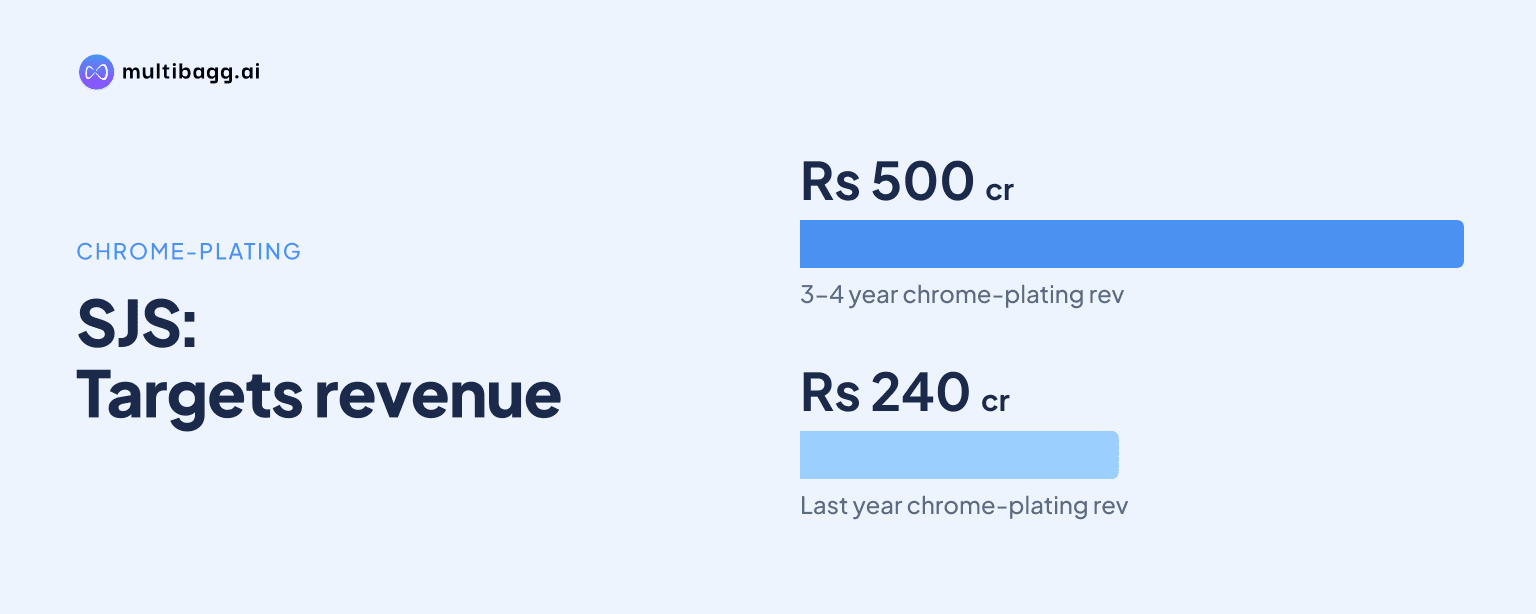
SJS Enterprises Limited aims to raise chrome-plating revenue to about Rs 500 crore within three to four years, from about Rs 240 crore last year, after doubling capacity. Management said on November 5, 2026 that a strong order pipeline, large inquiries and a Toyota Middle East opportunity support the planned ramp.
Know S J S Enterprises inside out
Results, valuation, peers and who's buying, in one view.
How much chrome-plating revenue is SJS targeting?
SJS is targeting about Rs 500 crore of chrome-plating revenue within three to four years, compared with about Rs 240 crore generated last year. Management said the latest expansion has added two times capacity, giving the business the ability to almost double its revenue base as customer programmes are secured and ramp up.
Management described the Rs 500 crore figure as its target, not as a disclosed order book or formal financial forecast. SJS said chrome plating had grown about 3.5 times over the preceding five years and that it hopes to achieve the next capacity doubling within three to four years, with a faster ramp preferable if demand converts sooner.
The company has taken a capacity-first approach before pursuing new customer programmes. Management said it had been cautious about accepting orders until it could ensure delivery to customer expectations, but the completed capacity work across plants now allows SJS to seek growth from existing partnerships and other customers.
What could drive SJS's chrome-plating ramp?
SJS expects pent-up demand, large inquiries under negotiation and exports to drive the chrome-plating ramp. Management said it established the new chrome-plating plant because demand had accumulated and described the active opportunities as mega inquiries, although it did not disclose their values, award status or production start dates.
Toyota's Middle East business is a named export opportunity for large-value chrome-plated plastic parts. Management said this work could start quickly through the new plant because certain resourcing assignments involve customers transferring tooling from another supplier, shortening the normal start-up process. The call did not establish that Toyota had awarded an order to SJS.
Cross-selling also forms part of the export plan. SJS said it had won decals business with Stellantis and that successful delivery on an initial programme can lead customers to consider additional products from its portfolio. This differs from the chrome-plating opportunity but illustrates management's plan to expand business with established export customers.
Management said acquisitions are not being evaluated solely as an export route. Its stated tests are whether SJS can scale a target rapidly, improve profitability through purchasing leverage, gain access to new markets or open relationships with global original equipment manufacturers, or OEMs. Management cited SJS Decoplast, which it said expanded four times in five years, as an example of its scaling model.
How quickly can SJS use the added capacity?
SJS aims to use the added chrome-plating capacity over three to four years, but management said the pace depends on negotiations, sourcing decisions and demand conversion. Its confidence rests on a strong pipeline and the potential for rapidly started resourcing work, rather than on a disclosed utilisation rate or annual revenue ramp for the chrome-plating plant.
The consumer business shows an external demand risk relevant to export-led growth. Management said SJS gave up a sizable low-margin customer business two quarters earlier and replaced it with a higher-margin consumer programme concentrated largely in the Middle East. Volumes from that replacement programme did not materialise as expected because of conflict and macroeconomic challenges in West Asia.
Management called that interruption a short-term hiccup and said it expected demand to recover in coming quarters, while separately indicating normalisation could take a couple of quarters. SJS reported a 31% earnings before interest, tax, depreciation and amortisation, or EBITDA, margin in Q2, which management attributed largely to product rationalisation. It did not disclose chrome-plating-specific margin or profitability targets.
The replacement of lower-margin work also means revenue growth does not necessarily follow volumes alone. Management said it had used constrained capacity for higher-margin products rather than pursuing lower-margin business, and that the broader capacity additions should let it address further growth opportunities while maintaining that product-selection approach.
Got a follow-up? Ask IRIS
How does chrome plating fit SJS's wider capacity programme?
SJS is expanding capacity at its Bengaluru operations, Walter Pack and display business alongside chrome plating, and management said the broader manufacturing network should be adequate for the next two to three years. At the standalone SJS operations, the company added 20% capacity by constructing almost 40,000 square feet above an existing Bengaluru building.
Standalone SJS utilisation was 70% to 75% before the 20% expansion and is now about 60%, management said. It explained that its printing business operates in batches across many stock-keeping units, or SKUs, requiring spare capacity for flexibility and seasonal demand. Management said utilisation of 80% to 85% would be a high level for that operation.
Management said it does not currently need more standalone capacity for the next two years, although it has land in Bengaluru that could support a new factory and a doubling of capacity if needed. It also cited equipment fungibility and Walter Pack's partly printing-based operations, where capacity is being expanded, as support for its two- to three-year capacity assessment.
SJS has separately guided Rs 65 crore of capital expenditure for its display business: Rs 25 crore for a local bonding facility and Rs 40 crore for a glass facility. Management expects asset turns of four to five times for local bonding and two to three times for glass, or around 3.5 times on average. These display investments are separate from the chrome-plating expansion.
What operating evidence supports SJS's growth plan?
SJS said sales grew 21.7% in Q2 while the four-wheeler and motorcycle market grew 13.2%, which management characterised as about 1.7 times market growth. For the first half, it said passenger-vehicle and motorcycle market growth was 15.3%, compared with SJS sales growth of 26.6%.
Management linked this outperformance partly to prioritising higher-margin products during a period of capacity constraints. It said newly completed expansions should help SJS pursue the growth opportunities it had previously limited, but the transcript did not provide a separate Q2 sales-growth figure, utilisation rate or order book for chrome plating.
Depreciation is set to rise from Q3 as recent facilities enter the accounts. SJS reported Q2 depreciation of Rs 10.89 crore, lower than the preceding quarter partly because an approximately Rs 10 lakh effect from an intangible recorded with Walter Pack was ending after three years. Management said the full depreciation impact of capitalised SJS Decoplast, Pune and Bengaluru facilities would begin in Q3.
Conclusion
SJS's target of about Rs 500 crore in chrome-plating revenue implies an increase of about Rs 260 crore from the approximately Rs 240 crore base reported for last year. The plan combines doubled capacity with potential resourcing transfers, export cross-selling and management's assessment of a substantial inquiry pipeline, but it is not supported by a disclosed contracted-revenue figure.
The next issues to watch are whether current negotiations become customer awards, the timing and scale of any Toyota Middle East programme, and whether West Asia consumer demand recovers over the couple of quarters management identified. Management has also said full depreciation from recently capitalised facilities will begin from Q3, while its existing manufacturing network is expected to cover the next two to three years.