










SJS raises FY27 margin guide after pruning low-margin work
Key highlights
- SJS cut FY 2027 growth guidance to 1.2x-1.5x industry growth from 1.5x-2x.
- SJS raised FY 2027 EBITDA margin guidance to 29%-30% from 27%-28%.
- Q2FY2027 EBITDA margin reached 31%, up 144 basis points year on year.
- Q2FY2027 revenue rose 16.9% to Rs 282.73 crore, while EBITDA increased 23.1% to Rs 89.64 crore.
powered by IRIS
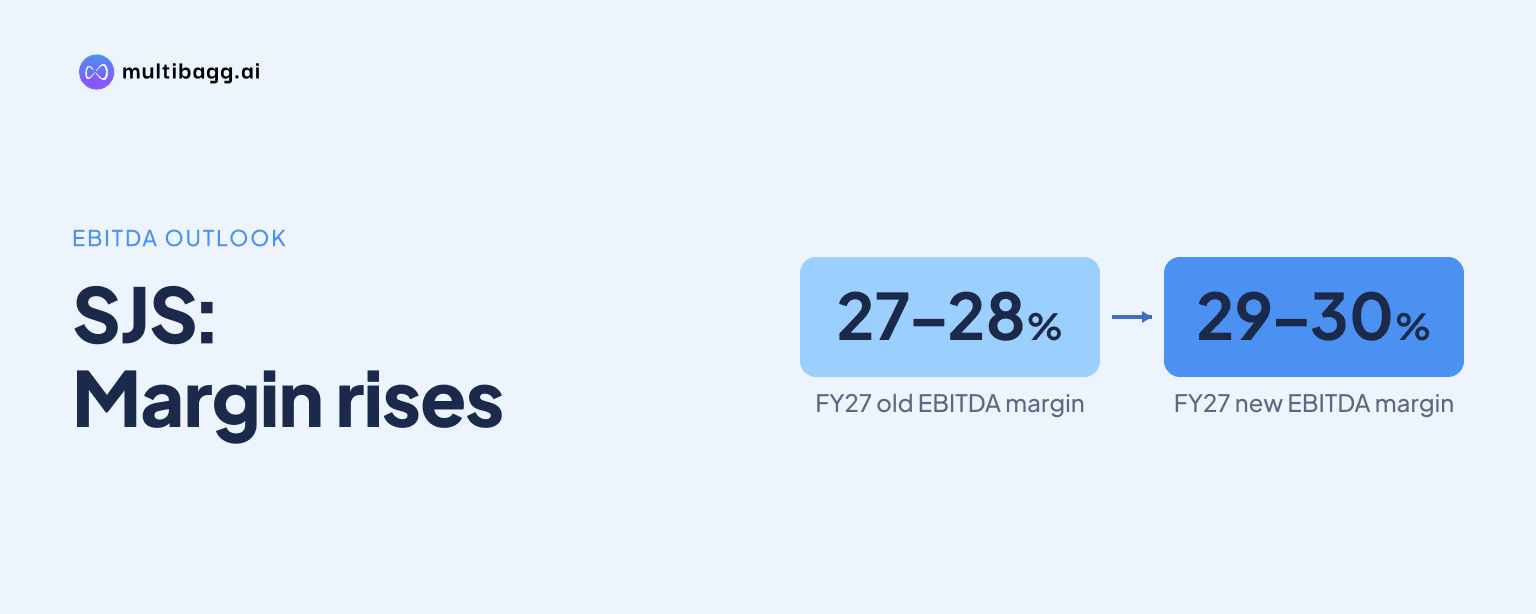
SJS Enterprises Limited lowered its FY 2027 revenue-growth outlook to 1.2x-1.5x passenger-vehicle and motorcycle industry growth but raised EBITDA margin guidance to 29%-30%, after Q2FY2027 EBITDA margin reached 31%. The revision follows the exit from selected low-margin work amid weaker consumer sentiment, export conditions and motorcycle-market exposure.
Know S J S Enterprises inside out
Results, valuation, peers and who's buying, in one view.
Why did SJS lower its FY27 growth guidance?
SJS reduced its FY 2027 revenue-growth framework to 1.2x-1.5x growth in the passenger-vehicle and motorcycle industries, from 1.5x-2x earlier. Management cited elevated commodity prices, subdued consumer sentiment and greater pricing pressure, alongside lower sales at consumer original equipment manufacturers, or OEMs.
The company also identified a widening divergence between scooter and motorcycle growth. SJS has limited exposure to scooters, while its two-wheeler portfolio is predominantly weighted towards motorcycles. Management said the recalibration reflected this market backdrop and its decision to allocate capacity towards more profitable products.
The lower relative-growth outlook follows a 16.9% year-on-year increase in Q2FY2027 revenue to Rs 282.73 crore, SJS's highest quarterly revenue. Passenger vehicles and exports were the main drivers, while September 2026 monthly revenue exceeded Rs 100 crore for the first time. H1FY2027 revenue increased 20.4% to Rs 543.73 crore.
Management said SJS had operated close to maximum capacity during the preceding two quarters. Its response was to choose business with better profitability rather than retain all available revenue opportunities, with newly added capacity intended to support domestic and export growth over the coming quarters.
Why did SJS raise its EBITDA margin guidance?
SJS raised FY 2027 earnings before interest, tax, depreciation and amortisation, or EBITDA, margin guidance to 29%-30% from 27%-28% because product mix and cost actions improved profitability. Q2FY2027 EBITDA margin was 31%, up 144 basis points year on year, and exceeded the new full-year guidance range.
Q2FY2027 EBITDA rose 23.1% to Rs 89.64 crore, growing faster than revenue, which increased 16.9% to Rs 282.73 crore. Gross profit increased 17.9% to Rs 159.73 crore and gross margin reached 56.5%, despite higher raw-material, crude-price and start-up costs.
Management attributed the quarterly margin improvement to higher exports, a favourable product mix, operating efficiency and the exit from low-margin products at Walter Pack India, or WPI. Profit after tax, or PAT, rose 34.8% to Rs 58.33 crore, producing a 20.6% margin that management described as its highest normalized quarterly PAT margin since listing.
The H1FY2027 figures show the same gap between sales and earnings growth. Revenue increased 20.4% to Rs 543.73 crore, while EBITDA rose 28.9% to Rs 169.6 crore and the EBITDA margin was 30.5%. This comparison indicates that the changed business mix contributed to earnings growth outpacing revenue growth.
Which low-margin business did SJS prune?
SJS said it had pruned low-margin work during the last two quarters, including returning a large consumer-business opportunity that did not meet its margin requirement. Management said it secured a successor consumer program with a higher margin, but demand was affected by conflict-related conditions in the Middle East.
The decision affected non-automotive growth in Q2FY2027 and H1FY2027, according to management's response to an analyst question. The exited customer represented a sizable consumer business, while the replacement program was focused largely on the Middle East and did not deliver the expected volume during the period.
SJS did not identify the customer or the product involved. Management said the product-portfolio rationalisation was complete and linked it to the 31% Q2FY2027 EBITDA margin, while noting that recovery in the replacement business depends on improvement in its end-market conditions.
Management also said softer commodity prices could improve buying sentiment across the four-wheeler, two-wheeler and consumer segments. That was presented as possible support for future volumes, not as a change to the 1.2x-1.5x FY 2027 revenue-growth framework.
Got a follow-up? Ask IRIS
What capacity and export plans support SJS growth?
SJS is adding capacity to pursue growth after the portfolio pruning. The SJS Decoplast chrome-plating facility in Pune began operations in August 2026 and doubled capacity, while the Bengaluru expansion adds 20% capacity and was expected to start commercial production in Q3FY2027.
Management said the chrome-plating business generated about Rs 240 crore in the prior year and could potentially reach about Rs 500 crore with the new capacity. It aims to reach that level in three to four years, supported by a stated order pipeline and inquiries including chrome-plated plastic parts for Toyota exports in the Middle East.
WPI became wholly owned after SJS acquired the remaining 9.9% stake for Rs 19.922 crore. WPI is consolidating three Ranjangaon plants into one facility expected to start operations by May 2027. SJS Display Electronics Private Limited is also building an automotive-display facility in Pune, scheduled to become operational in Q2FY2028.
Exports rose 23.1% year on year to Rs 28.25 crore in Q2FY2027 and accounted for 10% of revenue. H1FY2027 export growth was 45.8%, and management is targeting exports of 14%-15% of consolidated revenue by FY2028 through customer wins, cross-selling and expansion in markets including ASEAN, Europe and North America.
How is SJS funding its investment plans?
SJS has a FY2026-FY2028 capital-expenditure plan of Rs 270 crore to Rs 285 crore, covering chrome plating, painting, Bengaluru expansion, display and cover-glass operations, maintenance spending and WPI plant consolidation. It had spent Rs 131.06 crore by H1FY2027, including Rs 82.2 crore in FY2026 and Rs 48.86 crore in H1FY2027.
Management said the chrome-plating and Bengaluru projects were largely complete, with remaining capital expenditure to be funded through internal accruals. H1FY2027 cash flow from operations was Rs 107.05 crore and free cash flow was Rs 107.73 crore, while net cash stood at Rs 331.87 crore at September 2026, compared with Rs 243.7 crore at March 2026.
For SJS Display, management guided for Rs 65 crore of capital expenditure, comprising Rs 25 crore for a loca-bonding facility and Rs 40 crore for a glass facility. It expects asset turnover of 4x-5x for loca bonding and 2x-3x for glass, with an average of about 3.5x.
Q2FY2027 depreciation was Rs 10.89 crore, lower than the preceding quarter partly because an intangible-related impact from the WPI acquisition was ending after three years. Management said the Pune and Bengaluru facilities were capitalised in Q2FY2027, with higher depreciation expected from Q3FY2027.
Conclusion
SJS has lowered its FY 2027 relative revenue-growth expectation while lifting its margin target, reflecting an explicit preference for profitability over selected lower-margin sales. The 31% Q2FY2027 EBITDA margin, 144-basis-point year-on-year improvement and faster 23.1% EBITDA growth than 16.9% revenue growth show the effect of this product and capacity allocation strategy.
The next points to watch are the expected Q3FY2027 increase in depreciation, commercial production at the Bengaluru expansion, and the planned May 2027 start of WPI's consolidated Ranjangaon plant. Management's FY2028 targets include exports reaching 14%-15% of consolidated revenue and the scheduled Q2FY2028 launch of the Pune automotive-display facility.