










SJS Display Capex Targets 3.5x Turnover, No FY31 Goal
Key highlights
- SJS has allocated Rs 65 crore to SJS Display, comprising Rs 25 crore for LOCA bonding and Rs 40 crore for glass.
- SJS expects 4-5 times asset turnover for LOCA bonding and 2-3 times for glass, averaging about 3.5 times.
- The supplied November 5, 2026 call excerpt does not disclose an FY31 revenue target for SJS Display.
- SJS identified passenger vehicles as the initial display opportunity, with one vehicle potentially using one, two or three displays.
powered by IRIS
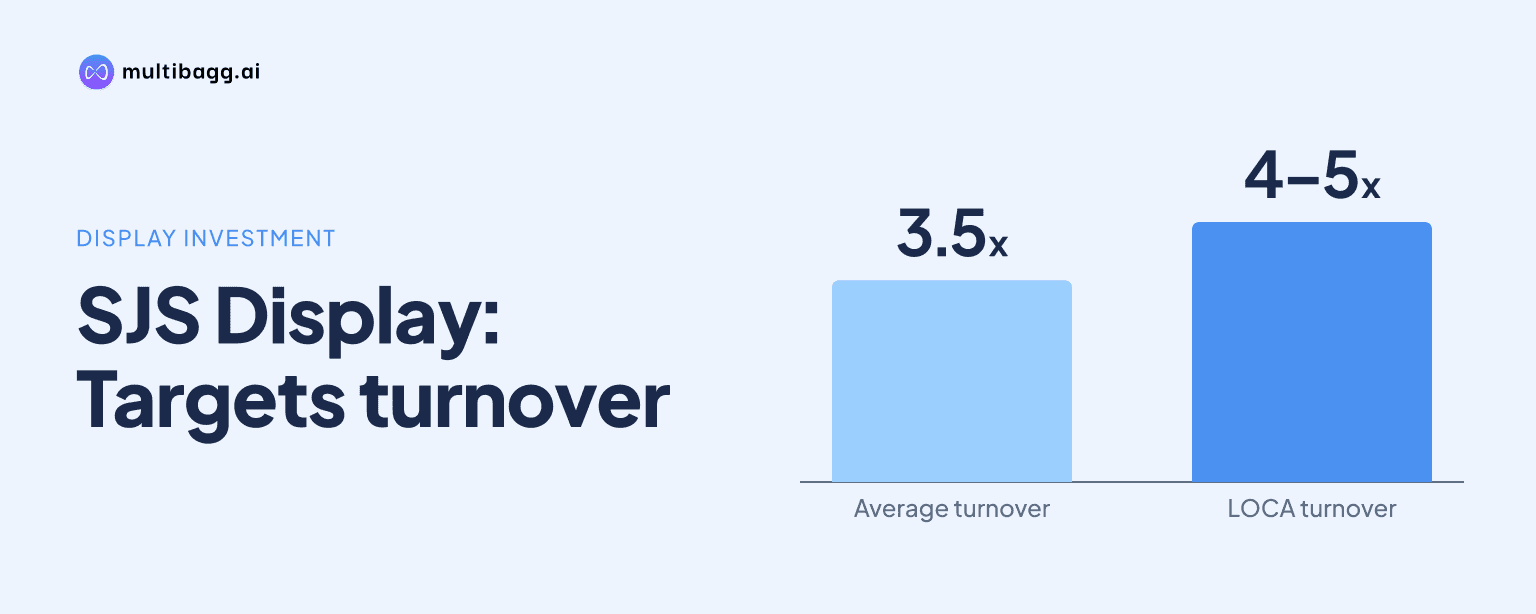
SJS Enterprises Limited has committed Rs 65 crore to SJS Display, with management expecting about 3.5 times average asset turnover from bonding and glass operations, but it did not disclose an FY31 revenue target in the November 5, 2026 call excerpt. The investment includes Rs 25 crore for LOCA bonding and Rs 40 crore for glass.
Know S J S Enterprises inside out
Results, valuation, peers and who's buying, in one view.
Has SJS set an FY31 revenue target for displays?
No, SJS did not state an FY31 revenue target, a Rs 500-700 crore revenue range or a display-market estimate in the supplied November 5, 2026 call excerpt. Management instead gave a Rs 65 crore capital-expenditure plan for SJS Display and turnover expectations for its two manufacturing activities.
Mahendra Naredi said Rs 25 crore of the Rs 65 crore outlay is earmarked for a local optical clear adhesive, or LOCA, bonding facility, while Rs 40 crore is allocated to a glass facility. He expects LOCA bonding, which he described as an assembly activity, to achieve 4-5 times asset turnover, compared with 2-3 times for glass.
The approximately 3.5-times average is not revenue guidance, a profit forecast or a timetable for utilisation. It reflects the different expected capital intensity of bonding and glass, with the 4-5-times range for assembly higher than the 2-3-times range for the glass operation.
What will SJS Display produce and localise?
SJS Display will localise display bonding, backlight units and cover glass for automotive applications. Sanjay Thapar said a typical display combines a backlight unit, a thin-film transistor, or TFT, screen and cover glass through LOCA bonding.
SJS's technical collaboration agreement, or TLA, with BOE Varitronix covers local display bonding, backlight-unit localisation and cover-glass production. The Rs 25 crore bonding allocation and Rs 40 crore glass allocation therefore address distinct portions of the display assembly rather than a single screen-sourcing activity.
Management links the cover-glass business to SJS's 40 years of printing experience. Thapar described cover glass as a printed component with a printed border and specialty coatings applied by lamination or coating, and said this capability could place SJS among the top two or three cover-glass producers in India.
The call excerpt did not disclose capacity in units, a production-start date, a named display customer or a contracted display order. Management's stated case rests on combining BOE Varitronix's display capability with SJS's customer relationships, development record and printing expertise.
Which automotive segments is SJS Display targeting?
Passenger vehicles are the initial opportunity identified by SJS for display applications. Thapar said passenger vehicles have the most complex display requirements and may contain one, two or three displays, increasing the addressable content per vehicle.
Management also described an industry shift from analogue or digital clusters to fully configurable displays across two-wheelers and four-wheelers. However, the direct response on the venture's initial market focused on passenger vehicles, where display complexity and the potential number of screens are higher.
Thapar cited rear-seat entertainment as another prospective use case, although SJS gave no volume or revenue estimate for it. A vehicle launched with rear-seat entertainment could add display demand, but the November 5, 2026 excerpt does not identify a programme or vehicle launch using that feature.
The display initiative differs from SJS's nearer-term chrome-plating expansion, for which management provided a revenue aspiration. Chrome-plating capacity has been doubled and could support about Rs 500 crore in revenue, versus about Rs 240 crore in the previous year, while SJS provided no comparable display revenue timetable.
Got a follow-up? Ask IRIS
Why does SJS expect local display supply to matter?
SJS expects proximity to matter because original equipment manufacturers, or OEMs, seek nearby suppliers after global supply-chain disruptions. Thapar said a vehicle cannot be completed without a display, making local supply relevant to an OEM's production continuity.
Management also referred to government efforts to raise local content and encourage OEM localisation as a business tailwind. The call did not name a policy, an incentive value, an import-duty change or a direct financial benefit for the Rs 65 crore SJS Display investment.
The display project is being developed alongside wider capacity additions at SJS. The company added nearly 40,000 square feet at Bengaluru by building above an existing facility, and standalone utilisation was about 60% after a 20% capacity increase, compared with 70%-75% before the addition.
Those Bengaluru additions are separate from SJS Display, but they illustrate management's capacity-first approach. Thapar said SJS had sufficient standalone capacity for the next two years, with potential to build a new Bengaluru factory if required, while display spending is specifically split between bonding and glass.
What should investors track at SJS Display?
The key disclosed operating markers are deployment of the Rs 65 crore capex and progress toward the 4-5-times LOCA-bonding and 2-3-times glass turnover ranges. The mix of bonding and glass activity will determine whether the combined business approaches management's approximately 3.5-times average.
Customer adoption is another unresolved indicator because the display case depends on localisation, nearshoring and SJS's product-development relationships. Unlike its reference to decals won with Stellantis and a large Hero MotoCorp programme supporting broader expansion, management did not announce a display customer or order.
SJS is pursuing the project while management reports a 31% earnings before interest, tax, depreciation and amortisation, or EBITDA, margin for the second quarter and 30.5% for the first half. Those company-level measures are not display forecasts, but management said product rationalisation and new capacity were intended to support wider growth.
Management expects a replacement consumer programme affected by West Asia conditions to recover over the next one or two quarters. That timing applies to the existing consumer portfolio rather than SJS Display, whose customer wins, commissioning schedule and revenue scale remain undisclosed in the supplied excerpt.
Conclusion
SJS has set out a defined Rs 65 crore entry investment for SJS Display, divided between Rs 25 crore of LOCA bonding and Rs 40 crore of glass capacity. Its stated opportunity combines local display assembly, backlight localisation and printed cover glass, with passenger vehicles identified as the first focus because they can use one, two or three displays.
The next disclosures to watch are capex completion, initial customer programmes, production timing and actual turnover against the 4-5-times bonding and 2-3-times glass benchmarks. Management has disclosed no FY31 display revenue objective in this call excerpt, leaving commercial scale and timing as the principal unresolved matters.