










Solarworld plans BESS project sales as returns target 16%
Key highlights
- Solarworld plans to sell two BESS IPP projects rather than hold them as long-term assets.
- Management targets a minimum IRR of about 16% on the two BESS IPP projects.
- Battery-grade lithium carbonate fell from around 200,000 yuan to about 90,000 yuan per tonne in six months.
- Solarworld targets around 600 BESS containers and Rs 1,500 crore to Rs 1,800 crore of BESS revenue next year.
powered by IRIS
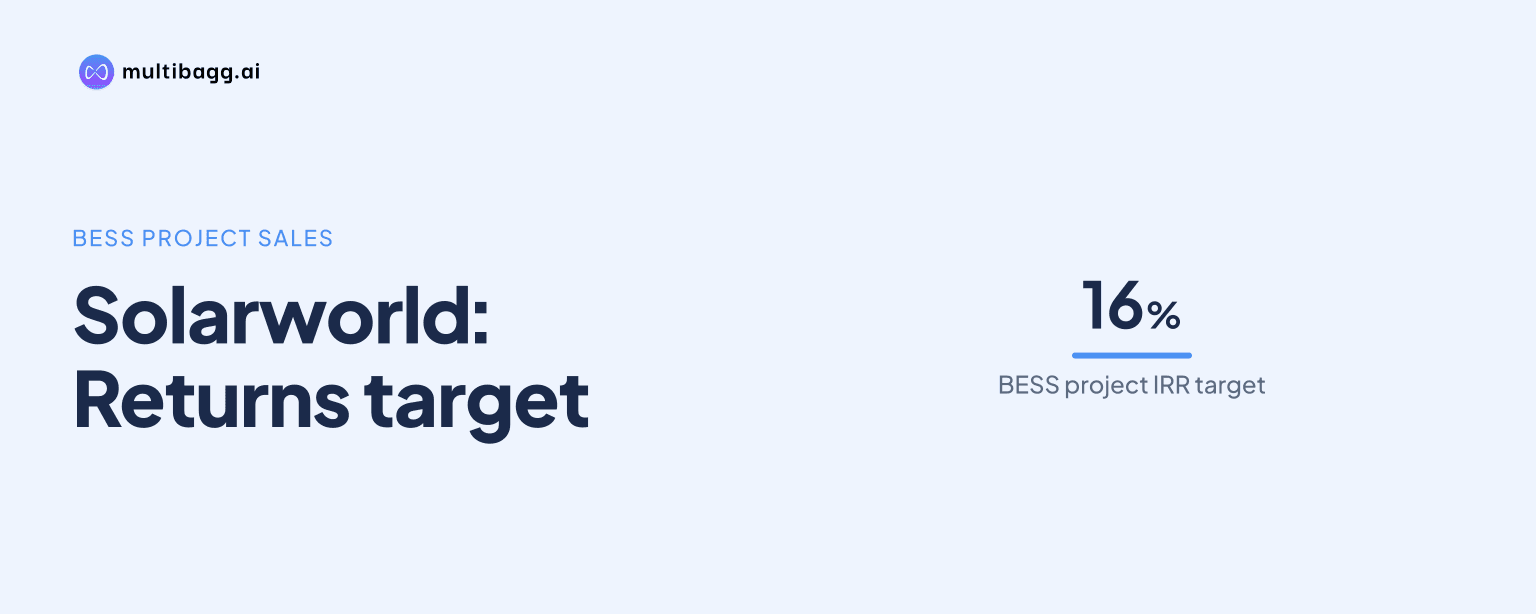
Solarworld said during its earnings call that it plans to sell its two battery energy storage system, or BESS, independent power producer, or IPP, projects rather than retain them long term, with management targeting a minimum internal rate of return, or IRR, of about 16% as battery costs declined. The company said this approach supports its focus on engineering, procurement and construction, or EPC.
Know Solarworld Energy Solutions inside out
Results, valuation, peers and who's buying, in one view.
Why will Solarworld sell its BESS IPP projects?
Solarworld will seek to offload its two BESS IPP projects because management wants the company to remain focused on EPC work rather than long-term project ownership. Management said the projects would be sold when an opportunity arises, although it is currently concentrating on their execution and did not disclose a buyer, expected valuation or transaction date.
Management said lower project costs could raise the premium available when the assets are sold. Its BESS return forecasts improved during the preceding two to three months, and the company said it would definitely not retain the projects for the long term. The planned sales therefore remain contingent on execution and a future opportunity to monetise the assets.
What returns does Solarworld target from BESS projects?
Solarworld is targeting a minimum IRR of about 16% for its two BESS IPP projects, according to management. The projects have fixed monthly revenue rates, while battery procurement costs can change, meaning a reduction in equipment costs can increase projected returns before any sale takes place.
The return outlook improved as battery-grade lithium carbonate fell to about 90,000 yuan per tonne from around 200,000 yuan per tonne six months earlier. Management said BESS IPP IRRs had dropped to about 8% to 9% when prices were elevated, but had almost doubled after Solarworld waited about six months before progressing procurement. These figures are management forecasts rather than reported project returns.
A separate BESS contract is structured differently from the two IPP projects. Management described that contract as fixed price and said it should be substantially profitable, with a profit after tax, or PAT, margin close to 10% when closed. The distinction matters because the IPP projects are intended for sale, whereas the fixed-price contract is being executed as EPC work.
How large is Solarworld's BESS EPC plan?
Solarworld is targeting around 600 BESS containers next year, with management expecting BESS to contribute about 50% of revenue, or Rs 1,500 crore to Rs 1,800 crore. This planned EPC and container activity would operate alongside the sale of the two IPP projects rather than replace Solarworld's EPC-led business model.
The company said it already had in-house orders for about 300 containers and was discussing another 200 to 300 containers with private developers. Management estimated the cost of a single container at close to Rs 3.2 crore. At the stated 600-container target, the container programme would be materially larger than the two-project IPP portfolio planned for monetisation.
Management described utility-scale storage as the largest BESS segment and estimated the Indian market at around 350 gigawatt-hours over the next five to six years. Solarworld has also launched 1-kilowatt-hour, 2-kilowatt-hour and 5-kilowatt-hour residential battery packs, while its first commercial and industrial installation for a restaurant was sized at 125/261 kilowatt-hours.
Got a follow-up? Ask IRIS
What could affect Solarworld's BESS sale timing?
Solarworld has not announced a sale date, buyer or price for either BESS IPP project, so project execution is the immediate condition before monetisation. Management said the projects' fixed monthly revenue and changing battery costs mean that the eventual premium depends in part on the returns that a buyer can assess at the time of a transaction.
Battery input volatility is the main disclosed variable. Lithium carbonate moved from around 200,000 yuan per tonne to about 90,000 yuan per tonne within six months, and management called BESS raw-material costs volatile. Solarworld said it delayed parts of procurement when prices were high while completing work that could proceed without incurring additional cost.
Management said its decision to wait helped improve BESS project returns from the earlier 8% to 9% range. That approach also formed part of a broader effort to manage input costs, although it did not provide separate execution dates or procurement milestones for the two IPP projects. Any asset sale remains an intention rather than a disclosed agreement.
How does BESS monetisation fit Solarworld's margin outlook?
Solarworld is pursuing BESS monetisation while managing pressure on fixed-price EPC contracts. Management said most of its revenue comes from public-sector customers through fixed-price tenders, and that material-cost increases can reduce margins because such contracts generally do not include price pass-through provisions.
Management cited an EPC contract for which Solarworld became the lowest bidder in October 2025 but received the letter of award only between February and March. It said raw-material prices and foreign-exchange rates changed significantly between October and January, before procurement could start after approvals. By comparison, the BESS IPP projects have fixed revenue but benefited from lower battery costs.
The company said it had completed turnover of about Rs 400 crore through H2 after delaying procurement in some areas when input prices were elevated. Management said it was guiding for a 5% to 6% margin and would try to improve this in H2 as prices moderated. The proposed BESS asset sales could create value through project premiums, but management has not quantified their potential effect on reported revenue or profit.
Conclusion
Solarworld's stated BESS strategy is to execute two IPP projects, target a minimum IRR of about 16%, and sell the assets instead of retaining them as long-term operating investments. The approach keeps BESS asset ownership limited while management pursues a broader EPC and container plan of around 600 units and Rs 1,500 crore to Rs 1,800 crore of BESS revenue next year.
The next disclosures to watch are progress on the two IPP projects, any identified buyer or sale terms, and whether battery costs remain near the 90,000-yuan-per-tonne level cited by management. Investors can also track delivery against the 600-container target and management's stated expectation that BESS could account for about 50% of revenue next year.