










Solarworld plans 70-80% of cell capacity for internal use
Key highlights
- Solarworld expects the two joint-venture partners to consume 70% to 80% of cell capacity internally.
- Solarworld said 15% to 20% of capacity may be sold to external customers.
- Solarworld operates a 1.5-gigawatt solar manufacturing plant that can convert about 1.5 gigawatts of cells into panels.
- Management targets about Rs 3,000 crore of following-year revenue, including Rs 1,500 crore to Rs 1,800 crore from BESS activities.
powered by IRIS
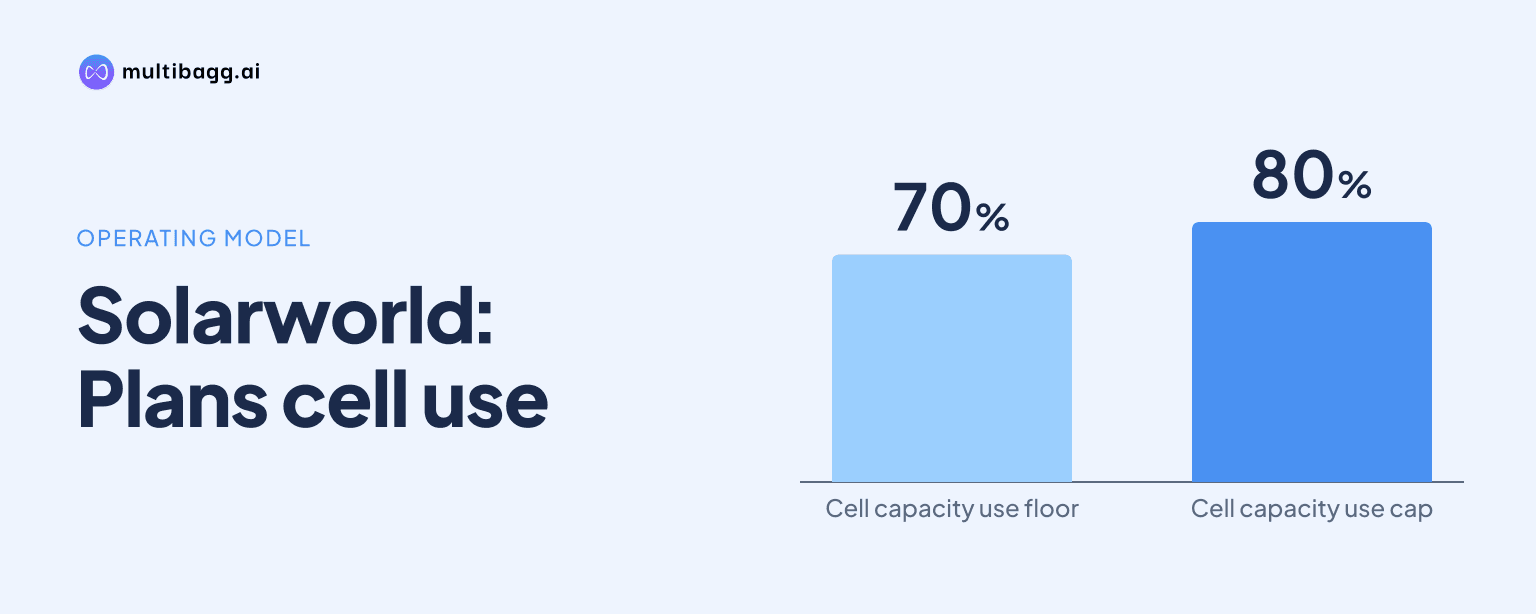
Solarworld Energy Solutions Limited said its solar-cell joint venture is designed chiefly to supply internal needs, with the two partners expecting to consume about 70% to 80% of capacity. The TOPCon facility is part of limited backward integration intended to support solar engineering, procurement and construction operations rather than build a large standalone manufacturing business.
Know Solarworld Energy Solutions inside out
Results, valuation, peers and who's buying, in one view.
Why is Solarworld building solar-cell capacity?
Solarworld is building solar-cell capacity to support its engineering, procurement and construction, or EPC, business through more control over supply, quality and margins. Management said the company has operated on an asset-light model for a long time, but chose backward integration to the extent needed for its solar-project activities.
The company does not intend to develop into a major standalone manufacturer, according to management. Solarworld said it would not expand the facilities into a 5-gigawatt or 10-gigawatt platform, drawing a distinction between its stated objective of becoming a backward-integrated EPC company and a strategy focused on selling manufacturing output at scale.
Management said the manufacturing investment can improve margin, continuity of quality and supply-chain availability for EPC work. That rationale is particularly relevant to government tenders, where bids may need to remain open for 120 to 180 days and Solarworld said there is limited scope to revise pricing after becoming the lowest bidder.
Solarworld also described the cell line as a higher-margin activity than EPC, while cautioning that its manufacturing scope will remain linked to project requirements. Management said pure solar EPC could account for about 30% to 40% of business in the following year, implying a planned shift toward battery energy storage system, or BESS, activity and solar manufacturing.
How will Solarworld use the joint venture's cell output?
Solarworld expects the two joint-venture partners to consume about 70% to 80% of the cell facility's capacity internally. Management said the remaining 15% to 20% may be sold to external customers, although it also estimated that Solarworld itself could readily utilise 60% to 70% in-house at present.
The different percentages refer to different scopes. The 70% to 80% estimate covers consumption by both joint-venture partners, while the 60% to 70% indication addresses Solarworld's own potential in-house use. Management did not disclose a capacity-utilisation schedule, cell pricing or the joint venture's expected financial contribution.
Solarworld already operates a 1.5-gigawatt solar manufacturing plant and said it can convert about 1.5 gigawatts of cells into solar panels internally. If output exceeds internal requirements, management said Solarworld could sell surplus panels or surplus cells into the market.
This allocation makes third-party sales a possible outlet for excess production rather than the central purpose disclosed on the call. The company framed the facility as a means to feed its existing solar manufacturing and EPC activities, not as a plan to pursue unrestricted expansion in module or cell sales.
Got a follow-up? Ask IRIS
Why has Solarworld selected TOPCon technology?
Solarworld said the joint-venture facility will use tunnel oxide passivated contact, or TOPCon, technology. Management's view was that TOPCon is currently a stable technology for India and that the risk of technological obsolescence in the domestic market is limited over the next five to seven years.
Management said many manufacturers in India are setting up TOPCon capacity, while some installed capacity remains based on M10R wafers and is being upgraded to G12R wafers. It said this suggests that a rapid, broad move to newer alternatives such as heterojunction technology, or HJT, is not currently evident in India.
Solarworld's management expects newer technologies to take time to be adopted locally because they generally carry higher costs and need installation and stabilisation. It also said India is a cost-sensitive market and that improved cell efficiency, which can reduce land needs, may have less immediate value where land is not a constraint for larger solar projects.
Management said HJT has not become as stable as TOPCon in its assessment, with limited installed capacity worldwide. It nevertheless acknowledged that technological changes will continue globally, and its position was specifically that those changes may not quickly percolate into India over the next four to five years.
For Solarworld, the more immediate issue is execution, according to management. It said the key task is obtaining, installing and commissioning plants, then operating them at high efficiency; no equipment supplier, production-yield target or intermediate commissioning milestone was disclosed on the call.
How does cell manufacturing fit Solarworld's revenue plans?
Solarworld's management has set a target of about Rs 3,000 crore of revenue for the following year and about Rs 5,000 crore over the next two to three years. It expects roughly Rs 1,500 crore to Rs 1,800 crore from BESS manufacturing and BESS EPC, alongside about Rs 1,200 crore to Rs 1,400 crore from solar EPC, module manufacturing and cell manufacturing.
That planned mix differs from the current-year guidance discussed on the call of Rs 1,600 crore to Rs 1,700 crore in revenue. An analyst referred to a 5% to 6% profit-after-tax margin expectation, and management said the final two quarters are important to the business, noting that prior-year profit after tax was about Rs 20 crore in the first half and about Rs 100 crore in the second half.
Management said BESS enquiries are increasingly coming from private customers and are linked to lithium-cell prices, which it expects to provide greater margin stability than pure solar EPC. It projected almost Rs 1,500 crore to Rs 1,800 crore of BESS revenue and said BESS projects should see limited margin movement under that pricing structure.
Solarworld described BESS as a larger near-term addressable market, estimating that India could install 350 to 400 gigawatt-hours of utility-scale BESS over the next five to six years. Management said a 1-megawatt container costs about Rs 70 lakh, while commercial, industrial and residential applications could add to demand beyond utility-scale projects.
The cell project therefore addresses a different operating need from BESS. BESS is intended to broaden revenue sources and reduce reliance on pure solar EPC, while the cell facility is intended to make Solarworld's solar-project delivery and module conversion more reliable through a controlled supply of cells.
Conclusion
Solarworld's cell joint venture is a measured backward-integration plan rather than a move into large-scale standalone manufacturing. Management expects 70% to 80% of capacity to be consumed by the two partners, with Solarworld's 1.5-gigawatt manufacturing plant providing a route to convert cells into panels for internal use or surplus sales.
The next disclosures to watch are the facility's installation, commissioning and operating-efficiency progress, as management identified execution as the key issue. Investors can also track progress against management's following-year revenue target of about Rs 3,000 crore and its two- to three-year target of about Rs 5,000 crore, including the changing contribution from BESS, solar EPC and manufacturing.