










Solarworld targets Rs 1,500-1,800 crore BESS revenue next year
Key highlights
- Solarworld targets Rs 1,500-1,800 crore of BESS revenue next year from about 600 containers.
- Solarworld has around 300 BESS containers in-house and is discussing another 200-300 with private developers.
- Solarworld said a utility-scale BESS container costs close to Rs 3.2 crore.
- Q2 FY27 revenue rose 77% to Rs 244 crore, while PAT declined to Rs 4.20 crore from Rs 9.30 crore.
powered by IRIS
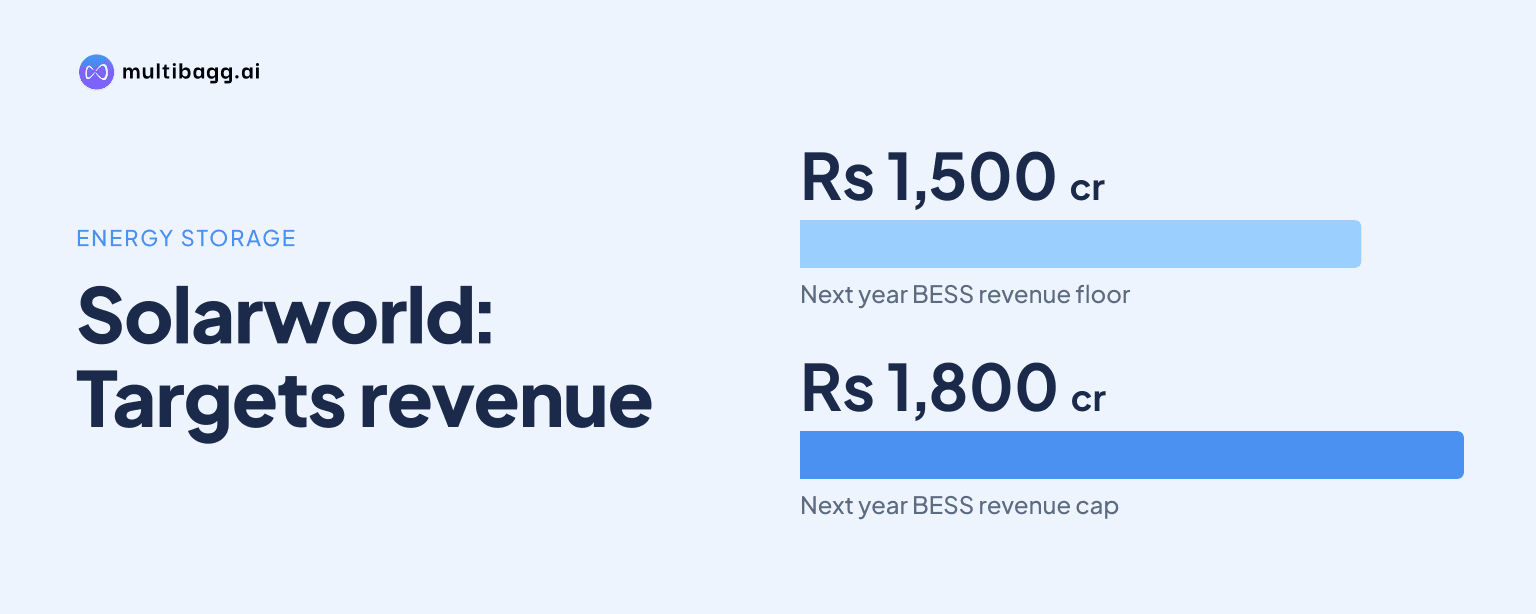
Solarworld said battery energy storage systems, or BESS, could generate Rs 1,500 crore to Rs 1,800 crore of revenue next year if it supplies about 600 utility-scale containers. Management said it already has in-house orders for around 300 containers and is discussing a further 200 to 300 with private developers.
Know Solarworld Energy Solutions inside out
Results, valuation, peers and who's buying, in one view.
How much BESS revenue is Solarworld targeting next year?
Solarworld is targeting Rs 1,500 crore to Rs 1,800 crore of BESS revenue next year, which management said could represent about 50% of company revenue. The estimate is linked to a target of about 600 containers, each costing close to Rs 3.2 crore according to management.
Management also targets company revenue of about Rs 3,000 crore next year, compared with its FY27 revenue outlook of Rs 1,600 crore to Rs 1,700 crore. The BESS range therefore broadly aligns with management's statement that storage could account for nearly half of next year's revenue, but the company did not provide a detailed revenue-recognition schedule by project.
The target remains forward-looking rather than reported revenue. Solarworld's revenue from operations in the first half of FY27 was Rs 412 crore, double the Rs 206 crore recorded in H1 FY26, showing that the proposed BESS contribution would require a substantial increase in execution scale next year.
What BESS orders support Solarworld's 600-container target?
Solarworld said it has utility-scale BESS orders for about 300 containers in hand and is discussing another 200 to 300 containers with private developers. Conversion of the high end of those discussions would bring the total to about 600 containers, the volume management is targeting for next year.
The company referred to three BESS projects while discussing returns. Solarworld has two independent power producer, or IPP, projects, one each from Gujarat Urja Vikas Nigam Limited and Rajasthan Rajya Vidyut Utpadan Nigam Limited, for which management is targeting a minimum internal rate of return, or IRR, of about 16%.
Solarworld said its National Thermal Power Corporation, or NTPC, BESS project is a fixed contract and could deliver a profit after tax, or PAT, margin close to 10% as the project closes. The IPP projects have fixed monthly revenue, while their costs can decline or rise, meaning their stated IRRs remain linked to equipment and battery-material prices.
Management said Solarworld intends to remain an engineering, procurement and construction, or EPC, company rather than hold BESS assets for the long term. It plans to execute the two IPP projects and offload them when an opportunity arises, so the future revenue mix may include container supply, EPC execution and gains from project monetisation.
Why does Solarworld expect BESS project economics to improve?
Solarworld said its BESS forecasts improved over the previous two to three months as battery-grade lithium carbonate prices declined. Management said the material price fell to about 90,000 yuan per tonne from around 200,000 yuan per tonne six months earlier, while also describing BESS raw-material pricing as volatile.
That cost trend differs from the metals pressure affecting FY27 solar EPC contracts. In Q2 FY27, Solarworld's revenue rose 77% year on year to Rs 244 crore from Rs 137.90 crore, but earnings before interest, tax, depreciation and amortisation, or EBITDA, declined to Rs 15.20 crore from Rs 18.10 crore. Its EBITDA margin was 5.9%.
Management attributed the Q2 margin decline partly to fixed-price public-sector contracts and higher input costs. Solarworld said most of its revenue comes from public-sector customers including NTPC, SJVN and Solar Energy Corporation of India, or SECI, whose tenders are generally fixed-price contracts.
Solarworld said it hedges foreign-exchange exposure associated with letters of credit for imported raw materials. However, management said it cannot directly hedge copper, steel and aluminium because it purchases processed goods, including transformers and tracker systems, rather than the underlying metals.
Got a follow-up? Ask IRIS
Which storage markets is Solarworld pursuing?
Solarworld is pursuing residential, commercial and industrial, and utility-scale BESS markets, with utility-scale identified by management as the largest segment. Management estimated India's utility-scale storage opportunity at around 350 gigawatt-hours over the next five to six years but gave no Solarworld market-share target.
In residential storage, Solarworld has launched battery packs with 1 kilowatt-hour, 2 kilowatt-hour and 5 kilowatt-hour capacities. Management said it was receiving business-to-business and business-to-consumer enquiries, but did not disclose orders, production capacity or revenue for these battery packs.
For commercial and industrial customers, Solarworld said it installed its first BESS project at a restaurant with a 125/261-kilowatt-hour specification. Management said the installation generated repeat and new enquiries, and identified generator replacement with two to four hours of lithium backup as one potential use case.
The company is also evaluating a 2-gigawatt-hour lithium-ion cell manufacturing facility in India. Solarworld withdrew its application under the production-linked incentive scheme because management considered the programme overcrowded, and said export restrictions involving Chinese technology and equipment require a cautious approach.
How does BESS fit Solarworld's FY27 and FY28 plans?
Solarworld's storage target is part of a broader plan in which management expects FY27 margins to remain under strain before improving in FY28. For H1 FY27, Solarworld reported EBITDA of Rs 35.80 crore and PAT of Rs 13.70 crore on Rs 412 crore of revenue, producing an EBITDA margin of 8.3%.
Management guided to an FY27 margin of 6% to 7% and PAT of Rs 80 crore to Rs 90 crore. For next year, it targets revenue of about Rs 3,000 crore and PAT of about Rs 200 crore to Rs 220 crore; these are management targets based on current pricing, not reported results.
Solarworld said it has orders worth about Rs 3,800 crore in hand. Management expects to execute another Rs 1,100 crore to Rs 1,200 crore during FY27, leaving roughly Rs 2,600 crore for the following year, although execution timing and profitability can be affected by material costs and contract structure.
Management also expects its solar cell line to begin operating in the second quarter of next year. It said recently won solar EPC orders carry higher prices than earlier orders, while lower copper and aluminium costs could support margins as those contracts are executed.
Conclusion
Solarworld has moved its BESS expansion from a broad strategic ambition to a quantified target of about 600 containers and Rs 1,500 crore to Rs 1,800 crore of next-year revenue. Existing orders for 300 containers, talks for another 200 to 300, and the stated aim for BESS to form about half of Rs 3,000 crore of revenue provide the basis for management's outlook.
The next disclosures to watch are conversion of private-developer discussions into orders, execution of the 300 in-house containers and the path of battery-material costs that influence BESS returns. Management also said it hopes to conclude its evaluation of a 2-gigawatt-hour lithium-ion cell facility by the end of the month or by December 15 at the latest.