










Solarworld Energy Solutions Revenue Up 77%, Profit Down 55% in Q2
Key highlights
- Solarworld's Q2 FY27 total income rose 81.1% year on year to ₹2,549.0 million.
- Q2 FY27 revenue from operations increased 76.9% to ₹2,439.7 million.
- Q2 FY27 EBITDA margin declined to 5.9% from 12.8% a year earlier.
- Solarworld reported a ₹38,560 million order book and FY27 revenue guidance of ₹16,000 million to ₹17,000 million.
powered by IRIS
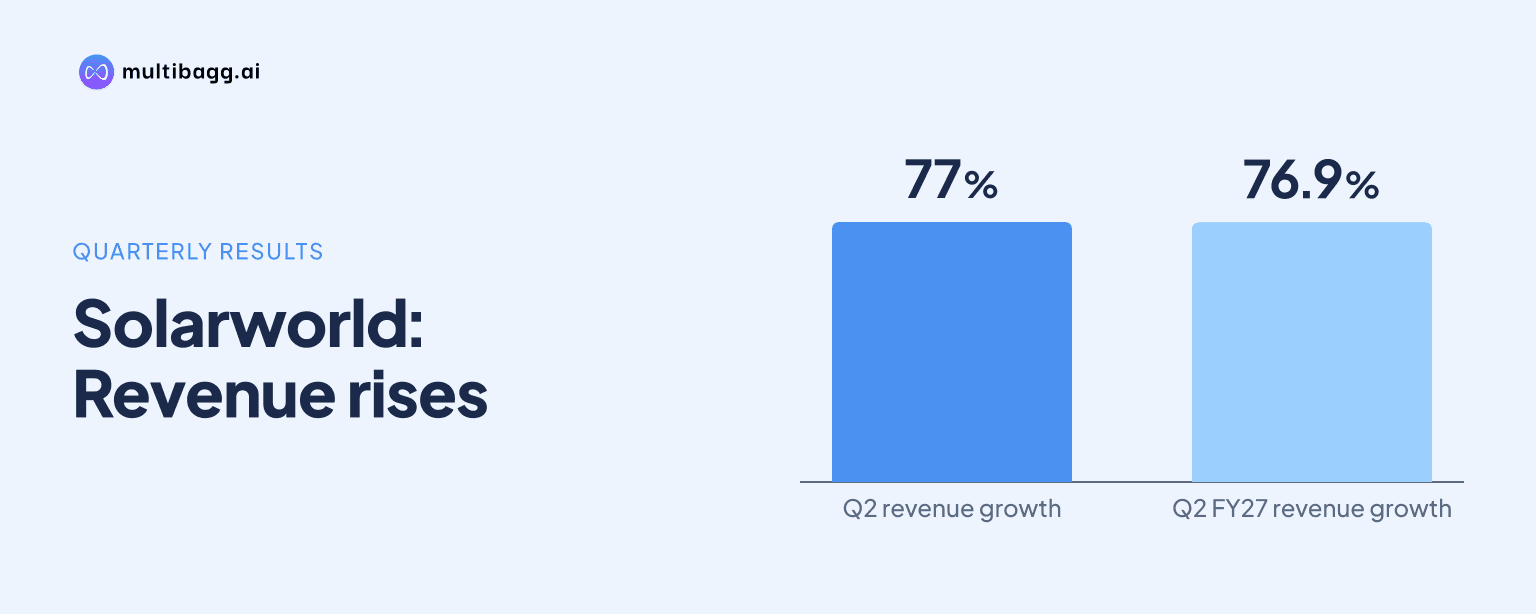
Solarworld Energy Solutions Limited reported Q2 FY27 revenue from operations of ₹2,439.7 million, up 76.9% year on year, but profit after tax fell 54.8% to ₹41.9 million as EBITDA margin declined to 5.9% from 12.8% a year earlier.
Know Solarworld Energy Solutions inside out
Results, valuation, peers and who's buying, in one view.
What did Solarworld report for Q2 FY27?
Solarworld Energy Solutions Limited reported total income of ₹2,549.0 million for the quarter ended September 30, 2026, an increase of 81.1% from ₹1,407.2 million in the corresponding quarter of FY26. Revenue from operations rose to ₹2,439.7 million from ₹1,379.0 million, according to the company’s Q2 FY27 earnings call.
The company reported EBITDA of ₹151.5 million in the quarter, compared with ₹181.0 million a year earlier. Profit after tax stood at ₹41.9 million, against ₹93.0 million in Q2 FY26. The result shows that higher project execution lifted revenue, while profitability came under pressure during the same period.
Why did profit decline despite higher revenue?
Solarworld said its Q2 EBITDA margin was 5.9%, well below the 12.8% reported in the comparable quarter. The earnings-call discussion linked the pressure to raw-material costs and conditions in the engineering, procurement and construction, or EPC, business, particularly fixed-price public-sector projects.
Management also referred to a significant slowdown in EPC activity, tied to the pace at which solar projects are being installed in India. As a result, revenue growth did not translate into higher EBITDA or profit. The gap between the 76.9% rise in revenue from operations and the 54.8% fall in profit after tax is the central financial feature of the quarter.
The company’s EBITDA for the first half of FY27 was ₹358.0 million, with an EBITDA margin of 8.3%. This was higher than the Q2 margin, indicating that the first-half operating outcome included a stronger contribution from the earlier quarter. First-half profit after tax was ₹137.0 million.
How did Solarworld perform in the first half of FY27?
Solarworld reported first-half FY27 revenue from operations of ₹4,120.0 million, compared with ₹2,060.0 million in H1 FY26, representing approximately 100% growth. The company has therefore recorded rapid execution growth over the first six months of the financial year, even as the second-quarter margin weakened.
The results were announced for the quarter and half year ended September 30, 2026. Solarworld held its Q2 and H1 FY27 earnings call on November 13, 2026, and subsequently made the audio recording available under its Regulation 30 disclosure. Managing Director Karthik Eldia said on the call that India’s renewable-energy opportunity was expanding from solar-capacity installation towards an ecosystem involving generation, storage and reliable power delivery.
Management discussed battery energy storage systems, data-centre EPC opportunities and domestic lithium-ion cell manufacturing as areas being evaluated. These comments describe the company’s stated areas of interest and do not represent completed projects or financial contributions to the reported quarter.
Got a follow-up? Ask IRIS
What is Solarworld’s FY27 guidance and order visibility?
Solarworld reduced its FY27 revenue guidance to ₹16,000 million to ₹17,000 million, according to the earnings-call summaries provided. Management also indicated a 5% to 7% margin range for FY27, lower than its earlier indication of about 10.5%.
The company reported an order book of ₹38,560 million. Based on the midpoint of its FY27 revenue guidance, that order book is about 2.3 times the guided annual revenue. The figure indicates contracted work visibility, although execution timing, input costs and project-level margins will determine how much converts into revenue and profit during the year.
Management cited 582 MW AC of battery energy storage system orders in the demand discussion. It also said EPC activity could remain slow for around 12 months. These two points underline the difference between demand in emerging storage-linked opportunities and near-term conditions in the broader solar EPC market.
What does the result mean for investors and the solar EPC sector?
Solarworld’s quarter reflects a key issue for EPC businesses: revenue can rise sharply when project activity is executed, while fixed-price contracts and cost changes can limit or reduce profit conversion. In Q2 FY27, the company’s revenue from operations increased by more than three-fourths, but EBITDA declined by ₹29.5 million and profit after tax declined by ₹51.1 million.
The company discussed metal-price increases affecting fixed-price public-sector EPC contracts. This is relevant because project costs can change after a contract is awarded, while the agreed project value may not adjust at the same pace. The lower Q2 EBITDA margin provides a measurable indication of this pressure, without establishing how long it will persist.
For the wider industry, management described a transition towards energy storage, power conversion and dependable power delivery alongside solar installation. It also said India could install 350 GWh to 400 GWh of battery energy storage projects over the next five to six years. That was a management view shared on the call, rather than an independently verified industry forecast.
Conclusion
Solarworld delivered strong Q2 FY27 revenue growth, with total income rising 81.1% to ₹2,549.0 million and revenue from operations increasing 76.9% to ₹2,439.7 million. However, lower EBITDA and a 54.8% decline in profit after tax show that costs and EPC conditions had a material effect on profitability during the quarter.
Investors will watch execution against FY27 revenue guidance of ₹16,000 million to ₹17,000 million, the stated 5% to 7% margin range, and progress on the ₹38,560 million order book. Management’s evaluations of a 2 GWh lithium-ion cell facility, a potential India joint venture for data-centre EPC and battery storage opportunities are further disclosed areas to monitor.