










Solarworld cuts FY27 margin outlook as metal costs rise
Key highlights
- Solarworld targets a 6%-7% FY27 margin and Rs 80 crore to Rs 90 crore of FY27 PAT.
- Q2 FY27 revenue rose 77% year on year to Rs 244 crore, while EBITDA declined to Rs 15.2 crore.
- Solarworld’s order book was Rs 3,856 crore on October 31, 2026, including Rs 1,138 crore of BESS EPC orders.
- Management projects FY28 BESS revenue of Rs 1,500 crore to Rs 1,800 crore.
powered by IRIS
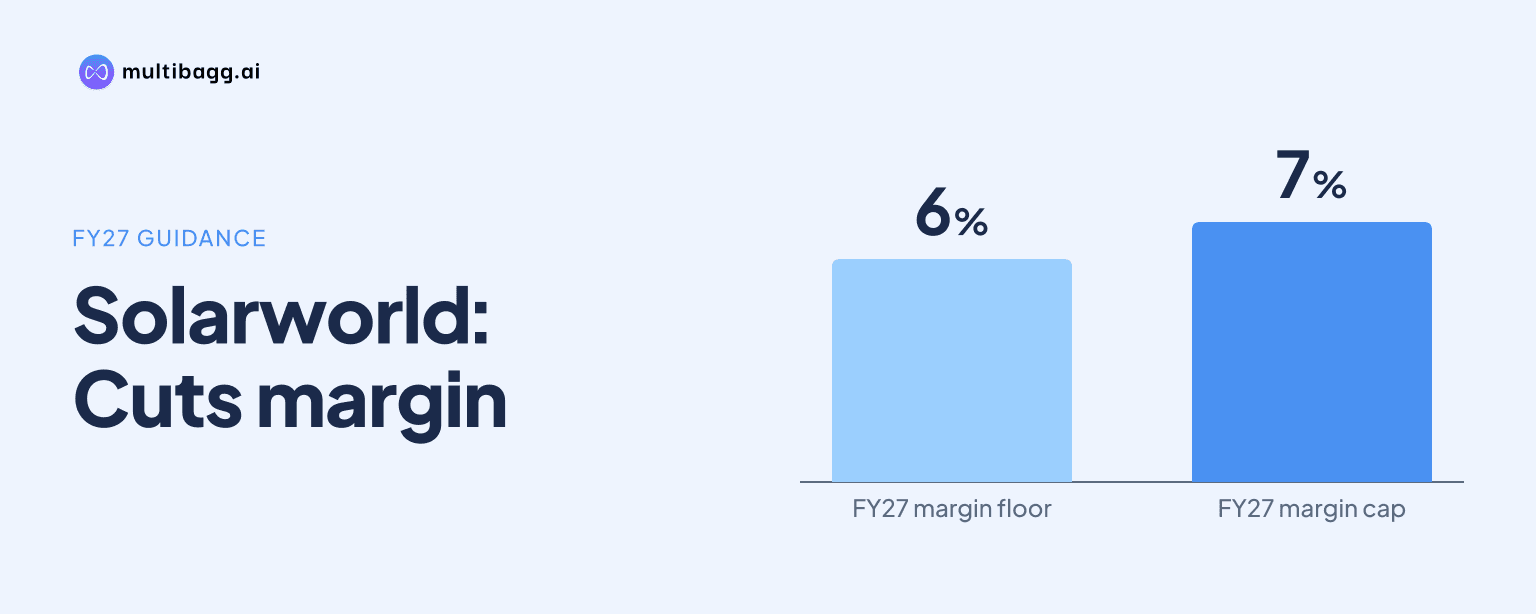
Solarworld Energy Solutions Limited targets a 6%-7% FY27 margin, with FY27 revenue of Rs 1,600 crore to Rs 1,700 crore, after fixed-price public-sector contracts exposed it to commodity inflation; in Q2 FY27, revenue climbed 77% year on year to Rs 244 crore while EBITDA fell to Rs 15.2 crore.
Know Solarworld Energy Solutions inside out
Results, valuation, peers and who's buying, in one view.
Why did Solarworld cut its FY27 margin outlook?
Solarworld cut its FY27 margin outlook because fixed-price contracts with public-sector undertakings leave it unable to fully pass higher copper, steel and aluminium costs to customers. Management said most of its revenue comes from customers including NTPC, SJVN and SECI, and that metal-price upcycles periodically reduce project margins. The company is now targeting a 6%-7% margin for FY27, while an analyst on the November 13, 2026 call referred to earlier guidance of about 10.5%.
Management retained a FY27 revenue target of Rs 1,600 crore to Rs 1,700 crore and guided for profit after tax, or PAT, of 5%-6%, equivalent to Rs 80 crore to Rs 90 crore. The revenue range is below the Rs 2,000 crore target cited by the analyst during the call. Solarworld expects to execute a further Rs 1,100 crore to Rs 1,200 crore of orders in FY27, with about Rs 2,600 crore of orders passing into the following year.
The revised outlook concerns the profitability of execution rather than the size of the secured portfolio. Solarworld’s consolidated order book was Rs 3,856 crore on October 31, 2026, including Rs 2,718 crore in solar engineering, procurement and construction, or EPC, and operations and maintenance, or O&M. Battery energy storage system, or BESS, EPC accounted for about Rs 1,138 crore, or almost 30% of the order book.
How did Solarworld’s Q2 and H1 FY27 earnings change?
Solarworld’s Q2 FY27 revenue increased, but EBITDA and PAT declined from Q2 FY26 as project costs rose. Revenue from operations reached Rs 244 crore in Q2 FY27 from Rs 137.9 crore a year earlier, while EBITDA, or earnings before interest, tax, depreciation and amortisation, declined to Rs 15.2 crore from Rs 18.1 crore. PAT fell to Rs 4.2 crore from Rs 9.3 crore.
Solarworld reported a Q2 FY27 EBITDA margin of 5.9%, compared with an 8.3% EBITDA margin for H1 FY27. H1 revenue nearly doubled to Rs 412 crore from Rs 206 crore in H1 FY26, but management said its revenue is weighted to the final two quarters. It expects material costs as a share of revenue to move closer to prior-year levels as projects approach execution during the second half.
Solarworld reported net worth of Rs 862 crore as of September 30, 2026, with a debt-to-equity ratio of 0.46 times. Management said its priorities while scaling the EPC and BESS businesses include cash-flow generation, working-capital efficiency and disciplined capital allocation.
Got a follow-up? Ask IRIS
Which Solarworld costs can be hedged or passed through?
Solarworld can hedge foreign-exchange exposure on outstanding letters of credit for imported materials, but it said it has limited scope to hedge copper, steel and aluminium directly. The company buys processed goods rather than the underlying metals. Management identified copper-based power transformers, aluminium-based inverter duty transformers and tracker systems supplied by GameChange as inputs affected by commodity movements.
Solarworld said the higher cost of processed equipment is not currently passed through under most public-sector tenders because those contracts are fixed price. This is the mechanism management gave for margin compression during a metals supercycle. It distinguished this exposure from foreign-exchange risk, which it can hedge on raw-material imports covered by letters of credit.
Management said copper and aluminium prices had started to decline by the November 13 call and that orders won during the current quarter had higher prices than older orders. Its expectation of improved FY28 margins therefore depends on lower input costs and the execution of newer contracts at revised prices, rather than a price-escalation mechanism on the existing fixed-price order book.
Can BESS and solar cells improve Solarworld’s FY28 profitability?
Management expects BESS to contribute almost half of Solarworld’s revenue and profitability in FY28, supported by secured orders and its commissioned manufacturing line. Solarworld has BESS orders of 582 megawatt alternating current and about 1.3 gigawatt-hour direct current from RRUVNL, GUVNL and NTPC. About 1 gigawatt of BESS manufacturing capacity is covered by orders in hand.
Management projected BESS revenue of Rs 1,500 crore to Rs 1,800 crore in FY28, based on a target of around 600 utility-scale containers. It said a single container costs close to Rs 3.2 crore. For BESS independent power producer projects from GUVNL and RVUNL, management is targeting a minimum internal rate of return of about 16%, while it expects the fixed-contract NTPC BESS project to deliver a PAT margin near 10% when closed.
BESS returns remain linked to battery-material costs. Management said battery-grade lithium carbonate had fallen to about 90,000 yuan per tonne from about 200,000 yuan per tonne six months earlier, materially improving its forecast for BESS project returns. It said the selling price in the independent power producer projects is fixed, meaning lower costs increase projected internal rates of return.
Solarworld is also developing a 2.4-gigawatt solar-cell facility through a joint venture at Narmadapuram, Madhya Pradesh, targeted for commercial production in June 2027. The first equity tranche of Rs 26.8 crore was paid on October 30, 2026. Management said it does not expect current solar-cell margins to persist as capacity expands, but projected margins of above 15%-20% for the business going forward.
Conclusion
Solarworld’s FY27 reset pairs sharply higher revenue expectations with lower profitability expectations. Q2 FY27 revenue rose 77% to Rs 244 crore, but EBITDA declined to Rs 15.2 crore and PAT fell to Rs 4.2 crore, showing the effect of commodity inflation on fixed-price EPC contracts before newer bids and lower input costs are reflected in execution.
The next developments to watch are Solarworld’s execution of Rs 1,100 crore to Rs 1,200 crore of FY27 orders, its FY28 BESS revenue target of Rs 1,500 crore to Rs 1,800 crore, and the June 2027 commercial-production target for the 2.4-gigawatt solar-cell facility. Management also said it may return to shareholders during the current quarter with details of short-term actions being evaluated by the board.