










S.P. Apparels lowers Sri Lanka FY27 outlook to Rs 150-170 crore
Key highlights
- SPAL cut its FY27 Sri Lanka revenue expectation to Rs 150 crore to Rs 170 crore from Rs 190 crore.
- One of four Sri Lanka factories awaits customer approval, with first shipments probably beginning in April 2027.
- SPAL retained its FY28 Sri Lanka revenue target of Rs 400 crore once all four factories operate on FOB orders.
- Consolidated Q2 FY27 revenue rose 5.8% year on year to Rs 452 crore, while H1 EBITDA rose 9.8% to Rs 128 crore.
powered by IRIS
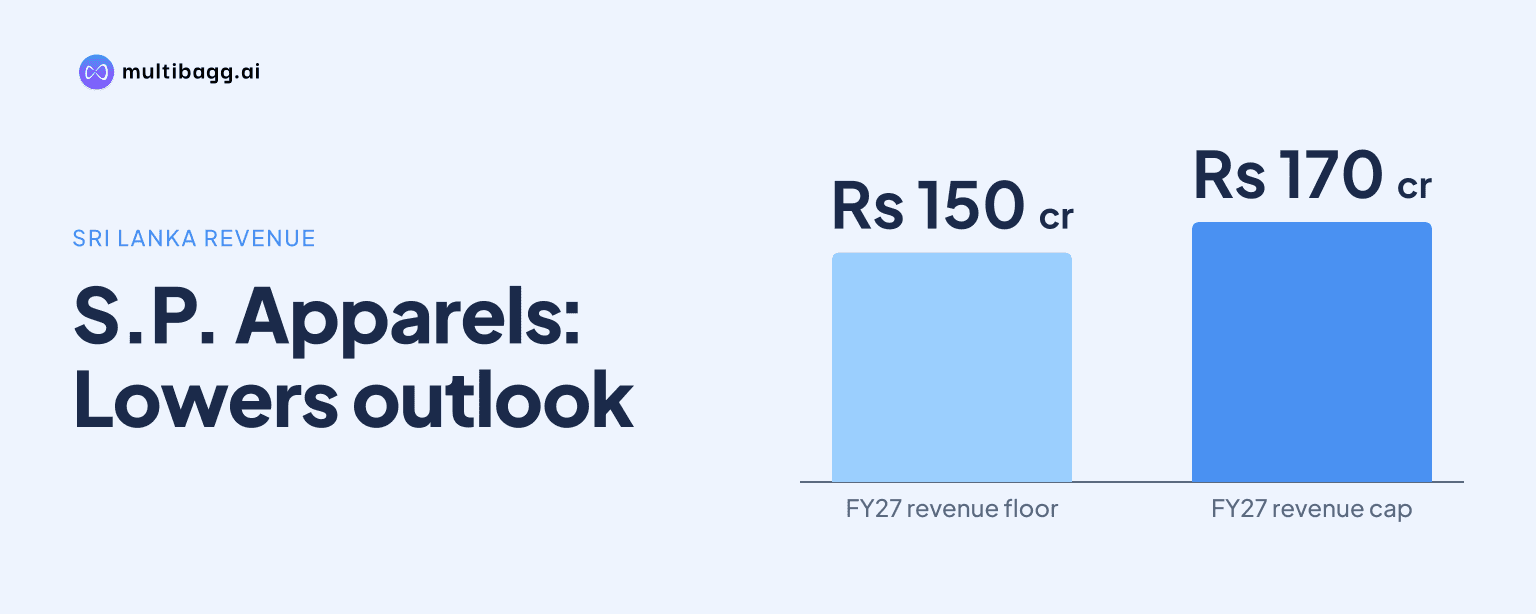
S.P. Apparels has lowered its FY27 Sri Lanka revenue expectation to Rs 150 crore to Rs 170 crore from Rs 190 crore because one of four factories is awaiting customer approval. Management retained its FY28 Sri Lanka revenue target of Rs 400 crore, contingent on all four factories operating on the company’s own FOB orders.
Know S P Apparels inside out
Results, valuation, peers and who's buying, in one view.
Why did SPAL lower its Sri Lanka FY27 revenue outlook?
SPAL lowered its FY27 Sri Lanka outlook because customer approval for its fourth factory has been delayed. Chief Financial Officer V. Balaji said the earlier FY27 expectation was Rs 190 crore, but revenue may now end in the Rs 150 crore to Rs 170 crore range because of the U.S. issue cited during the call. The revised range is Rs 20 crore to Rs 40 crore below the previous expectation.
Chairman P. Sundararajan said the delayed approval at one of four factories had made it difficult to raise Sri Lanka revenue. The facility is currently doing job work, which management said keeps it operational while the approval process continues. Management expects approval within three to four months, and Mr. Sundararajan said the first shipment from the fourth factory would probably start in April 2027.
The timing matters because SPAL expects all four Sri Lanka factories to be operating on its own FOB orders by FY28. Management said the fourth factory’s clearance would allow fuller utilisation of the available capacity. It also said the site’s current job work is an interim arrangement rather than the intended long-term revenue model.
What has SPAL reported from Sri Lanka so far?
SPAL reported 1,700 machines in Sri Lanka during the Q2 FY27 call. In response to a question on current machine count and first-half revenue, Mr. Balaji said the Sri Lanka operation had generated Rs 45 crore in the first half. This figure was given alongside the disclosure that three factories had received clearance and one was awaiting customer approval.
The transcript also contains a different first-half revenue figure. In a subsequent answer, P.V. Jeeva said Sri Lanka had delivered Rs 70 crore in the first half and was expected to generate Rs 80 crore in the second half, implying Rs 150 crore for FY27. Management later clarified the broader FY27 range as Rs 150 crore to Rs 170 crore, but did not reconcile the Rs 45 crore and Rs 70 crore first-half figures.
The Sri Lanka ramp-up has affected the garment division’s profitability as well as revenue. Mr. Balaji said Sri Lanka revenue of about Rs 60 crore was reducing the overall garment margin because that business does not receive a 6.5% duty-drawback benefit and was operating at about a 10% margin. Mr. Sundararajan also cited pre-operative challenges, which management expected to ease in two to three months.
Can SPAL still deliver Rs 400 crore from Sri Lanka in FY28?
SPAL maintained that it can deliver Rs 400 crore of Sri Lanka revenue in FY28 once the fourth factory is cleared and all four sites operate on FOB orders. Mr. Balaji said approval would enable full utilisation of the Sri Lanka facilities for FOB production. Management did not provide a revised FY28 target despite cutting the FY27 expectation by up to Rs 40 crore.
Management expects higher revenue to spread fixed overheads across a larger production base. The company’s guidance for the combined garment division, covering SPAL and Sri Lanka, remains a 15% earnings before interest, tax, depreciation and amortisation, or EBITDA, margin. The call did not disclose a separate FY28 margin target for Sri Lanka, whose current margin was cited at about 10%.
SPAL also described additional expansion plans in Sri Lanka beyond the four current factories. Mr. Sundararajan said the company plans to add two factories, or capacity equivalent to 1,000 machines, in the following year. In the prepared remarks, management described the plan as an evaluation of one or two further factories, subject to disciplined execution and returns.
Got a follow-up? Ask IRIS
How does the Sri Lanka delay affect SPAL’s wider FY27 plan?
SPAL said the Sri Lanka delay is one of the revenue timing issues within its wider FY27 plan. Asked about the Rs 2,000 crore FY27 revenue guidance, Mr. Sundararajan said the second half should exceed the Rs 853 crore recorded in the first half. Mr. Balaji said revenue could reach 95% of the guidance because of “a couple of pushovers,” while management remained hopeful of meeting the stated plan.
Consolidated revenue from operations was Rs 452 crore in Q2 FY27, up 5.8% from Rs 427 crore in Q2 FY26 and 12.8% from Rs 401 crore in Q1 FY27. First-half revenue was Rs 853 crore, up 2.7% year on year. First-half consolidated EBITDA increased 9.8% to Rs 128 crore, and the EBITDA margin rose to 15% from 14% in H1 FY26.
Capacity utilisation was 74% during the quarter across 5,700 machines, compared with 4,950 machines in the corresponding prior-year quarter. Management attributed the utilisation level primarily to customer-order timing rather than a shortage of installed capacity. It expects utilisation to move to about 80% in the near term and to 80% to 85% by the end of March.
Which other businesses are expected to support SPAL’s second half?
Young Brand Apparels reported adjusted operational revenue of Rs 109.1 crore in Q2 FY27, up 29.4% year on year, on sales of 7.6 million pieces. Its order book stood at Rs 175 crore, and management said additional production facilities had begun contributing to revenue. Management also said some Q2 growth had shifted from Q1 and that a similar performance could be expected in the second half.
SPUK reported Q2 FY27 revenue of Rs 38.1 crore, more than doubling from Rs 18 crore in Q2 FY26. Its H1 FY27 revenue rose to Rs 71 crore from Rs 33 crore, and its order book was GBP 45 lakh. Management expects SPUK to reach EBITDA break-even in Q3 and become EBITDA-positive in Q4 after adding three customers.
The retail division reported H1 FY27 EBITDA of Rs 50 lakh, compared with an EBITDA loss of Rs 1.5 crore in H1 FY26. Management said retail had remained EBITDA-positive for five consecutive quarters and would continue organic growth for now. It plans to seek a profit-before-tax position for three further quarters before considering capital raising through private equity or an SME listing.
Conclusion
The lower Sri Lanka outlook reflects a specific factory-approval delay rather than a reduction in SPAL’s FY28 ambition. The Rs 150 crore to Rs 170 crore FY27 range is below the previous Rs 190 crore expectation, while the country’s roughly 10% margin and the absence of a 6.5% duty-drawback benefit have also affected the combined garment division’s profitability.
The next disclosed milestone is customer approval and a probable April 2027 first shipment from the fourth Sri Lanka factory. Investors will also watch whether utilisation rises from 74% toward the 80% to 85% end-March range, whether all four sites move to FOB orders, and whether management proceeds with the proposed two additional Sri Lanka factories or 1,000-machine equivalent capacity.