










S.P. Retail may need parent equity despite EBITDA progress
Key highlights
- S.P. Retail management said EBITDA has been positive for six to seven quarters.
- S.P. Retail may convert secured parent-company loans into equity during the current financial year.
- S.P. Retail exited four stores since the last financial year while expanding franchisee and online channels.
- Management said S.P. Retail may need additional equity because its debt has increased.
powered by IRIS
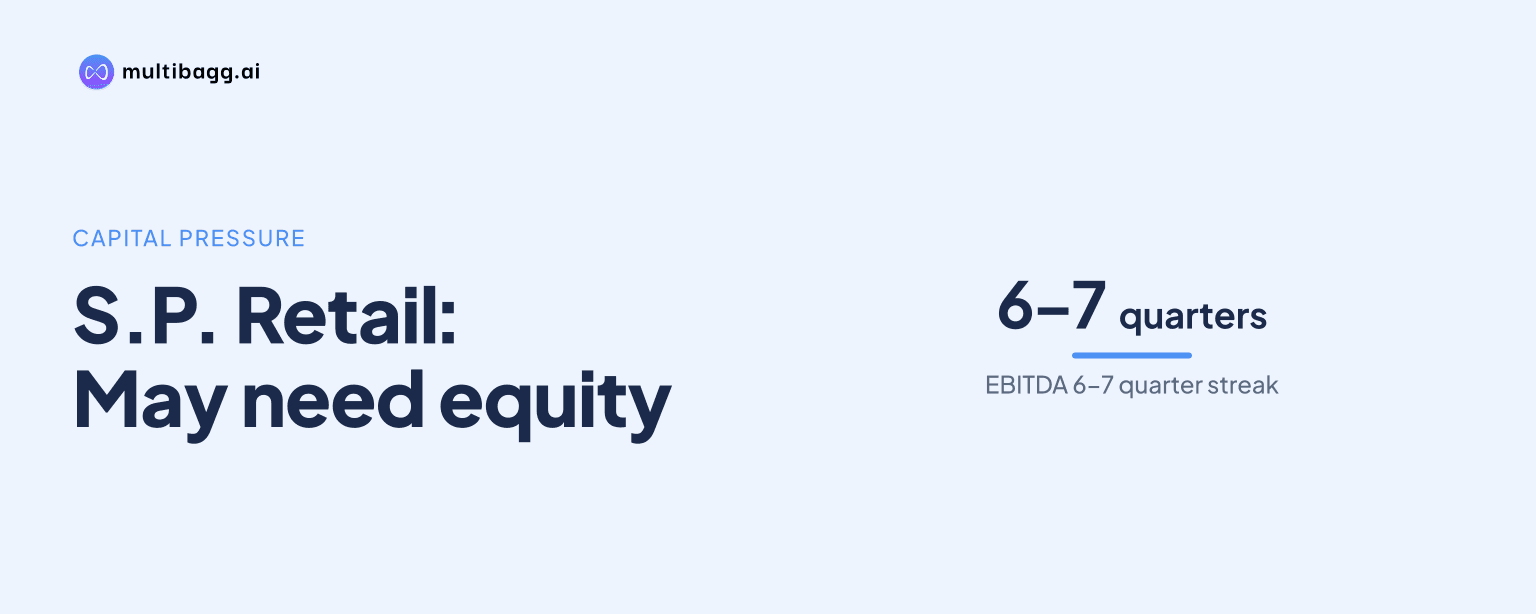
S.P. Retail may convert parent-company secured loans into equity and may require additional funding despite six to seven quarters of EBITDA-positive performance, because management identified higher debt and related finance costs as the remaining constraint on profitability. Management said the conversion could be planned during the current financial year.
Know S P Apparels inside out
Results, valuation, peers and who's buying, in one view.
Why may S.P. Retail need fresh parent equity?
S.P. Retail may need fresh parent equity because its debt has increased, and management said equity could be used to reduce that debt and its finance costs. V. Balaji said the parent company had already supported S.P. Retail through a secured loan and may convert that loan into equity during the current financial year.
Management also said additional equity may be necessary beyond a conversion of existing loans. When asked whether further funds might be required if an external private-equity raise did not proceed, V. Balaji said S.P. Retail’s debt had gone up and that management may have to infuse equity to reduce it. The call did not disclose the amount of parent loans, total retail debt or the prospective size of any infusion.
The funding issue relates to the capital structure rather than the operating-cost definition used for EBITDA, or earnings before interest, taxes, depreciation and amortisation. S. Chenduran said all operating expenses had been considered in S.P. Retail’s EBITDA assessment, with finance costs and depreciation remaining below that measure. He subsequently confirmed that rental costs were included in operating expenses.
Management said raising money from the market would be the preferred outcome, while it was working on that route in parallel with parent support. However, it did not identify a potential investor, valuation, fundraising timetable or amount. S.P. Retail’s disclosed options therefore remain a parent-loan conversion, further parent equity, and a possible external capital raise.
Has S.P. Retail reached operating break-even?
S.P. Retail has been EBITDA-positive for the last six to seven quarters, according to management, against an internal and external milestone of eight quarters to reach break-even or consistently perform better at the EBITDA level. S. Chenduran said management now believed the business had turned the corner operationally.
This marks a change from the period when the unit was still working toward its eight-quarter milestone. Management did not provide quarterly revenue, EBITDA, margin or loss figures for S.P. Retail, so the transcript does not quantify the magnitude of the improvement. It did, however, describe six to seven quarters of positive EBITDA as evidence of consistency rather than a one-quarter recovery.
The call contained two differently framed comments on cash generation. V. Balaji said S.P. Retail was positive on the cash-flow front, while S. Chenduran said it would probably be cash profitable within the next six months. Management did not define either cash-flow measure or reconcile the two statements, but it separately identified debt and finance costs as the factor holding back profitability beyond EBITDA.
S.P. Retail’s EBITDA measure includes rental and other operating costs, according to management’s response to an analyst’s accounting question. That clarification is relevant because the retail operation has physical stores as well as online sales and franchisee outlets. Finance costs and depreciation, rather than rent, were described as the principal items outside EBITDA.
Got a follow-up? Ask IRIS
What is supporting S.P. Retail’s operating performance?
S.P. Retail’s operating performance is being supported by online sales, franchisee stores, and institutional and corporate orders, management said. Since the last financial year, S.P. Retail has exited four stores while moving toward more franchisee stores, and management said online sales made the largest contribution to the strategy change.
Institutional and corporate supply is another channel cited by management. S.P. Retail supplies T-shirts to large corporate customers in the information-technology and pharmaceutical sectors, and management said this business had grown significantly. The call did not disclose revenue, order volumes, gross margin or customer concentration for either the online or corporate channel.
S.P. Retail has almost zero in-house manufacturing, with all production currently outsourced, according to management. It said no retail production came from S.P. Apparels Limited’s factories. This distinguishes the retail operation’s sourcing model from the group’s garmenting business, although the transcript did not provide procurement costs or outsourcing margins.
Management also pointed to improving gross margins, healthy inventory and controlled overheads. It said S.P. Retail’s stores were producing good results and its online business was growing, without attaching figures to these measures. Angel and Rocket, a brand launched in India in the last four years, was also described by management as having performed well.
What milestone will determine S.P. Retail’s funding path?
S.P. Retail’s stated operating milestone is eight quarters of break-even or consistently better EBITDA performance, and management said it has completed six to seven EBITDA-positive quarters. The milestone was described as having been set internally and externally, but management did not identify the external parties involved.
The disclosed milestone does not include a debt-reduction target, finance-cost target, revenue threshold or cash-profit date. That leaves limited visibility on the point at which S.P. Retail could operate and grow without parent funding. Management’s decision to consider converting debt into equity indicates that the six to seven-quarter EBITDA record has not yet removed the balance-sheet issue.
Management said it would be keen to convert debt into equity and infuse more money because it viewed operating performance as consistent. It also said S.P. Retail would continue to grow with parent-company support if needed. The basis given was the performance of stores, online sales, gross margins, inventory and overhead control.
External funding remains an unresolved part of the plan. Management described market fundraising as the best outcome but gave no scheduled event or date for a private-equity process. Until it provides funding amounts and debt details, the relative roles of loan conversion, new parent equity and third-party capital cannot be measured from the call.
Conclusion
S.P. Retail’s reported six to seven quarters of EBITDA-positive performance show that management sees progress in a model built around online sales, franchisee stores, corporate T-shirt supply and outsourced production. Yet the same call makes clear that higher debt and finance costs remain separate constraints, creating a potential need to change parent loans into equity and add funds.
The next development to watch is management’s stated plan to consider converting secured parent loans into equity during the current financial year. Investors will also await clarity on any market fundraising, the amount of debt targeted for reduction, and whether the expected cash-profitability position is reached within the next six months.