










S.P. Apparels targets 1,000 Sri Lanka machines for FY28
Key highlights
- SPAL plans Sri Lanka capacity equivalent to 1,000 additional machines in FY28.
- Management said a new northeast Indian garment factory may need two to three years, and potentially four to five years, to reach reasonable efficiency.
- A 500-machine Sri Lankan factory awaits customer approval expected before the end of March, with shipments planned from April.
- Management expects Sri Lanka revenue to approach Rs 400 crore next year if all four factories operate together.
powered by IRIS
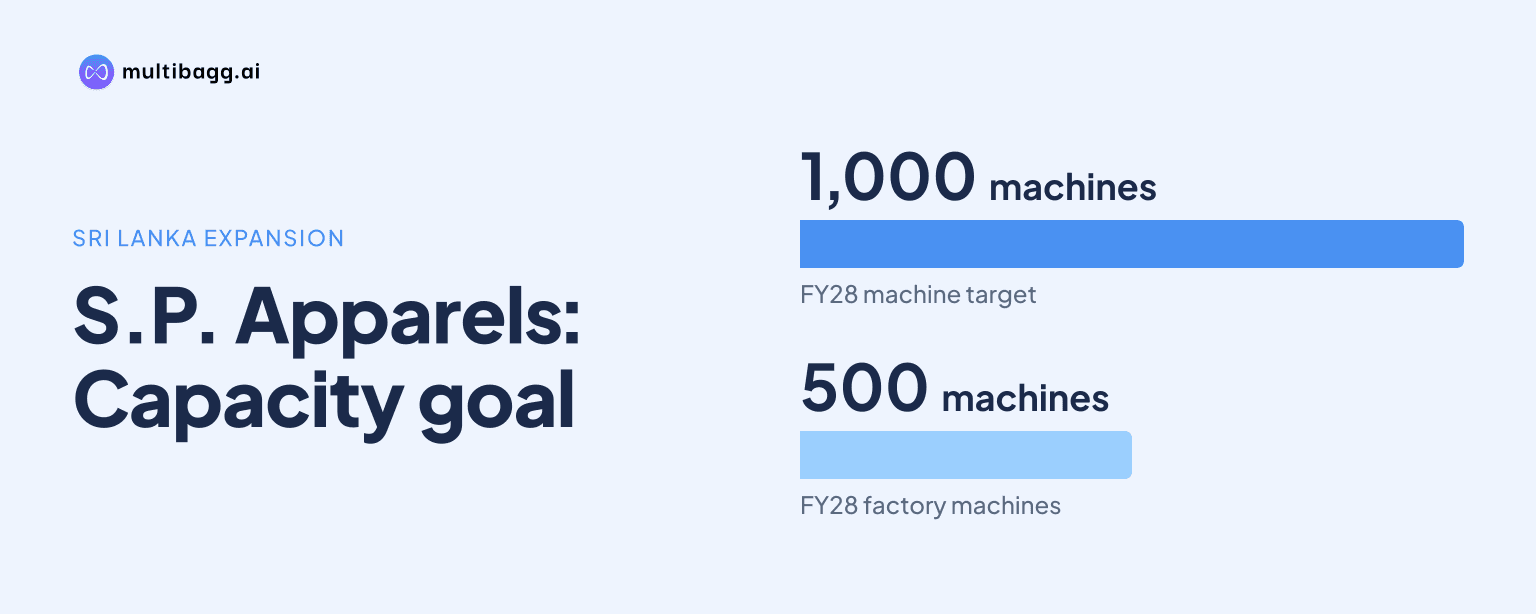
S.P. Apparels plans to add Sri Lanka capacity equivalent to 1,000 machines in FY28 because management says an acquired operating factory can take orders from day one, while a new northeast Indian plant may need two to three years, and potentially four to five years, to reach reasonable efficiency. Management also expects Sri Lanka revenue to approach Rs 400 crore next year.
Know S P Apparels inside out
Results, valuation, peers and who's buying, in one view.
Why is SPAL expanding in Sri Lanka rather than northeast India?
SPAL is prioritising Sri Lanka because management says available factories there have experienced garment workers and can offer faster production ramp-up than a new plant in northeast India. Management said both options are available, but workers in northeast states would need to be recruited, trained and brought to operating efficiency, whereas an acquired Sri Lankan facility already has an experienced workforce.
The time difference is the central part of management's comparison. SPAL said a newly established northeast Indian factory would take at least two to three years to reach reasonable efficiency and may take four to five years. In Sri Lanka, management said production can continue from the day a factory is acquired, allowing orders to be booked immediately rather than waiting for a new workforce to develop.
Customer approval is a further reason cited by management. SPAL said a new factory requires clearance from existing customers, who need at least six months of operating history before approval. An acquired Sri Lankan factory can be offered to customers for approval immediately, although approval is still required. Management also said access to Sri Lanka is easier for SPAL than entering northeast India.
How many machines will SPAL add in Sri Lanka in FY28?
SPAL plans to add two factories or equivalent capacity of 1,000 machines in Sri Lanka in FY28. Management described the proposal as part of continuous growth in the country, separate from machine additions planned at the parent garment business in India and at Young Brand Apparel's Salem facility.
The 500-machine factory is SPAL's second-largest facility in Sri Lanka, according to management. It is operational and currently undertaking job work to keep the site running while customer approval from one of SPAL's largest customers is under process. Management expects that process to finish before the end of March, enabling order shipments from April.
SPAL said the 500-machine site would operate alongside three other Sri Lankan factories, indicating a four-factory network. Management also said Sri Lanka's capacity, operations and overall setup should settle over the next two to three months. The planned 1,000-machine addition would therefore follow the stabilisation of the existing network rather than replace the ramp-up required at the 500-machine site.
Got a follow-up? Ask IRIS
Can SPAL's Sri Lanka business approach Rs 400 crore next year?
SPAL could approach Rs 400 crore of Sri Lanka revenue next year if the 500-machine factory runs alongside the other three facilities, management said. This is a management outlook conditional on customer approval and the start of shipments from April, not reported revenue or a guaranteed result.
Management said the 500 machines at the pending-approval site would make a substantial contribution to revenue after customer orders begin. Revenue from US customers started only after August following tariff-related disruption, and management said SPAL's standalone business had lower activity in the first and second quarters because of that issue. The Sri Lanka forecast therefore depends on a different operational milestone: the customer approval and conversion from job work to shipments.
The comparison with a new Indian factory explains the preference for acquisitions, in management's view. A Sri Lankan operating site can avoid the earlier stages of recruiting, training and building productivity, while a new facility also needs a six-month operating record for customer approval. The call did not disclose acquisition cost, capital expenditure, output per machine or the revenue contribution expected from each planned new machine.
How does Sri Lanka fit into SPAL's wider garment plan?
Sri Lanka is part of SPAL management's guidance for 10% to 15% growth in the next financial year and an average 15% earnings before interest, tax, depreciation and amortisation, or EBITDA, margin for the Garment division. Management linked this outlook to Sri Lanka settling operationally, US tariff conditions stabilising, Indian factories gradually filling and growth at Young Brand Apparel.
The parent garment business has separate Indian capacity plans. Management said it would add 700 machines from the first quarter of the next year using its existing factory, while regaining 1,000 machines from April after they were reduced following US tariff disruption. In contrast, the Sri Lanka proposal is for 1,000 additional machines through two factories or equivalent capacity, making it an expansion rather than a recovery of withdrawn capacity.
Young Brand Apparel has three facilities and offers another comparison within the group. Management guided for at least 20% growth, with expansion at Salem and growth also expected from Tirupur because utilisation improvements at the main facility near Chennai are more difficult. Its machine base was about 1,100 at the time of the call, with management expecting about 1,300 machines by year-end.
Management did not rule out one Young Brand Apparel factory in Sri Lanka because customers have asked for another setup there to mitigate country risk. That possibility remains separate from the 1,000-machine FY28 plan discussed for SPAL's Sri Lanka business. It also shows that customer location preferences, as well as factory readiness and workforce experience, are part of management's stated expansion rationale.
Conclusion
SPAL's Sri Lanka strategy rests on management's view that acquired operating factories offer a quicker route to productive capacity than new northeast Indian plants. The company is seeking to stabilise a four-factory network, convert a 500-machine unit from job work to customer shipments, and then add capacity equivalent to 1,000 machines in FY28, while targeting Sri Lanka revenue close to Rs 400 crore next year.
The next disclosed milestone is customer approval for the 500-machine factory before the end of March, followed by planned shipments from April. Management has also said the Sri Lanka setup should settle within two to three months, while its next-financial-year guidance calls for 10% to 15% growth and an average 15% Garment division EBITDA margin.