










SPUK Targets Rs 500 Crore Revenue in Three to Five Years
Key highlights
- SPUK plans to reach Rs 500 crore in revenue within three to five years.
- Management said SPUK had about 5-6 customers and added 3 more customers.
- Management expects SPUK could grow by 50% to 100% over the next 2-3 years.
- The call did not disclose SPUK revenue, EBITDA, a Q3 breakeven target or a steady-state margin.
powered by IRIS
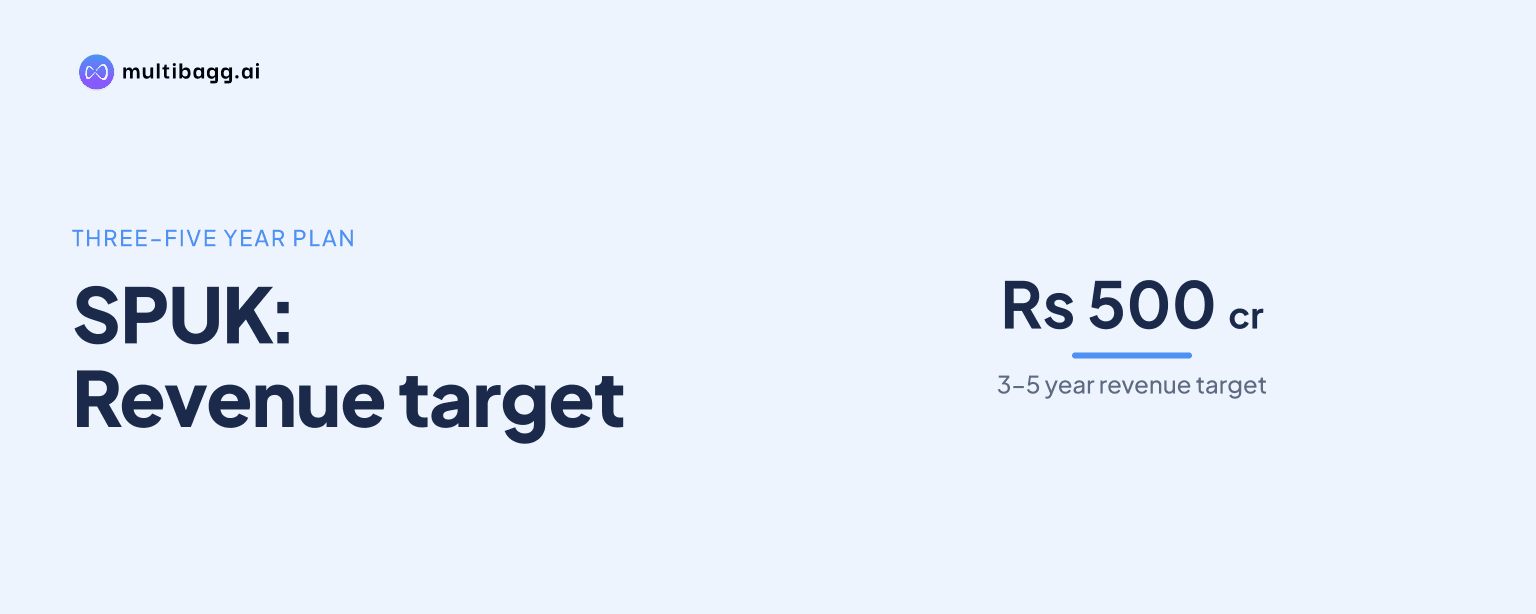
SPUK plans to reach Rs 500 crore in revenue within three to five years, management said, after adding three customers to an existing base of about five to six customers. Management also expects 50% to 100% growth over the next two to three years, but did not disclose SPUK revenue, EBITDA or a Q3 breakeven target.
Know S P Apparels inside out
Results, valuation, peers and who's buying, in one view.
What revenue target has SPUK set?
SPUK has set a plan to reach Rs 500 crore of revenue in three to five years. Management stated this objective when asked whether the trading business could eventually reach Rs 1,000 crore over five to 10 years, but it did not endorse the larger figure or provide annual revenue milestones toward Rs 500 crore.
Management separately said SPUK could deliver 50% to 100% growth over the next two to three years, including the possibility of doubling. These are forward-looking management expectations rather than reported results, and the supplied call extract does not disclose the business's current quarterly or annual revenue base.
The two timeframes describe different milestones. The 50% to 100% expectation applies over the next two to three years, while the Rs 500 crore plan extends over three to five years. Without a disclosed starting revenue figure, the call does not permit a calculation of the revenue increase required in each year.
How does SPUK plan to grow revenue?
SPUK plans to grow through customer additions and fuller product-development, design and order-execution services for large retailers. Management said major customers, including Marks and Spencer, are seeking full-service support covering product development, design collections and execution of orders.
Management said SPUK had worked with two to three customers for the past two to three years before adding three more customers. It said these customers were satisfied with its product development, range and design support, but did not disclose order values, contract terms, conversion dates or expected revenue from Marks and Spencer or the other additions.
The customer base remains relatively concentrated based on the disclosed figures. Management referred to about five to six customers before the three additions and said their volumes were large, but it did not identify the revenue share of any customer or quantify the business that could be generated by the newer relationships.
Management described the opportunity as scalable because SPUK's current numbers are “not big,” leaving room for larger percentage increases. That assessment is a management view, not a reported performance measure, because the call gave no historical revenue series for SPUK and no comparison with its previous two-to-three-year sales growth.
Is SPUK targeting EBITDA breakeven in Q3?
The supplied call extract does not state that SPUK is targeting EBITDA breakeven in Q3. Management said SPUK's EBITDA margins should become better as revenue grows and fixed expenses are diluted, but it gave no quarter, breakeven revenue threshold or numerical margin target.
The Q3 comments elsewhere in the call concerned the wider garment business rather than SPUK. Management said garment operations were picking up from Q3 and Q4 would be better, while it also discussed regaining 1,000 machines from April and adding 700 machines from the next financial year's first quarter. Neither statement was an SPUK profitability forecast.
Management also did not disclose SPUK's current EBITDA, operating loss, fixed-cost base, finance cost or cash flow. The transcript therefore supports a directional expectation of margin improvement from higher revenue, but it does not support a conclusion on when SPUK may become EBITDA-positive.
Got a follow-up? Ask IRIS
Why could scale change SPUK's margins?
Management's stated margin mechanism is fixed-cost dilution: as SPUK's trading revenue rises over the next two to three years, it expects fixed expenses to be spread across a larger sales base. Management linked this operating leverage to its 50% to 100% growth expectation and said EBITDA margins would naturally improve.
The expected margin progression depends on SPUK delivering the services sought by retailers, including product development, design collections and order execution. The call did not say whether SPUK earns commissions, holds inventory, bears foreign-exchange exposure or uses a specific sourcing-pricing structure, so its gross-margin mechanics cannot be determined from this exchange.
No steady-state EBITDA margin was provided for SPUK. Management's response to a question about the business's long-term margin focused on growth and fixed-cost absorption, unlike its separate indication that the wider garmenting business could achieve an average 15% EBITDA margin in the next financial year as Sri Lanka scales.
Are SPUK customers linked to the parent company's factories?
SPUK is a separate business entity with its own customers, and management said the three newly added customers would support SPUK only. It distinguished SPUK from the parent company's customers and from Young Brand's customers, indicating that customer ownership is separate across the three businesses.
That separation means SPUK's Rs 500 crore plan should not be treated as a direct factory-order target for the parent company. Management did not say that SPUK's customer additions would provide manufacturing revenue to the Indian parent, and it explicitly said SPUK has nothing to do with the parent company in this customer-business context.
Other group expansion plans are separate from SPUK's trading target. Management said Sri Lanka could approach Rs 400 crore in the next year if customer approval for a factory is completed before the end of March and shipments start from April, with about 500 machines at that factory expected to add to revenue. It did not state that this manufacturing plan overlaps with SPUK revenue.
Conclusion
SPUK's disclosed plan is to build a larger trading operation through three new customer relationships, fuller services for retailers and higher revenue that could dilute fixed expenses. The clearest target is Rs 500 crore within three to five years, while management's 50% to 100% growth expectation over two to three years provides its nearer-term ambition. No Q3 EBITDA breakeven target or steady-state margin was disclosed.
The next point to watch is evidence that the added customers convert into reported sales and margin progression. Management identified Marks and Spencer among the newer relationships and said it expects growth over the next two to three years, but it has not disclosed SPUK revenue, customer-level order values, EBITDA or annual milestones toward the Rs 500 crore goal.