










S.P. Apparels Limited Q2 Revenue Rises 5.8% to ₹452.2 Crore
Key highlights
- S.P. Apparels reported Q2 FY27 consolidated revenue of ₹452.2 crore, up 5.8% year-on-year and 12.8% quarter-on-quarter.
- Q2 FY27 profit after tax rose 6.8% year-on-year to ₹37.1 crore, while EBITDA increased 4.7% to ₹66.7 crore.
- H1 FY27 revenue grew 2.7% to ₹853 crore, while profit after tax increased 11.9% to ₹61.9 crore.
- H1 FY27 EBITDA margin improved to 15.0% from 14.0% in the corresponding previous-year period.
powered by IRIS
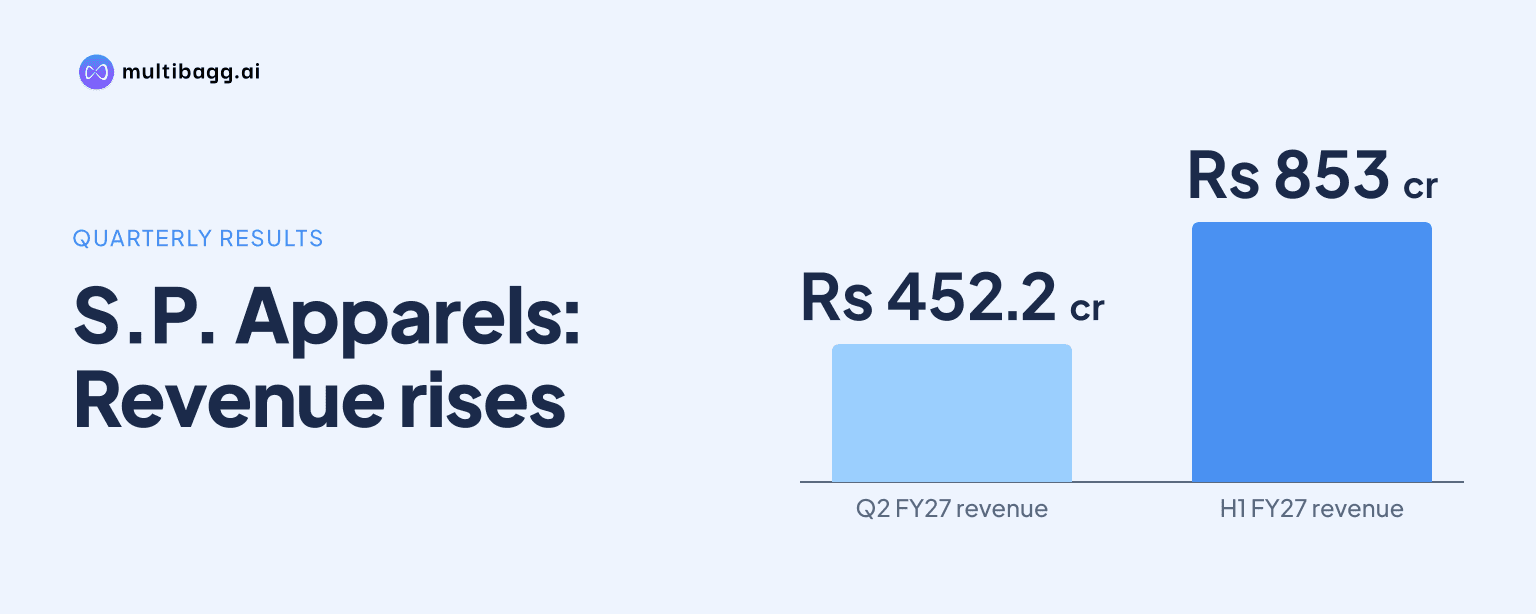
S.P. Apparels Limited reported consolidated revenue of ₹452.2 crore for Q2 FY27, up 5.8% year-on-year and 12.8% sequentially, as customer ordering patterns improved after U.S. tariff-related uncertainty affected the first quarter. Quarterly profit after tax rose 6.8% to ₹37.1 crore.
Know S P Apparels inside out
Results, valuation, peers and who's buying, in one view.
What did S.P. Apparels report for Q2 FY27?
S.P. Apparels reported consolidated revenue from operations of ₹452.2 crore in Q2 FY27, compared with ₹427.3 crore in Q2 FY26. Revenue was also higher than the ₹401 crore recorded in Q1 FY27, marking sequential growth of 12.8%. The company said the improvement reflected a gradual normalisation in customer ordering patterns.
Profitability grew at a slower rate than revenue during the quarter. EBITDA rose 4.7% year-on-year to ₹66.7 crore, while the EBITDA margin was 14.7%, compared with 14.9% a year earlier. Profit after tax increased 6.8% to ₹37.1 crore, and quarterly earnings per share rose to ₹14.7 from ₹13.8 in Q2 FY26.
Why did revenue improve from the first quarter?
Revenue improved from Q1 FY27 because customer ordering activity began to recover in the second quarter, according to management. The company said some American customers had deferred order placements during the first quarter due to uncertainty around U.S. tariffs. That disruption affected the pace of revenue growth at the start of the financial year.
Management described the Q2 recovery as gradual rather than complete. The sequential increase of ₹51.2 crore in revenue over Q1 gave the company a stronger base entering the second half of FY27. The call was hosted by DAM Capital Advisors Limited on November 16, 2026, and included senior management led by Chairman and Managing Director P. Sundararajan.
The company did not provide a detailed split of the deferred orders, customer contracts, or the precise impact of tariff uncertainty on individual business units in the supplied material. Its stated explanation focused on broad ordering behaviour among U.S. customers and the subsequent recovery in Q2.
How did S.P. Apparels perform in the first half of FY27?
S.P. Apparels recorded consolidated revenue of ₹853 crore in H1 FY27, an increase of 2.7% year-on-year. The first-half revenue trend shows that the stronger second quarter partly offset the slower start to the year, but the six-month growth rate remained below the Q2 rate.
First-half EBITDA increased 9.8% to ₹128 crore and the EBITDA margin improved to 15.0% from 14.0% in H1 FY26. Profit before tax rose 9.3% to ₹87.3 crore. Profit after tax increased 11.9% to ₹61.9 crore, while the PAT margin improved to 7.3% from 6.7% a year earlier.
Earnings per share for H1 FY27 stood at ₹24.7, compared with ₹22.1 in the corresponding prior-year period. The gap between revenue growth and profit growth indicates that S.P. Apparels delivered higher operating and net profitability over the half year despite modest top-line expansion.
Got a follow-up? Ask IRIS
What does the quarter mean for investors and operations?
For investors, the key operational point is the return of sequential revenue growth after the first-quarter disruption in U.S. customer orders. Q2 revenue growth of 12.8% quarter-on-quarter provides evidence that order flows improved, although the 2.7% H1 revenue growth also shows the impact of the earlier deferrals on the overall first-half result.
The margin data requires attention as well. Q2 EBITDA margin was 14.7%, slightly below the 14.9% recorded a year earlier, while the H1 EBITDA margin increased by 100 basis points to 15.0%. This means the half-year profitability outcome was stronger than the quarterly margin comparison alone suggests.
Management indicated that it expected to achieve about 95% of its FY27 revenue guidance. It also identified the ramp-up in Sri Lanka as an important element of its plans. The supplied material does not state the numerical revenue guidance, the expected contribution from Sri Lanka, or a timetable for the ramp-up.
Why do U.S. orders and the Sri Lanka ramp matter?
U.S. customer demand matters because management specifically linked first-quarter order deferrals to uncertainty around U.S. tariffs. For an apparel exporter, delayed purchase decisions can shift production schedules and revenue recognition between quarters. The Q2 recovery therefore matters primarily as an indication that some customer ordering patterns had normalised.
The Sri Lanka ramp is relevant to S.P. Apparels' future operating capacity and growth plan, based on management's comments. However, the company did not disclose production volumes, investment amounts, customer allocations, or expected financial contribution in the supplied earnings-call information. Investors will need further disclosures to assess the scale and timing of the initiative.
The company also reported that Young Brand Apparel generated Q2 adjusted operational revenue of ₹109.1 crore, compared with ₹84.3 crore a year earlier, an increase of 29.4%. Its adjusted EBITDA was ₹18.1 crore versus ₹12.2 crore. The adjusted measures include realised foreign exchange and exclude unrealised mark-to-market items, as specified in the supplied presentation summary.
Conclusion
S.P. Apparels delivered a better Q2 FY27 after a tariff-related slowdown in U.S. customer order placements affected the first quarter. Revenue rose 5.8% year-on-year to ₹452.2 crore, while Q2 profit after tax increased 6.8% to ₹37.1 crore. For H1 FY27, profit grew faster than revenue and margins improved, supporting the company’s emphasis on profitability alongside a recovery in sales momentum.
The next points to watch are management's progress towards about 95% of its FY27 revenue guidance, the continuation of customer order normalisation, and disclosures on the Sri Lanka ramp. The supplied call material does not provide the guidance amount or a detailed timeline for the Sri Lanka operation, leaving those as unresolved factors for subsequent updates.