










Star Imaging shifts growth focus to B2B and B2C channels
Key highlights
- B2G contributed 52% of Star Imaging revenue, while B2B and B2C together accounted for 48%.
- Star Imaging said B2C payments are upfront and B2B payment terms are 30 to 40 days.
- Management agreed with approximately Rs 60 crore to Rs 65 crore of second-half revenue after about Rs 49 crore in the first half.
- The Dwarka facility and an allotted public-private partnership project carried cumulative capital commitment of Rs 30 crore.
powered by IRIS
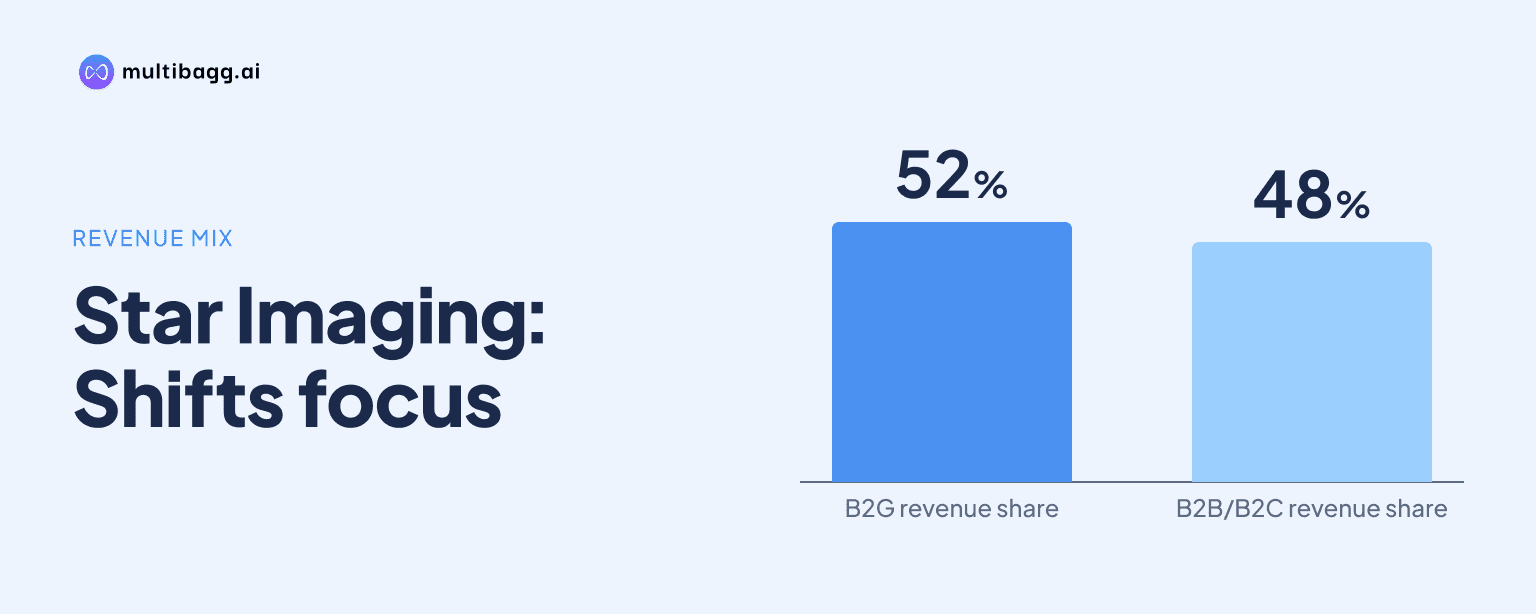
Star Imaging is shifting its growth emphasis to business-to-business (B2B) and business-to-consumer (B2C) diagnostics, which together accounted for 48% of revenue, while business-to-government (B2G) supplied 52%, because B2C payments are upfront and B2B payments take 30 to 40 days, compared with government receivables that management said normally take six months.
Know Star Imaging and Path Lab inside out
Results, valuation, peers and who's buying, in one view.
Why is Star Imaging prioritising B2B and B2C?
Star Imaging is prioritising B2B and B2C because management cannot control the release of government tenders, whereas it can expand private partnerships and consumer diagnostic centres. Management said B2G contributes 52% of revenue, leaving B2B and B2C at a combined 48%, and described B2B and B2C as the primary focus because tenders emerge only when governments issue them and Star Imaging then chooses whether to bid.
The reported growth comparison also favours the private-facing channels. B2B revenue had grown 20% and B2C revenue 21%, according to an analyst's question that management confirmed. Management did not provide separate revenue amounts for the two channels or a fixed medium-term split, but said the combined B2B and B2C revenue mix would remain around 50% to 60%.
How does Star Imaging's payment cycle differ by channel?
Star Imaging receives B2C payments upfront, gives B2B private hospitals and institutions 30 to 40 days to pay, and said government receivables generally follow a six-month realisation process. This distinction is central to management's cash-conversion explanation: it said cash is chiefly tied up in government receivables rather than in the B2C business or the shorter-cycle B2B arrangements.
Management told an analyst that it expected receivables by the end of the second half to be at a similar percentage level to the prior year. It characterised six months as the regular standard time for government receipt realisations, rather than setting out a revised collection target. The strategy therefore retains B2G exposure, which was 52% of revenue, while placing emphasis on channels with immediate payment or a 30-to-40-day credit period.
What will drive Star Imaging's second-half revenue?
Star Imaging said B2B and B2C would provide more of the contribution to approximately Rs 60 crore to Rs 65 crore of second-half revenue, with the Dwarka facility expected to add to B2C once operational. The company had reported about Rs 49 crore of revenue in the first half, and management agreed that Rs 60 crore to Rs 65 crore was an approximate second-half outcome in response to an analyst's calculation based on its stated 20% to 25% growth ambition.
Dwarka is a significant component of that plan. Management said the Dwarka facility and an undisclosed allotted public-private partnership project were expected to be operational by the end of the following month, with cumulative capital commitment of Rs 30 crore for the two projects. An analyst referred to Rs 5 crore to Rs 6 crore of initial-year revenue for Dwarka; management said the centre should reach breakeven within its first year and optimal performance after two years.
Got a follow-up? Ask IRIS
How is Star Imaging adding private capacity and partnerships?
Star Imaging had 26 diagnostic centres after adding two in the first half through tie-ups with R G Stone hospitals, where it installed computed tomography, or CT, machines. Management said the two centres were performing well, and it plans two additional B2C centres after Dwarka. The network expansion is also intended to support more B2B partnerships, for which management expects the same kind of growth in coming years without quantifying a revenue-share target.
The company identified further operating leverage in existing facilities as well as expansion. Management said its pathology business has substantial capacity leverage, is being expanded through B2B partnerships, and is increasing genome-testing capacity in its laboratory. In radiology, Star Imaging is installing another magnetic resonance imaging, or MRI, machine at Tilak Nagar and said its other centres have about 30% capacity available for utilisation.
How will Star Imaging approach government tenders?
Star Imaging will continue to evaluate B2G opportunities across India but says it will bid only where the economics are feasible and viable. Management said it has a couple of B2G projects in the pipeline where tenders have been released, while another allotted public-private partnership project has not been publicly detailed because its memorandum of understanding, or MoU, had not yet been signed.
Management also described its bidding discipline in a tender system determined by the lowest bidder, or L1. It said Star Imaging studies a project before bidding and does not participate in aggressive bids, citing 48% and 52% as examples of pricing levels offered by other bidders. This leaves the timing and volume of future B2G awards dependent on tender releases and Star Imaging's feasibility assessment.
Conclusion
Star Imaging is seeking to place more incremental growth in B2B and B2C while B2G remains its largest channel at 52% of revenue. The reported 20% B2B growth and 21% B2C growth, combined with upfront B2C receipts and 30-to-40-day B2B payment terms, explain management's preference for those channels over business tied to government tender availability and six-month collections.
The next items to watch are the planned operational start of Dwarka and the allotted public-private partnership project by the end of the following month, as stated by management. Management also agreed with approximately Rs 60 crore to Rs 65 crore of second-half revenue, plans two further B2C centres after Dwarka, and has additional B2G tenders under evaluation, while offering no fixed target for the B2B-B2C split.