










Star Imaging receivables reach Rs 64 crore, draining cash
Key highlights
- Star Imaging's trade receivables rose to approximately Rs 64 crore at September 2026 from Rs 49.9 crore at FY26-end.
- Star Imaging recorded negative operating cash flow of Rs 6.2 crore in H1 FY27 after a Rs 17.5 crore working-capital outflow.
- Approximately Rs 15 crore of receivables related to legacy Covid-period government transactions, while Rs 15 crore to Rs 16 crore was overdue by more than six months.
- Star Imaging received approximately Rs 7 crore against outstanding receivables in the first week of Diwali.
powered by IRIS
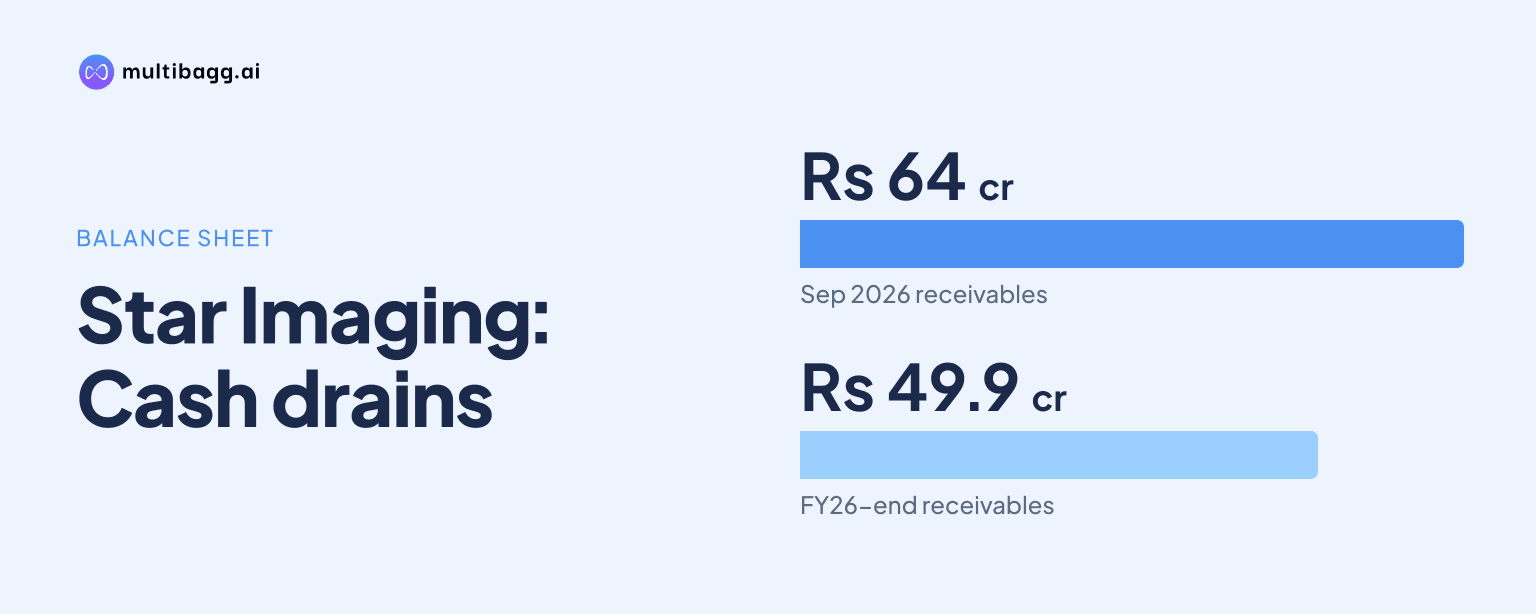
Star Imaging and Path Lab Limited reported approximately Rs 64 crore of trade receivables at September 2026 and negative operating cash flow of Rs 6.2 crore in H1 FY27, as a Rs 17.5 crore working-capital outflow outweighed cash generation despite Rs 48.9 crore of revenue from operations.
Know Star Imaging and Path Lab inside out
Results, valuation, peers and who's buying, in one view.
Why did Star Imaging report negative operating cash flow in H1 FY27?
Star Imaging reported negative operating cash flow of Rs 6.2 crore in H1 FY27 because working capital created an outflow of approximately Rs 17.5 crore. Trade receivables increased to approximately Rs 64 crore at September 2026 from Rs 49.9 crore at the end of FY26, while revenue from operations rose 8% year on year to Rs 48.9 crore from Rs 45.2 crore.
Management said the receivable increase was primarily associated with business-to-government collections and subcontracted tenders, rather than only H1 FY27 sales. In Uttar Pradesh, Star Imaging operates both directly awarded government contracts and subcontracted arrangements, under which it completes work and bills an intermediary contractor before that contractor raises a corresponding bill to the government.
Under this subcontracted structure, Star Imaging receives payment after the government pays the intermediary contractor. Management said that added step can extend collections after contracted work is completed, because payment depends on both the government department and the contractor. The company identified acceleration of regular-business collections as an immediate FY27 priority.
How much of Star Imaging's receivables is overdue?
Star Imaging said approximately Rs 15 crore of its September 2026 receivables related to legacy Covid-period transactions with the Delhi and Union Territory government. Management said these dues had been pending for an extended period and that it was pursuing recovery through the concerned department, a liaison officer and legal representatives.
Following a change in government, Star Imaging was required to resubmit historical transaction records, previous payment details and supporting documentation for the Rs 15 crore Covid-period balance. Management said the information had been submitted and it was awaiting confirmation from the relevant authorities on payment release. That balance represented about one-quarter of the approximately Rs 64 crore receivables disclosed at September 2026.
In response to an analyst's question, management said a further Rs 15 crore to Rs 16 crore was pending for more than six months, apart from the Rs 15 crore of Covid-period dues. Management also referred to some subcontracted receivables from the previous financial year that had been pending for four to five months, but did not provide a complete receivables-ageing schedule.
Star Imaging said it received approximately Rs 7 crore against outstanding receivables in the first week of Diwali. Management expected greater clarity on regular receivables by the end of December, while continuing follow-ups with government departments and contractual counterparties. The receipt followed the September 2026 reporting date and did not change the approximately Rs 64 crore balance reported for that date.
Got a follow-up? Ask IRIS
How did Star Imaging's profit compare with its cash flow?
Star Imaging remained profitable in H1 FY27, but reported profit and operating cash flow moved in different directions. Earnings before interest, tax, depreciation and amortisation, or EBITDA, declined to Rs 14.1 crore from Rs 17.3 crore in H1 FY26, while profit after tax, or PAT, fell to Rs 7.8 crore from Rs 10 crore and operating cash flow was negative Rs 6.2 crore.
Management attributed the EBITDA-margin decline of 9.3 percentage points to upfront expenditure on human capital, advertising and marketing, alongside minor upgrades and maintenance at diagnostic machines. It also cited a revenue-mix change in H1 FY27, with Uttar Pradesh contributing a slightly lower share and Delhi accounting for a higher share, affecting blended margins.
Business-to-consumer, or B2C, revenue grew 21% and business-to-business, or B2B, revenue increased 20% in H1 FY27, while business-to-government, or B2G, revenue was broadly stable. B2C and B2B together made up approximately 48% of Rs 48.9 crore of H1 FY27 revenue. Finance cost declined 74% to Rs 0.33 crore from Rs 1.3 crore after Star Imaging repaid two loans during the period.
What is Star Imaging's plan to improve cash generation?
Star Imaging is working toward cash-flow neutrality by the end of FY27 by improving regular-business collections and utilisation at existing facilities, according to management. The target is a management objective, not a reported result, and management said cash realisation from services already delivered would be a central priority in the second half of FY27.
The company planned Rs 20 crore to Rs 25 crore of capital expenditure in FY27, primarily for diagnostic equipment and centre development. Its planned Dwarka Diagnostic Center will include computed tomography, or CT, magnetic resonance imaging, or MRI, ultrasound and X-ray services. Management targeted commissioning by the end of November, subject to approval under the Pre-Conception and Pre-Natal Diagnostic Techniques Act, or PCPNDT.
Management said the Dwarka centre could generate annual revenue of approximately Rs 5 crore to Rs 6 crore in its initial year. Star Imaging also added approximately 40 to 45 hospitals to its B2B empanelment network, taking hospital tie-ups to more than 150, as it seeks to increase business from its existing diagnostic network.
Three public-private partnership, or PPP, projects involving CT, MRI, ultrasound and X-ray services were in the pipeline, with site preparation and machine orders completed but memorandum of understanding signings pending. Management also cited a CT facility in Faridabad through its RG Stone collaboration, expanding MRI capacity at Tilaknagar and laboratory infrastructure for genome sequencing as projects under development.
Conclusion
Star Imaging's H1 FY27 results show that revenue growth of 8% to Rs 48.9 crore and PAT of Rs 7.8 crore did not translate into positive operating cash flow. Receivables rose to approximately Rs 64 crore, while the Rs 17.5 crore working-capital outflow resulted in negative Rs 6.2 crore of operating cash flow. The disclosed overdue exposure included Rs 15 crore of legacy Covid-period government dues and a further Rs 15 crore to Rs 16 crore pending for more than six months.
The next developments are management's expected clarity on regular receivables by the end of December, progress after the approximately Rs 7 crore collection during Diwali, and whether the Dwarka centre is commissioned by the end of November after PCPNDT approval. Management's cash-flow-neutrality target by the end of FY27 also depends on faster collections, higher centre utilisation and conversion of the three pending PPP projects into operating facilities.