










Star Imaging H1 FY27 Margin Falls as Receivables Reach ₹64 Crore
Key highlights
- Star Imaging reported H1 FY27 revenue of ₹48.9 crore, up 8.2% year on year.
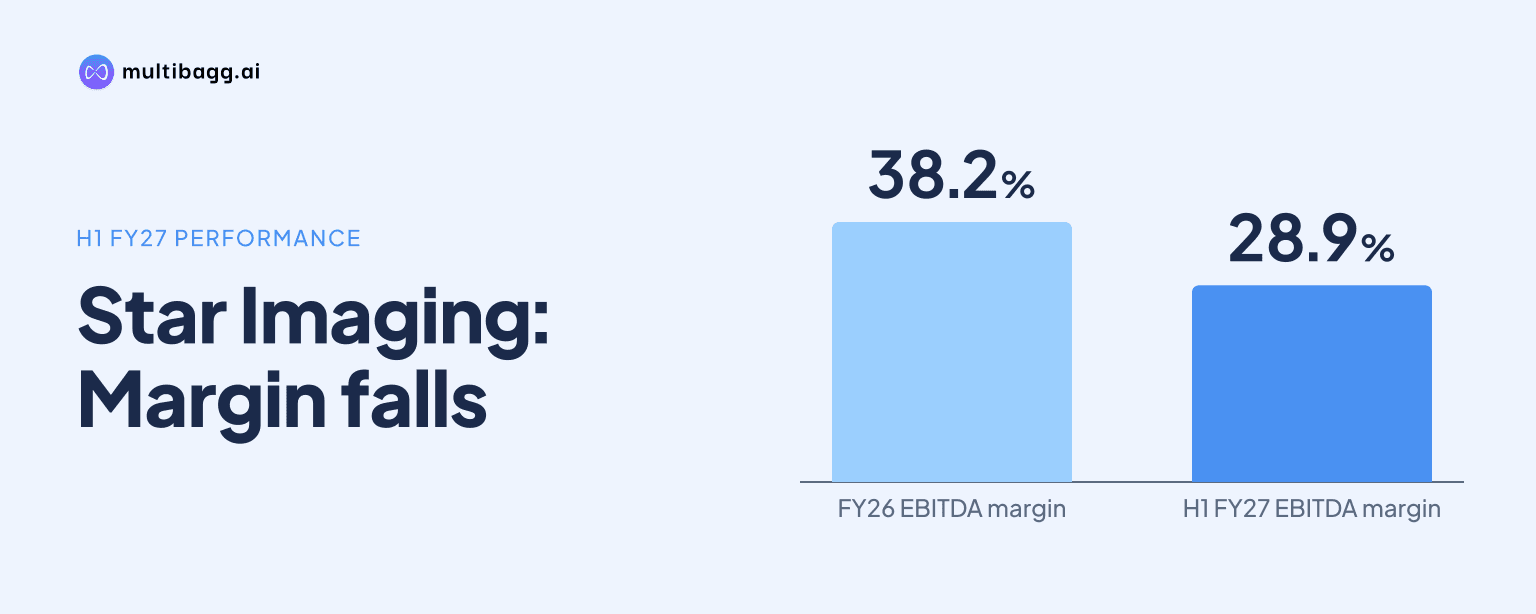
- EBITDA fell 18% to ₹14.1 crore and the margin declined to 28.9% from 38.2%.
- Receivables increased to about ₹64 crore from ₹49.9 crore at FY26-end.
- H1 FY27 operating cash flow was negative ₹6.2 crore, while planned FY27 capital expenditure is ₹20 crore to ₹25 crore.
powered by IRIS
Star Imaging and Path Lab Ltd reported H1 FY27 revenue of ₹48.9 crore, up 8.2% year on year, but its EBITDA margin declined to 28.9% and receivables rose to ₹64 crore. The results place profitability and cash conversion at the centre of investor attention despite management's stated growth plans.
Know Star Imaging and Path Lab inside out
Results, valuation, peers and who's buying, in one view.
What did Star Imaging report for H1 FY27?
Star Imaging reported revenue from operations of ₹48.9 crore for the half year ended 30 September 2026, compared with ₹45.2 crore in H1 FY26. Revenue growth was supported by the business-to-business and business-to-consumer segments, while radiology and pathology both contributed to the company's operations.
Radiology revenue stood at ₹39.7 crore, up 6% year on year, while pathology revenue was ₹7.6 crore, up 17%. The company said hospital tie-ups and improved centre utilisation supported revenue. However, the overall 8.2% increase in revenue was more modest than management's longer-term ambition of 20% to 25% annual revenue growth.
Profitability weakened during the period. EBITDA declined 18% year on year to ₹14.1 crore, and the EBITDA margin fell from 38.2% in the prior-year period to 28.9%. Profit after tax declined 22.8% to ₹7.8 crore.
Why did Star Imaging's EBITDA margin decline?
Star Imaging attributed the margin decline to investment, maintenance and business mix, and management said it aims to operate within a 30% to 35% EBITDA margin range. This range is below the 37.5% FY26 margin that management had earlier described as sustainable.
The lower margin came even as revenue expanded, indicating that costs increased faster than sales during H1 FY27. The available call summary does not provide a numerical breakup of maintenance, investment or mix-related costs. It does show that management views utilisation of operating facilities and conversion of projects into active centres as priorities.
The margin change matters because diagnostic businesses depend on a combination of test volumes, pricing, fixed facility costs and network utilisation. Higher utilisation can support operating leverage, while investment in new facilities and maintenance can pressure near-term profitability. Star Imaging did not provide FY28 revenue figures on the call.
How did receivables and cash flow change in H1 FY27?
Star Imaging's receivables rose to about ₹64 crore from ₹49.9 crore at the end of FY26, an increase of roughly ₹14.1 crore. Management identified collections and improvement in the cash conversion cycle as an immediate priority.
About ₹15 crore of receivables relates to legacy government dues from the COVID-era period and has been outstanding for more than six months. The company described government tender opportunities as pending, leaving the timing and scale of business-to-government revenue uncertain.
Operating cash flow was negative ₹6.2 crore in H1 FY27. The combination of higher receivables and negative operating cash flow is material because accounting revenue does not immediately translate into cash available for expansion, capital expenditure or other operating needs.
Got a follow-up? Ask IRIS
What is management's growth and investment plan?
Star Imaging has outlined a 20% to 25% annual revenue growth ambition and plans FY27 capital expenditure of ₹20 crore to ₹25 crore. Its stated focus includes network expansion, project execution and raising utilisation at facilities.
Management also said it aims to remain debt-free. That objective places importance on internal cash generation, particularly while the company is investing in its network and managing elevated receivables. The call summary did not disclose the funding mix for the planned capital expenditure.
The company indicated that B2B and B2C segments are key areas of focus. Government tenders remain pending, and management did not present a firm revenue expectation from B2G business. This makes commercial execution in existing and expanding private-sector channels relevant to the stated growth ambition.
What does the earnings call mean for investors and operations?
Star Imaging's H1 FY27 results show that revenue growth has continued, but earnings and cash flow have not kept pace. The decline in EBITDA and profit, together with the rise in receivables, means investors will likely track collections, operating cash flow and margin movement alongside revenue growth.
For operations, management has identified the conversion of projects into functioning facilities, better centre utilisation and faster collections as the main areas requiring attention. The reported pathology growth of 17% was faster than radiology's 6% growth, although radiology remained the substantially larger revenue contributor at ₹39.7 crore.
The earnings call was held on 18 November 2026 at 3:00 PM IST and lasted 31 minutes. Star Imaging subsequently made the audio recording available to investors through its disclosed channels.
Conclusion
Star Imaging delivered higher H1 FY27 revenue of ₹48.9 crore, but profitability and cash conversion weakened as EBITDA margin fell to 28.9%, profit after tax declined to ₹7.8 crore and operating cash flow turned negative ₹6.2 crore. The rise in receivables to ₹64 crore is a central financial issue alongside the lower margin.
Investors will watch whether Star Imaging improves regular-business collections, resolves legacy government dues, lifts facility utilisation and keeps FY27 capital spending within the stated ₹20 crore to ₹25 crore plan. Management's 30% to 35% margin target and 20% to 25% annual growth ambition provide the disclosed benchmarks for future updates.