










Star Imaging targets 20–25% growth with Rs 20–25 crore capex
Key highlights
- Star Imaging plans Rs 20–25 crore of FY27 capital expenditure to support management’s 20–25% annual revenue-growth ambition.
- The proposed Dwarka centre is expected by management to generate Rs 5–6 crore annually in its initial years.
- Three public-private partnership projects have completed site preparation and machine orders, while memorandum-of-understanding signing remains pending.
- Radiology generated Rs 39.7 crore in H1 FY27, compared with Rs 7.6 crore from pathology.
powered by IRIS
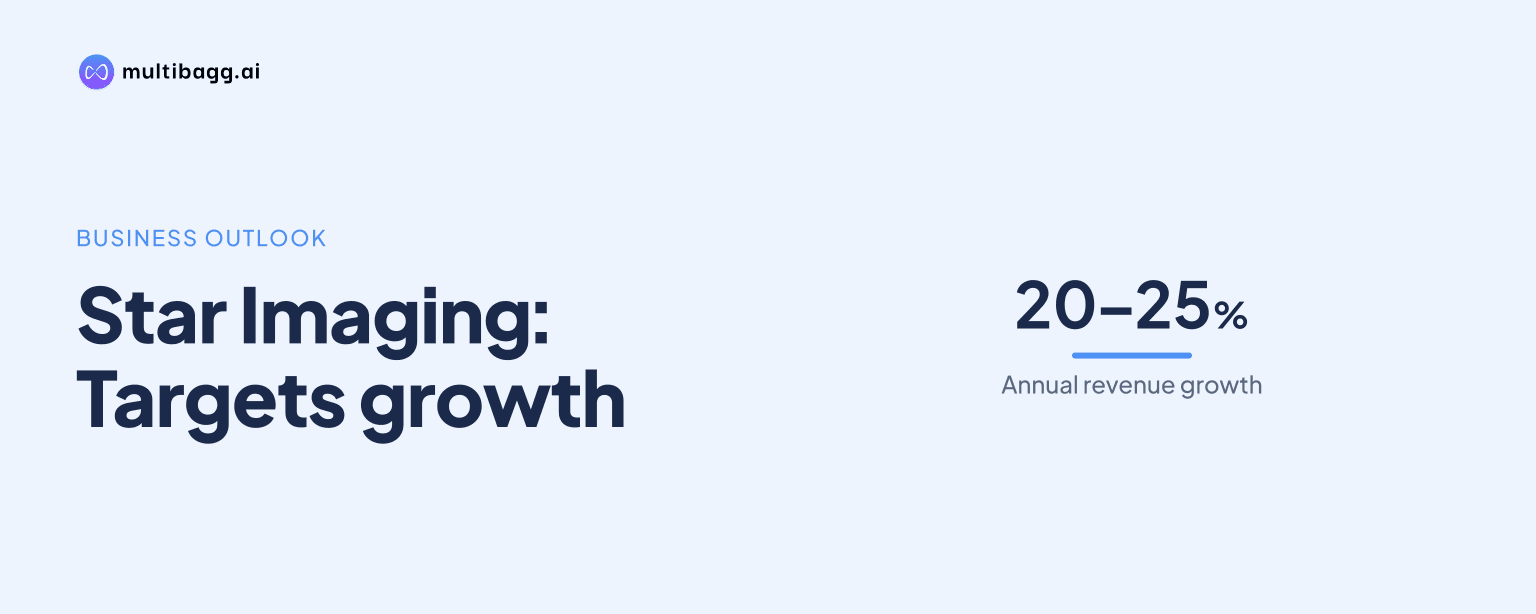
Star Imaging and Path Lab Limited plans Rs 20–25 crore of capital expenditure in financial year 2027 (FY27) to support management’s 20–25% annual revenue-growth ambition, alongside three public-private partnership projects and a Dwarka diagnostic centre expected to generate Rs 5–6 crore annually in its initial years.
Know Star Imaging and Path Lab inside out
Results, valuation, peers and who's buying, in one view.
What is Star Imaging’s FY27 expansion plan?
Star Imaging’s FY27 expansion plan combines equipment spending, new centres, hospital collaborations and government projects. The company intends to deploy Rs 20–25 crore on diagnostic equipment and centre construction, with management linking that investment to a 20–25% annual revenue-growth ambition. The programme also includes added magnetic resonance imaging capacity at Tilak Nagar, dedicated laboratory infrastructure for genome sequencing, and expansion into Gurgaon and Noida.
The plan builds on a network of 26 centres, comprising seven in Delhi, 18 in Uttar Pradesh and one in Maharashtra. Star Imaging identifies the Delhi-National Capital Region (NCR) as its core market and plans to widen its coverage through the Gurgaon and Noida expansion. Its proposed Dwarka centre would offer computed tomography, magnetic resonance imaging, ultrasound and X-ray services, rather than operating as a single-modality outlet.
How will Star Imaging use its Rs 20–25 crore capital expenditure?
Star Imaging says its planned Rs 20–25 crore FY27 capital expenditure will fund diagnostic equipment and centre construction. Management presents this spending as the capacity-building mechanism behind its 20–25% annual revenue-growth ambition, but does not allocate a stated amount to individual centres, machines or projects. The presentation also does not disclose a funding mix, equipment-level budget or phased commissioning schedule for the capital programme.
The investment plan includes increasing magnetic resonance imaging capacity at Tilak Nagar and establishing dedicated genome-sequencing laboratory infrastructure. These additions show that the planned spending covers both radiology and specialised laboratory capabilities. Star Imaging also plans to extend its RG Stone collaboration through an additional computed tomography facility in Faridabad, while identifying further hospital imaging tie-ups as opportunities.
What revenue base supports Star Imaging’s capacity expansion?
Star Imaging’s radiology business was its largest disclosed service segment in the first half of FY27, reporting Rs 39.7 crore of revenue, compared with Rs 7.6 crore from pathology. The difference indicates that planned investment in imaging equipment, including magnetic resonance imaging and computed tomography capacity, is directed toward the company’s largest reported revenue stream. Cardiac testing contributed Rs 1.3 crore during the same first-half period.
Star Imaging also reported Rs 20 lakh from neurology diagnostics and Rs 10 lakh from urology and other tests in H1 FY27. Its service range spans radiology, pathology, cardiac, neurology and urology-related testing, while the Dwarka centre is planned with four radiology modalities. The proposed genome-sequencing laboratory would extend the specialised-service offering, although the presentation gives no separate revenue target for that facility.
Got a follow-up? Ask IRIS
When is the Star Imaging Dwarka centre expected to start?
Star Imaging plans to operationalise its full-fledged Dwarka diagnostic centre by end-November, subject to the regulatory approval specified in the presentation. The centre is planned to include computed tomography, magnetic resonance imaging, ultrasound and X-ray services. Management expects Dwarka to generate annual revenue of Rs 5–6 crore in its initial years, making it the only newly announced centre with a stated revenue expectation.
The end-November timing is conditional, so the centre’s opening depends on the required approval rather than representing a confirmed commissioning date. The Rs 5–6 crore estimate is management’s initial-years expectation, not reported revenue. Compared with radiology revenue of Rs 39.7 crore in H1 FY27, Dwarka is intended as an additional diagnostic location within a larger imaging-led business rather than a replacement for the existing network.
What is the status of Star Imaging’s government and hospital projects?
Star Imaging has three public-private partnership projects in the execution pipeline covering computed tomography, magnetic resonance imaging, ultrasound and X-ray services. Site preparation and machine orders have been completed, but memorandum-of-understanding signing remains pending. This means preparatory work has started while the formal agreement milestone has not yet been completed.
Star Imaging already collaborates with the governments of Uttar Pradesh, Delhi and Nashik under public-private partnership arrangements for diagnostic services. Its disclosed role includes establishing, operating and managing radiology units; supplying and installing equipment; maintaining computed tomography scanners; and providing skilled and unskilled manpower. The company says it has established a Delhi radiology unit with a 1.5-tesla magnetic resonance imaging machine and a 16-slice computed tomography scanner, while facilitating computed tomography and magnetic resonance imaging tests through a private agency on a royalty basis.
Conclusion
Star Imaging’s disclosed expansion programme links a Rs 20–25 crore FY27 capital plan to management’s 20–25% annual revenue-growth ambition through several capacity routes. The programme combines the proposed Dwarka centre’s Rs 5–6 crore annual revenue expectation, three pending public-private partnership projects, added imaging capacity, genome-sequencing infrastructure and wider coverage in Gurgaon and Noida.
The next milestones are the end-November target for Dwarka, the regulatory approval required before it can open, and memorandum-of-understanding signing for the three public-private partnership projects. Progress on the Faridabad computed tomography facility, Tilak Nagar capacity addition and the Rs 20–25 crore FY27 spending programme will also indicate whether management’s expansion timetable is advancing as described.