










Sula says Telangana overtook Karnataka in premium wine sales
Key highlights
- Telangana recorded nearly 40% year-on-year growth in Q2 and overtook Karnataka in Sula’s elite and premium sales.
- Sula said it holds more than 70% share of Telangana’s elite and premium wine market.
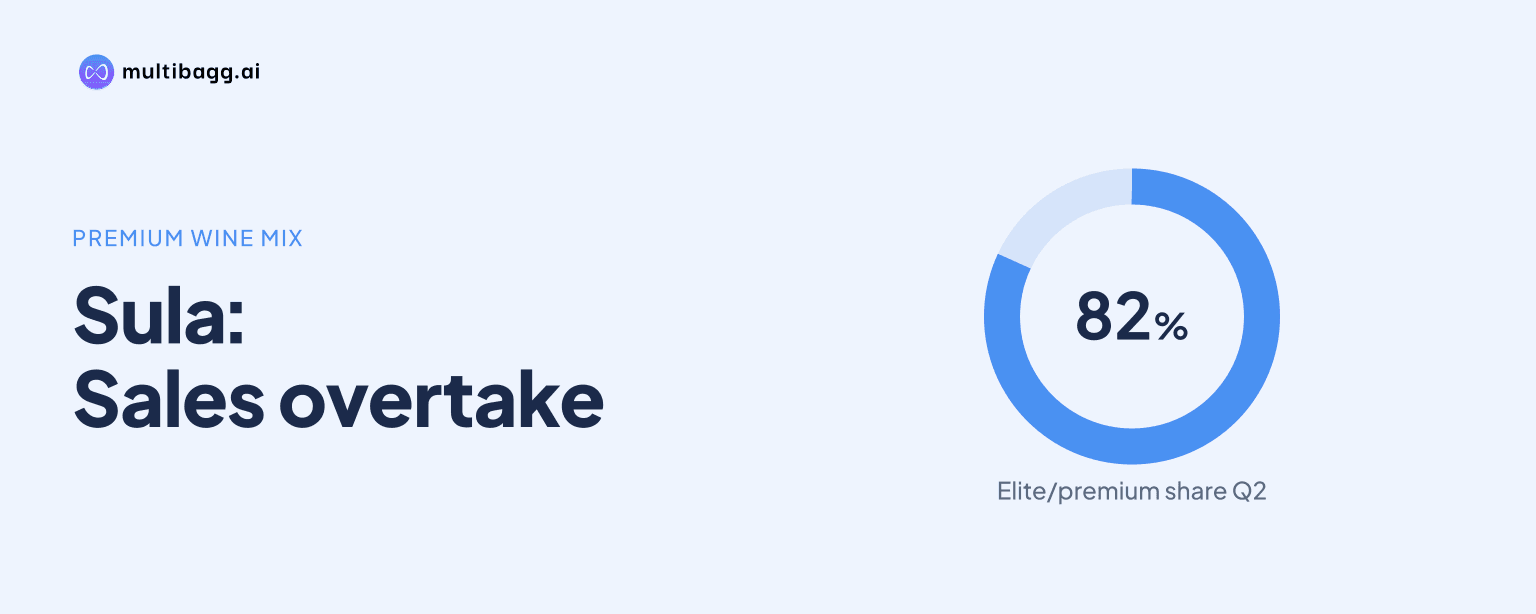
- Elite and premium wines accounted for a record 82% of Sula’s Q2 sales, up 420 basis points year-on-year.
- Sula’s Q2 EBITDA rose 8% year-on-year to Rs 27.5 crore, despite a 280-basis-point gross-profit decline.
powered by IRIS
Sula Vineyards Limited said Telangana overtook Karnataka as its second-largest elite and premium wine market in Q2 after nearly 40% year-on-year growth in Telangana. Management said Telangana’s advance reflected sustained momentum over several years, while Karnataka’s intrinsic sales and depletions remained below expectations despite earlier destocking measures.
Know Sula Vineyards inside out
Results, valuation, peers and who's buying, in one view.
Why did Telangana overtake Karnataka in Sula’s premium wine sales?
Telangana overtook Karnataka because its elite and premium sales grew nearly 40% year-on-year in Q2 while Karnataka remained subdued, management said. Sula did not disclose state-level revenue or volume figures, but Rajeev Samant said Telangana had “now overtaken Karnataka” in elite and premium sales, making it Sula’s second-largest market for that portfolio.
Management said Q2 growth was partly measured against a lower base a year earlier, but did not view the result as only a base-effect outcome. Telangana has recorded sustained growth in the segment over the past five or six years, Samant said, and the latest quarter marked an all-time high for Sula’s elite and premium sales in the state. Telangana’s premium mix is also distinct: more than 80% of sales are red wine, compared with roughly 55% to 60% in Maharashtra.
How large is Telangana’s role in Sula’s premium portfolio?
Telangana is now a material contributor to a portfolio that represented a record 82% of Sula’s overall sales in Q2, up 420 basis points year-on-year. Elite and premium portfolio sales rose 9% year-on-year in the quarter, led by double-digit growth in The Source, Sula sparkling wines and Sula Merlot. Telangana’s nearly 40% expansion therefore outpaced the portfolio’s overall growth.
Sula has more than 70% market share in Telangana’s elite and premium segment, management said. On a broader basis, Samant estimated the Indian elite and premium wine market, including domestic and imported wines, at about Rs 1,000 crore. He said Sula’s share in the domestic Indian premium wine market was between 70% and 75%, while noting that imported-wine data are harder to measure.
The market shift broadens Sula’s geographic base as premiumisation takes a larger share of group sales. Goa, Rajasthan, West Bengal and exports also recorded growth in Q2, although management gave no individual growth rates for those regions. The premium sales mix rose from about 77.8% a year earlier to 82%, based on the disclosed 420-basis-point increase.
What is driving Sula’s Telangana sales growth?
Sula’s Telangana growth is being driven by elite and premium wines in a red-wine-led market where management said it has captured more than 70% share. The state’s more-than-80% red mix differs from Maharashtra’s 55% to 60% red mix in the same portfolio, indicating that Telangana demand is concentrated in a specific part of the wine range rather than mirroring every major market.
The sales increase has a different margin profile from growth in Maharashtra and Karnataka. Management said Telangana operates at a lower gross margin but has meaningfully lower selling and distribution costs. It said the resulting effect on earnings before interest, tax, depreciation and amortisation, or EBITDA, was relatively modest: Q2 EBITDA rose 8% year-on-year to Rs 27.5 crore and the EBITDA margin increased 85 basis points to 20.3%.
Sula also reduced operating expenses by 4% year-on-year in Q2, helping offset higher blended grape costs and the regional mix. Gross profit declined by 280 basis points year-on-year, including a 150-basis-point impact from the harvest 2026 procurement mix, in which Sula bought more wine grapes after limiting open-market table-grape purchases. Management expects that cost effect to continue into Q3.
Got a follow-up? Ask IRIS
How are Karnataka and Maharashtra affecting Sula’s regional mix?
Karnataka remains a constraint on Sula’s regional sales mix because its intrinsic sales and depletions, meaning sales through the distribution chain to consumers, are not yet at the desired level. Management said Karnataka had been subdued even after Sula made market changes and some destocking adjustments in the previous year. It expects those destocking changes to provide some benefit over the next one or two quarters.
Management linked the continuing Karnataka difficulty partly to the state’s emphasis on beer over recent months, without identifying a specific policy measure. In contrast, Maharashtra has shown growth for at least the past three quarters after a period of disruption. Samant described Maharashtra’s current trajectory as low-single-digit growth overall and high-single-digit growth in elite and premium wines.
This divergence matters because Maharashtra and Karnataka are Sula’s higher-margin core markets, whereas Telangana has lower gross margin but lower selling and distribution costs. Telangana’s faster growth therefore changed the sales mix in Q2, but management said the effect on EBITDA margin was modest rather than proportionate to the gross-margin difference.
What could change Sula’s premium market ranking next?
Sula’s next regional ranking will depend on state policy and on the pace of recovery in Karnataka, Delhi, Haryana and Goa, management said. It expects Maharashtra, Karnataka and Telangana to remain its top three state markets for about another year. After that period, management said another state could enter the top tier, but gave no revenue target for such an outcome.
Goa has shown double-digit growth in recent quarters, according to management, supported by a recovery in wine demand from domestic tourism after international tourism weakened. Delhi remains affected by excise-related disruption over the past three to four years, while Sula said Haryana’s quota system currently treats Indian wines differently from imported wines. Sula said it is lobbying Haryana’s government for a policy change.
Management also cited a possible external catalyst for the premium category: a reduction in duties on qualifying wines under an India-European Union free-trade agreement. Samant said the expected timing had moved from December or January to around May 2027, while stressing that timing remained uncertain. He said lower duties could bring more wine marketing investment from producers and support category development.
Conclusion
Telangana’s move ahead of Karnataka shows that Sula’s premium growth is no longer reliant solely on its traditional core markets. Nearly 40% growth in Telangana, more than 70% elite-and-premium market share there, and an 82% premium portfolio mix support Sula’s stated premiumisation strategy, even as the state’s lower gross margin changes the regional mix.
The next indicators are Karnataka’s sales and depletions over the coming one or two quarters, and whether grape-cost pressure starts easing from Q4 as harvest 2027 procurement normalises. Management also plans to launch a ready-to-drink product shortly for the popular and economy segment, while the timing of the India-European Union agreement and state-policy changes in Haryana and Delhi remain unresolved.