










Sunlite plans 21,000-ton addition by Q1 FY28 for Rs 37 crore
Key highlights
- Sunlite plans 21,000 tons of additional capacity by Q1 FY28 with approximately Rs 37 crore of capital expenditure.
- The 20,000-ton copper-products project requires approximately Rs 24 crore and follows reported 100.9% utilisation at 25,000 tons of parent copper capacity.
- Sunlite plans a 1,000-ton ATC and busbar addition costing approximately Rs 13 crore; existing value-added capacity is 2,640 tons at 56.87% utilisation.
- Sunlite says bank loans and own funds will fund both projects, while busbar production started in September 2025.
powered by IRIS
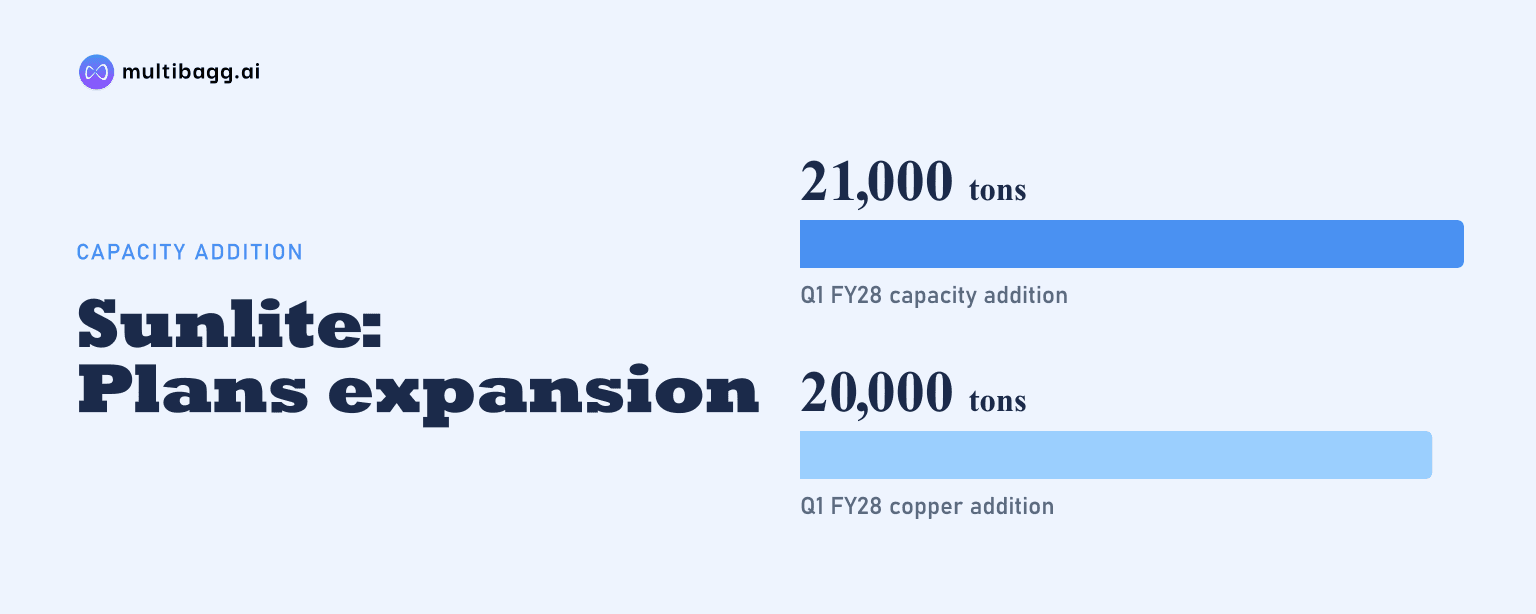
Sunlite Recycling Industries Ltd. plans to add 21,000 tons of capacity by the first quarter of FY 2027-28, with approximately Rs 37 crore of spending split between a 20,000-ton copper-products project and a 1,000-ton value-added-products project. Sunlite says bank loans and own funds will finance both additions.
Know Sunlite Recycling Industries inside out
Results, valuation, peers and who's buying, in one view.
What capacity is Sunlite adding by Q1 FY28?
Sunlite is planning 21,000 tons of capacity additions by Q1 of financial year (FY) 2027-28, comprising 20,000 tons of copper products and 1,000 tons of value-added copper ATC and busbar products. The presentation assigns the 20,000-ton project to Sunlite Aluminium Private Limited, which it identifies as a wholly owned subsidiary, while the value-added project is presented under Sunlite.
The 20,000-ton copper-products project requires approximately Rs 24 crore, and the 1,000-ton value-added project requires approximately Rs 13 crore. Their combined Rs 37 crore outlay matches Sunlite’s strategic-growth disclosure for 2026-28, which states that the parent-and-subsidiary additions are targeted for Q1 FY28.
Sunlite does not give a consolidated installed-capacity total after commissioning. Its subsidiary slide lists the existing 25,000-ton capacity and 100.9% utilisation as being in the parent company, while identifying Sunlite Aluminium Private Limited as the entity undertaking the 20,000-ton project. This leaves the final allocation of capacity between the parent and subsidiary undisclosed.
Why is Sunlite increasing copper-products capacity?
Sunlite cites domestic and export-market requirements for the 20,000-ton copper-products addition, while reporting 100.9% utilisation at the parent company’s existing 25,000-ton copper capacity. The stated utilisation is above the reported rated capacity, and the planned addition is equivalent to 80% of that 25,000-ton base.
The presentation separately says Sunlite’s operations have been de-bottlenecked and upgraded for 20% more capacity without major capital expenditure. It does not quantify the tonnage created by that work, identify the period when it will be available, or say whether the 20% improvement is included in the planned 20,000-ton subsidiary expansion.
Sunlite describes its manufacturing chain as scrap to rod to wire to busbar or strips. The company says it uses material-to-material physical hedging in this recycling-based model, and characterises that mechanism as a way to stabilise margins during copper-price volatility. The capacity plan is presented as part of its forward-integration strategy in copper products.
How does the value-added project affect Sunlite’s product mix?
Sunlite plans to add 1,000 tons of copper ATC and busbar capacity to an existing 2,640-ton value-added-products base that was operating at 56.87% utilisation. The presentation says the project is intended to meet domestic and export requirements and expand the company’s product range.
The disclosed utilisation figures differ across the two projects: the 25,000-ton parent copper capacity is shown at 100.9%, compared with 56.87% for 2,640 tons of value-added capacity. This means Sunlite is pursuing a larger copper-products addition alongside further expansion of a downstream capacity base that had lower reported utilisation.
Sunlite says wires and cables production commenced in April 2025 at approximately 6 metric tons per day, and busbar production started in September 2025. The planned 1,000-ton project therefore follows the start of production in both downstream areas rather than marking Sunlite’s first entry into wires, cables or busbars.
The company also says it has acquired new land for expansion and that busbar production has already commenced. It does not allocate the approximately Rs 13 crore cost between ATC, busbar equipment, land and other purposes, and it provides no product-specific revenue, margin or utilisation target for the 1,000-ton addition.
Got a follow-up? Ask IRIS
How will Sunlite finance the Rs 37 crore plan?
Sunlite says bank loans and own funds will finance the two projects costing approximately Rs 37 crore in total. The presentation does not disclose the expected share of debt and internal funds, loan terms, repayment schedule or the timing of capital deployment before the Q1 FY28 target.
For the subsidiary expansion, Sunlite lists income-tax benefits, capital subsidy and interest subsidy as key benefits. The presentation does not quantify these items, provide their approval status or state any eligibility conditions, so it does not disclose a net project cost after potential incentives.
Sunlite’s standalone balance sheet reported long-term borrowings of Rs 7.104 crore at H1FY27, compared with Rs 46.8 lakh at FY26 and Rs 5.016 crore at FY25. Short-term borrowings were Rs 1.162 crore at H1FY27, down from Rs 11.264 crore at FY26 and Rs 3.999 crore at FY25, showing a change in the reported standalone borrowing mix before the expansion deadline.
H1FY27 is a half-year period and is not directly comparable with the full-year FY26 and FY25 figures. However, Sunlite reported an EBITDA margin of 2.38% in H1FY27, up from 2.16% in FY26 and 1.71% in FY25; the presentation gives no forecast for the expansion’s effect on revenue, profit or margins.
What other growth actions has Sunlite disclosed for 2026-28?
Sunlite says its Ahmedabad branch office is operational and is intended to improve market reach and client servicing in the western region. This branch-office initiative is listed alongside the 21,000-ton capacity programme and the stated Rs 37 crore capital expenditure for 2026-28.
Management also says Sunlite plans to expand into new product verticals through forward and backward integration, targeting value-added niche applications. Unlike the 20,000-ton copper and 1,000-ton value-added projects, the presentation gives no capacity, capital expenditure, product category or timetable for these further vertical plans.
Conclusion
Sunlite’s disclosed expansion combines scale in copper products with additional value-added ATC and busbar capacity. The Rs 37 crore programme consists of a 20,000-ton subsidiary-led copper project and a 1,000-ton value-added project, against reported utilisation of 100.9% at the parent’s 25,000-ton copper capacity and 56.87% at the 2,640-ton value-added base.
The next disclosed milestone is Q1 FY28, when Sunlite targets completion of both projects. Investors can watch for commissioning progress, the eventual parent-and-subsidiary capacity allocation, the debt-versus-own-funds financing split, and details on the potential income-tax, capital and interest subsidies identified for the subsidiary project.