










Synergy Green Keeps FY27 Target, Sees H2 Margin Recovery
Key highlights
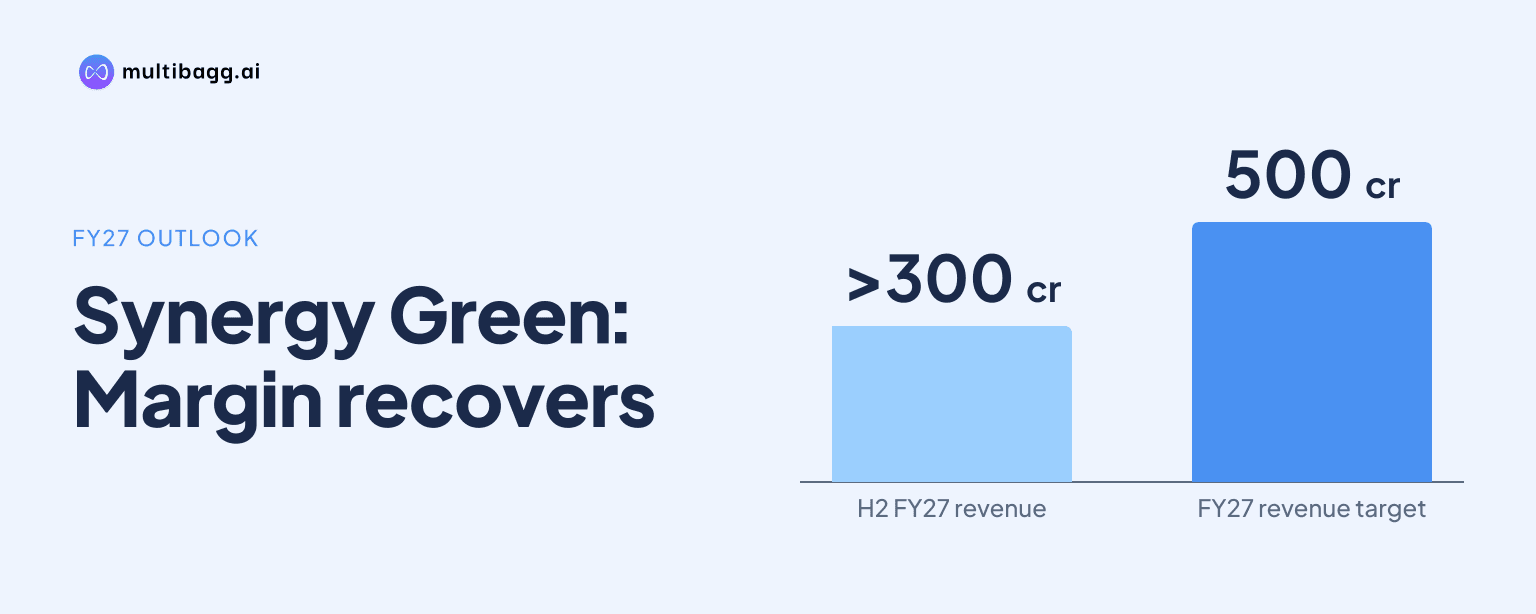
- Synergy Green retained its management target of Rs 500 crore FY27 revenue and expects more than Rs 300 crore in H2.
- H1 FY27 total income rose 20.2% to Rs 192 crore from Rs 159.76 crore in H1 FY26.
- H1 FY27 PBDIT margin declined to 8.9% from 15.6% a year earlier.
- Management estimates a 17-18% H2 EBITDA margin and expects exports to account for around 30% of FY27 revenue.
powered by IRIS
Synergy Green Industries Limited retained its management target of Rs 500 crore revenue for FY27 despite export-shipping disruption, saying existing capacity and built inventory can support more than Rs 300 crore of second-half revenue. Management estimates a 17-18% H2 EBITDA margin after H1 PBDIT margin declined to 8.9%.
Know Synergy Green Industries inside out
Results, valuation, peers and who's buying, in one view.
Can Synergy Green meet its FY27 revenue target?
Synergy Green says it has sufficient capacity and inventory to meet its Rs 500 crore FY27 turnover target. Executive Director V. Srinivasa Reddy said the company can generate more than Rs 150 crore of revenue sequentially and expects more than Rs 300 crore in H2, the half year ending March 31, 2027.
Management continues to project FY27 revenue growth of 33% over FY26. Total income in H1 ended September 30, 2026 was Rs 192 crore, compared with Rs 159.76 crore in H1 FY26, an increase of 20.2%. Production rose 25.8% year on year in H1, outpacing revenue growth as some completed castings could not be shipped.
Management said castings unable to reach ports because of vessel shortages remain inventory at cost and are not recognised as revenue. Reddy said the combination of built-up inventory and ongoing production should enable Synergy Green to exceed Rs 300 crore of H2 revenue without changing the Rs 500 crore FY27 target.
Why did Synergy Green’s first-half margin decline?
Synergy Green reported H1 PBDIT, or profit before depreciation, interest and taxes, of Rs 17.13 crore, equal to an 8.9% margin, compared with 15.6% in H1 FY26. Q2 FY27 PBDIT margin was 10.2%, versus 15.7% in Q2 FY26, as raw-material, consumable and logistics costs increased.
Management put the H1 FY27 raw-material cost impact at about 8%. It cited a more than 50% increase in furan prices during Q1, followed by higher commodity prices in Q2. Furan is a foundry consumable, and management said broad cost increases extended beyond inputs covered by regular customer price-adjustment mechanisms.
The previous year's capacity expansion raised foundry capacity to 45,000 tonnes per annum, but its ramp-up also left manpower costs partly unabsorbed in H1 FY27. Capacity utilisation was about 75% in the first half, while management projects about 80% utilisation for the full FY27 year.
Synergy Green said quarterly price corrections are based on weighted-average prices from the prior quarter, creating a one-quarter recovery lag. Management said it was receiving a weighted-average price increase of nearly 5% for Q3, although annual contracts cannot be repriced during their 12-month term.
Got a follow-up? Ask IRIS
What supports Synergy Green’s H2 margin recovery plan?
Management estimates a 17-18% H2 EBITDA margin and continues to guide for about 100 basis points of full-year margin expansion. A basis point is one-hundredth of a percentage point. Reddy said an H2 result in that range is needed to offset the 8.9% H1 PBDIT margin and meet the full-year objective.
The outlook is lower than management's earlier expectation of around 300 basis points of improvement, when it had considered a margin of about 16% including other income. Reddy said commodity inflation and capacity ramp-up costs changed the near-term position, but management did not foresee a material departure from the revised 100-basis-point guidance, subject to a possible 50-basis-point variation.
Management said customer cost pass-throughs for commodity inflation have been about 8-10%. The quarterly formula generally covers pig iron, cold rolled coil and, for many customers, furan. However, management said other costs also increase during broad inflation, leaving an estimated 100-150 basis-point margin impact.
Synergy Green also cited its 10-megawatt captive solar power portfolio as a cost-containment measure. Management said Maharashtra raised energy costs by more than 20% in April, while captive power limited the impact. The machine shop was operating at about 45-50% utilisation after developing seven or eight products, and management expects a better contribution within five to six months.
How are export shipments affecting Synergy Green’s outlook?
Synergy Green says shipment disruption has deferred revenue recognition rather than altered its FY27 revenue target. Management said October saw reasonably good movement, with about 60-70% of delayed material beginning to move. The company is giving customers shipping dates about eight weeks in advance to manage vessel availability.
The constraint is particularly acute for over-dimension consignments requiring specialised vessels. Management said newer original equipment manufacturers serving the US lack the shipping arrangements of established customers such as Vestas. In some cases, customers are paying freight equal to 50-60% of component cost but still face vessel-booking constraints.
Export freight is borne by customers, according to management, while Synergy Green faces higher logistics costs in imported inputs such as furan. Management said furan prices had softened by 5-10%, but that benefit was offset by increased input logistics costs. It added that shipping and insurance costs had risen sharply amid war-related disruption, with logistics costs almost three times higher.
Management expects export revenue to grow by more than 50% in FY27 and account for around 30% of total revenue, compared with about 25% in the prior year. It also disclosed a confirmed Nordex export order book of more than Rs 200 crore for the US market, while Vestas had asked the company not to lose even 10 minutes of capacity because of component demand.
Conclusion
Synergy Green has maintained its Rs 500 crore FY27 revenue target because its 45,000-tonne annual foundry capacity, existing inventory and export order flow support more than Rs 300 crore of H2 revenue. The central execution issue is margin recovery: PBDIT margin fell from 15.6% in H1 FY26 to 8.9% in H1 FY27 as input inflation, delayed customer price recovery and expansion-related costs outweighed revenue growth.
The next indicators are whether delayed export cargo continues moving after the 60-70% progress reported for October, and whether the nearly 5% Q3 price increase offsets elevated material and logistics costs. Management's 17-18% H2 EBITDA estimate depends on raw-material prices stabilising, while its machine-shop plan calls for higher contribution within the next five to six months from the current 45-50% utilisation level.