










Synergy Green says execution dictates greenfield timing
Key highlights
- Synergy's 45,000-tonne capacity could support Rs 600 crore to Rs 650 crore of revenue, according to management.
- Management estimates demand above 60,000 tonnes against Synergy's 45,000-tonne installed capacity.
- A greenfield project would take 15 to 18 months once started and may be pursued within the next two to three years.
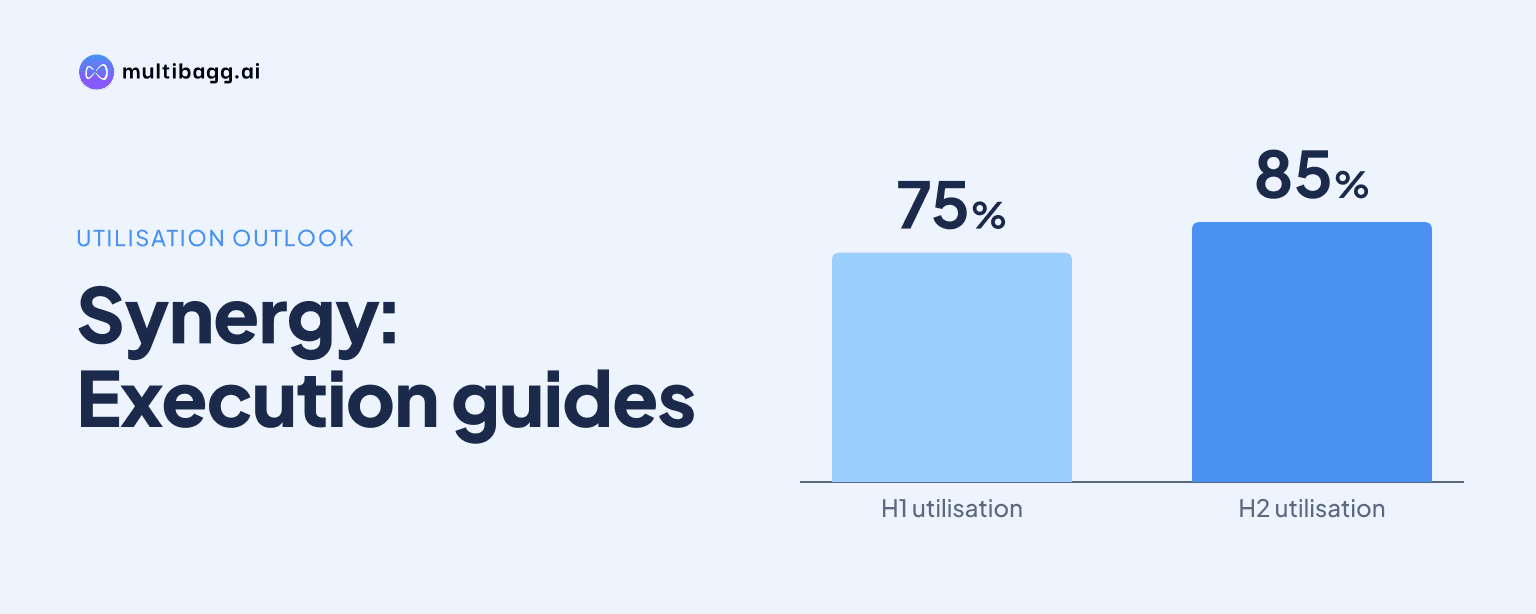
- Synergy expects utilisation to rise from 75% in the first half to 85% in the second half.
powered by IRIS
Synergy Green says execution readiness, workforce training and financing discipline, rather than demand, will determine when it starts a new greenfield plant, despite management estimating demand above 60,000 tonnes against its 45,000-tonne capacity. Management said the proposed facility would take 15 to 18 months to build after approval.
Know Synergy Green Industries inside out
Results, valuation, peers and who's buying, in one view.
Why is Synergy delaying its greenfield expansion?
Synergy is delaying a greenfield decision because it wants to stabilise the capacity expansion completed last March before adding another facility. That expansion lifted capacity from 30,000 tonnes to 45,000 tonnes, and management said it recruited many people during the past year who now need training and integration into operations.
Management said it could raise funds and add capacity more quickly, but does not want to take on excessive debt or raise equity at valuations it considers inappropriate. Executive Director V. Srinivasa Reddy said the main constraint is the ability to execute, because large-casting production requires specialised people and equipment alone cannot convert capacity into output.
Is demand high enough for Synergy to build another plant?
Yes, Synergy said available demand loosely exceeds 60,000 tonnes, compared with its existing 45,000-tonne capacity. Management said Nordex and Vestas alone could absorb its full capacity, while it has also added or developed relationships with Adani, Senvion, Siemens Gamesa and Envision during the past year.
Adani and Senvion are operating customers, while Siemens Gamesa and Envision were described as being under development. Synergy also said Suzlon had approached it about component development linked to localisation, but the company is limiting new development work because it cannot yet allocate enough capacity beyond existing original equipment manufacturer, or OEM, commitments.
Synergy said its strategy is to establish customer demand before adding capacity, rather than build a plant and then seek orders. Management said this approach can support a faster ramp-up and avoid under-absorption, noting that India has only three foundries serving 15 OEMs in this large-casting segment.
What revenue can Synergy generate from current capacity?
Synergy said its 45,000-tonne capacity could support revenue of Rs 600 crore to Rs 650 crore when utilisation improves. Management raised that range from its earlier Rs 550 crore to Rs 600 crore estimate because inflation and product prices have increased, not because installed capacity has risen beyond 45,000 tonnes.
The company reported utilisation of about 75% in the first half and expects 85% in the second half, resulting in an 80% full-year projection. The planned increase of 10 percentage points between the two halves is central to management's revenue expectation from the expanded base.
Management said revenue could exceed Rs 500 crore in the current year if logistics conditions permit, while adding that exports account for 50% of that expectation. It also said revenue for FY27 is supported by capacity and demand, while FY28 growth remains intact, according to management.
Got a follow-up? Ask IRIS
When could Synergy start and finish a greenfield plant?
Synergy said a greenfield plant would require around 15 to 18 months to build once it is started, but it did not disclose a project start date. Management said it first wants to stabilise the existing expansion over the next two quarters and then consider the project in phases.
Management's broader expectation is to undertake the greenfield project within the next two to three years. It said it is also considering whether the project can be brought forward, but stressed that the 45,000-tonne operation and recently expanded workforce must be stable before it commits to a larger investment.
Synergy said its growth objective is about 25% compound annual growth rate, or CAGR, reflecting the workforce-intensive nature of foundry operations. Management expects growth of 33% in the current year and 25% to 30% in the following year, while describing those figures as its expectations rather than formal guidance.
How do costs and funding discipline affect the decision?
Synergy said raw-material volatility remains a risk, although customer contracts allow it to pass on inflation quarter by quarter rather than overnight. Management said it should get closer to its margin expectations even if elevated raw-material prices persist for six months or one year, subject to the stated assumptions.
Electricity costs affected the first half by about Rs 3 crore, which management said was roughly 1.5 percentage points of earnings before interest, taxes, depreciation and amortisation, or EBITDA. Management said approximately Rs 1 crore to Rs 1.5 crore was related to retrospective charges, while a higher base tariff will remain.
Synergy said nearly 60% of its electricity is supplied through a combination of wind and solar arrangements. It is using contracted wind open access to offset part of the tariff increase, although management said wind-based open access provides less savings than captive solar, which it estimated at Rs 7 to Rs 8 per unit.
Conclusion
Synergy's greenfield timing is therefore tied to operational preparation and capital allocation rather than an absence of orders. Demand above 60,000 tonnes exceeds its 45,000-tonne capacity, and management sees Rs 600 crore to Rs 650 crore of revenue potential from that base, but it does not regard demand alone as sufficient reason to accelerate a new plant.
The next developments to watch are the planned stabilisation over the next two quarters, the expected move from 75% first-half utilisation to 85% in the second half, and any decision to advance the greenfield project. Management is also working on whether it can add 10% to 15% of capacity and support 15% to 20% revenue growth without relying fully on the new facility.