










Synergy Green Nordex US order book exceeds Rs 200 crore
Key highlights
- Synergy confirmed Nordex US export orders of more than Rs 200 crore for the coming 12 months.
- Management expects export revenue to grow by more than 50% and reach about 30% of FY26-27 revenue.
- First-half production rose 25.8%, while revenue increased 20.2% as unshipped castings accumulated in inventory.
- Synergy expects capacity utilisation to rise from about 75% in the first half to about 85% in the second half.
powered by IRIS
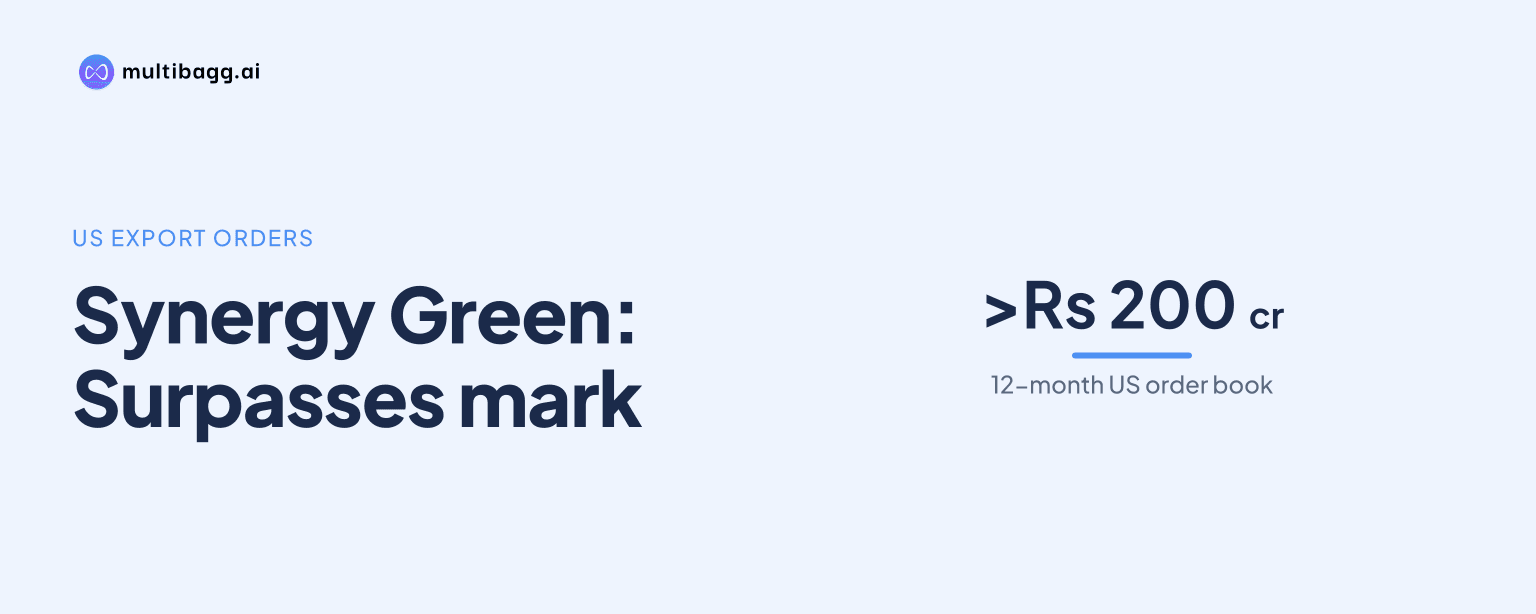
In FY26-27, Synergy Green confirmed Nordex US export orders exceeding Rs 200 crore for the coming 12 months, while management expects export revenue to increase by more than 50%. The order book supports a US-led export plan, although shortages of vessels for oversized castings have left some completed production in inventory.
Know Synergy Green Industries inside out
Results, valuation, peers and who's buying, in one view.
What is Synergy's Nordex export order book?
Synergy has finalised its Nordex arrangement and holds a confirmed export order book of more than Rs 200 crore for US supplies over the next 12 months. Management said the Nordex order book was fully booked and added that Vestas had asked it not to leave even 10 minutes of capacity unused because of customer demand.
The Nordex orders form part of Synergy's FY26-27 outlook for more than 50% export-revenue growth and export contribution of about 30% of total revenue, compared with about 25% in the previous year. Management retained its projection of 33% overall revenue growth, supported by added capacity and new customers, while identifying logistics as the key delivery constraint.
Why is the US driving Synergy's export opportunity?
The US is driving Synergy's export opportunity because Nordex, previously focused mainly on Europe and other markets, has entered the US and built what management described as a very good order book. Management said electricity demand from data centres linked to artificial intelligence, alongside existing installation needs, was increasing demand for renewable-energy equipment in the US.
Europe remains active, but Synergy said its castings generally do not go there because Europe has domestic manufacturing and can source from China without tariff barriers. Management said tariff differences in the US favour Indian suppliers, while newer original equipment manufacturers, or OEMs, are seeking non-Chinese casting supply chains. These points were management's assessment of the market.
Synergy works with 6 of 15 leading global wind OEMs, including Vestas, Envision, Siemens Gamesa, Nordex and Adani. Wind castings account for about 70% of its portfolio, wind-industry gearbox castings another 15%, and the balance comes from non-wind applications including cone crushers, coal pulverisers, mining and pumps.
How are vessel shortages affecting Synergy's export revenue?
Vessel shortages are delaying Synergy's sales conversion because completed castings that cannot move to ports remain inventory at cost rather than being recognised as revenue. Management said ships for over-dimensional cargo are especially difficult for newer OEMs serving the US to secure, unlike Vestas, which has an established arrangement with shipping company Maersk.
Customers are paying freight equal to about 50% to 60% of component cost in some instances to move castings from India to the US, according to management, yet booking vessels remains difficult. Synergy said export freight is borne by customers, but delayed movement still postpones its revenue recognition. The company provides shipping dates about 8 weeks in advance as customers seek multiple shipping options.
Management reported reasonably good movement in October, when about 60% to 70% had started moving, without specifying whether that referred to accumulated inventory or planned consignments. Synergy expects to generate more than Rs 300 crore of revenue in the second half from inventory and production, and said annual revenue could exceed Rs 500 crore if logistics constraints ease.
Got a follow-up? Ask IRIS
What does the Nordex order book mean for Synergy's FY26-27 finances?
The Nordex order book adds visibility to the export component of Synergy's FY26-27 plan, but first-half revenue conversion lagged production. Total income for the half year ended September 30, 2026 was Rs 192 crore, compared with Rs 159.76 crore in the half year ended September 2025, while production rose 25.8% and revenue rose 20.2% year on year.
Profit before depreciation, interest and taxes, or PBDIT, margin was 10.2% in Q2 FY26-27, down from 15.7% in Q2 FY25-26, while the first-half margin declined to 8.9% from 15.6%. Management attributed the pressure to raw-material inflation, which it estimated had an impact of about 8% in the first half, and said furan consumable prices rose by more than 50% in Q1.
Management maintained its expectation of about 100 basis points of full-year margin expansion and estimated second-half earnings before interest, tax, depreciation and amortisation, or EBITDA, margin of 17% to 18%. It said Q3 pricing reflected a weighted-average increase of about 5%, but customer price corrections are based on the previous quarter's weighted average and therefore lag input-cost movements.
Can Synergy meet export demand with its existing capacity?
Synergy said its established capacity can support the FY26-27 revenue plan, with annual casting capacity of 45,000 tonnes and first-half utilisation of about 75%. Management expects utilisation to average about 80% for the full year, comprising roughly 75% in the first half and an expected 85% in the second half.
Management said sequential turnover can exceed Rs 150 crore and described execution rather than demand as the current constraint. It said Nordex and Vestas alone could absorb existing capacity, while Adani, Senvion, Siemens Gamesa and Envision add to its OEM opportunity. Envision had not yet been onboarded and remained under development.
Machine-shop utilisation had reached about 45% to 50% after Synergy developed 7 to 8 products, according to management. Management expects a better machine-shop contribution within 5 to 6 months as product approvals and cycle times improve. Its 10-megawatt captive solar portfolio and contracted wind open access together provide about 60% of electricity needs, partly offsetting Maharashtra tariff increases of more than 20% announced in April.
Conclusion
Synergy's Nordex order book of more than Rs 200 crore makes US exports a material part of its FY26-27 growth plan, alongside management's forecast for export revenue to grow by more than 50%. The difference between first-half production growth of 25.8% and revenue growth of 20.2% shows that shipping availability, rather than demand softening cited by management, is currently limiting the conversion of output into sales.
The next test is second-half execution, when management expects more than Rs 300 crore of revenue, about 85% capacity utilisation and EBITDA margin of 17% to 18%. Investors should watch whether vessel availability improves, whether raw-material costs stabilise enough for quarterly price adjustments to catch up, and whether the machine shop adds the contribution management expects within 5 to 6 months.