








Takyon Networks Ltd expects Rs 36 crore H2 FY27 billing
MAX Plan at ₹4,999/yr

Find your next multibaggerBe a Pro Investor
Research stocks and track your picks on the go. Download the app.
Key highlights
- Takyon expects about Rs 36 crore of its Rs 46.65 crore order book to be executed and billed in H2 FY27.
- Takyon reported H1 FY27 revenue of Rs 30.61 crore and a loss after tax of Rs 8.45 crore.
- Takyon received fresh orders worth more than Rs 35 crore in the 45 days after September 2026.
- Takyon's receivable days declined to 178 days on September 30, 2026, from 228 days on March 31, 2026.
powered by IRIS
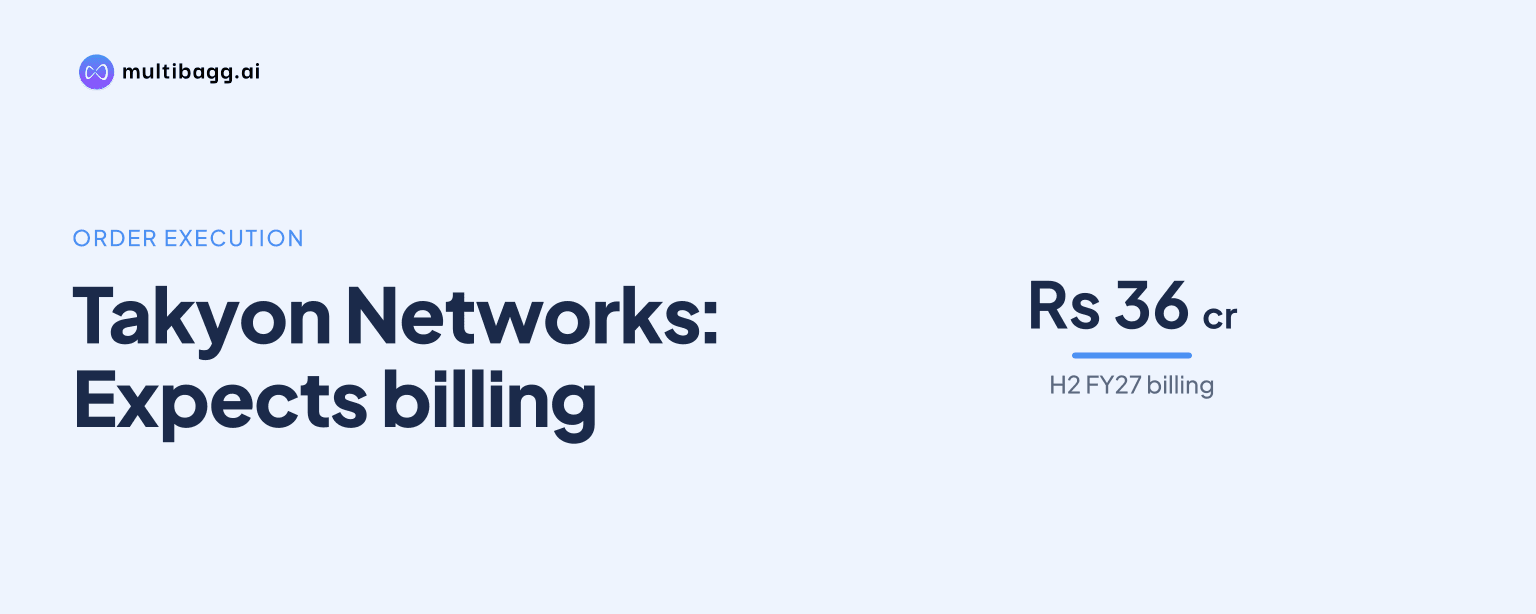
Takyon Networks Ltd expects to execute and bill about Rs 36 crore of its Rs 46.65 crore undisputed order book in H2 FY27, after reporting H1 FY27 revenue of Rs 30.61 crore and a loss after tax of Rs 8.45 crore. Management attributed the first-half result to delayed execution, higher component costs and longer supplier lead times.
Know Takyon Networks inside out
Results, valuation, peers and who's buying, in one view.
How much of Takyon's order book could be billed in H2 FY27?
Takyon expects about Rs 36 crore of its Rs 46.65 crore undisputed order book, as of November 15, 2026, to be executed and billed in H2 FY27. Management said the balance would flow into FY28, making delivery and billing against project milestones its stated priority for the remaining half of FY27.
The H2 billing expectation is forward-looking, not reported revenue. It is based on current execution schedules and the order pipeline, while the H1 FY27 experience showed that original equipment manufacturer, or OEM, lead times and hardware availability can shift project billing between periods.
Takyon said it had already billed close to Rs 6 crore in the 45 days after September despite holidays. The order book remains weighted toward state-government and public-sector undertaking, or PSU, clients, where management said execution and billing are typically concentrated in the second half of the financial year.
Why did Takyon report a loss in H1 FY27?
Takyon reported an Rs 8.45 crore loss after tax in H1 FY27 because delayed revenue coincided with higher costs on older fixed-price projects. Revenue was Rs 30.61 crore, while earnings before interest, tax, depreciation and amortisation, or EBITDA, was a loss of Rs 7.95 crore and the loss-after-tax margin was 27.35%.
Management said the pressure was concentrated in Q1 FY27, when it cited revenue of about Rs 10 crore and losses of Rs 7.20 crore. In Q2 FY27, it cited revenue of Rs 20.65 crore and losses of Rs 1.25 crore, indicating lower losses as quarterly revenue increased, although the H1 FY27 result remained negative.
Several contracts had been priced before increases in memory, storage and networking-equipment costs, management said. As government and PSU contracts are largely fixed-price, Takyon said it absorbed those cost increases on older projects rather than passing them to customers; it added that prices were revised on some enterprise work, including NCC and certain other contracts.
During the call, management said component prices had risen by as much as 300% in some cases after orders were awarded. It also cited fixed employee, project-delivery and administrative costs, which had a larger effect when revenue was lower, and said H2 FY27 actions include overhead rationalisation, tighter discretionary-spending approvals and closer alignment of project manpower with delivery schedules.
Got a follow-up? Ask IRIS
Which new orders support Takyon's H2 FY27 outlook?
Fresh orders worth more than Rs 35 crore received in the 45 days after September support Takyon's expectation of stronger H2 FY27 activity. That order inflow exceeded the approximately Rs 22 crore of orders secured during the entire April-to-September H1 FY27 period.
Management identified a Rs 10 crore railway order and a Rs 20 crore order from a leading energy-exchange platform among the post-September wins. The railway order adds to Takyon's government and infrastructure exposure, while management described the energy-exchange platform as an enterprise body rather than a public-sector power company.
Takyon said its bid pipeline was stronger than at any point in the previous year, but did not disclose its value or an expected conversion rate. The key execution issue is whether the Rs 46.65 crore November 15 order book can convert into billed revenue without a repeat of the component-price and lead-time disruptions reported in H1 FY27.
How is Takyon changing its client mix and cash cycle?
Takyon aims for enterprise customers to contribute about 10% to 11% of annual sales, compared with a current single-digit contribution, with management describing this as a near-term H2 FY27 objective. It is building a dedicated enterprise-technology vertical in Delhi and the National Capital Region to pursue customers with shorter sales and collection cycles than government and PSU clients.
The company is targeting enterprise technology, cybersecurity and power-sector work, while also expanding into the Northeast and bidding in western India, particularly in banking, financial services and insurance, or BFSI. It plans to broaden work for existing clients through maintenance, upgrades and managed services, which management said could provide more predictable revenue than one-off projects.
Cash collection is also part of the H2 FY27 plan. Receivable days declined to 178 days as of September 30, 2026, from 228 days as of March 31, 2026, after Takyon introduced an age-wise review of receivables and dedicated follow-up on long-outstanding dues.
Takyon is also seeking closer engagement with OEM partners to support delivery timing. Management named HPE Aruba, Ruckus, HP, Dell, Palo Alto, Fortinet and Ivanti across networking, compute, data centres, cybersecurity and patch-management software, and said these relationships are intended to support timely procurement and project execution.
Conclusion
Takyon's recovery case for H2 FY27 rests on converting about Rs 36 crore of its Rs 46.65 crore order book into execution and billing after H1 FY27 revenue of Rs 30.61 crore produced an Rs 8.45 crore loss after tax. The increase from about Rs 10 crore of Q1 revenue to Rs 20.65 crore in Q2, alongside more than Rs 35 crore of fresh post-September orders, explains management's expectation of a better second half.
The next disclosed measures to watch are billing against the Rs 36 crore H2 FY27 plan, enterprise customers' progress toward a 10% to 11% annual-sales contribution, and further movement in receivable days from 178 days at September 30, 2026. Management also expects the portion of the November 15 order book not billed in H2 FY27 to flow into FY28, leaving procurement discipline, project delivery and collections as key unresolved execution matters.

