








Takyon Networks posts Rs 8.45 crore H1 loss on cost spikes
MAX Plan at ₹4,999/yr

Find your next multibaggerBe a Pro Investor
Research stocks and track your picks on the go. Download the app.
Key highlights
- Takyon Networks reported H1FY27 revenue of Rs 30.61 crore and a net loss of Rs 8.45 crore.
- H1FY27 cost of goods sold was Rs 31.50 crore, exceeding revenue by Rs 0.89 crore.
- Q1FY27 net loss was Rs 7.20 crore, while Q2FY27 net loss narrowed to Rs 1.25 crore.
- Takyon Networks had an undisputed order book of Rs 46.65 crore as of November 15, 2026.
powered by IRIS
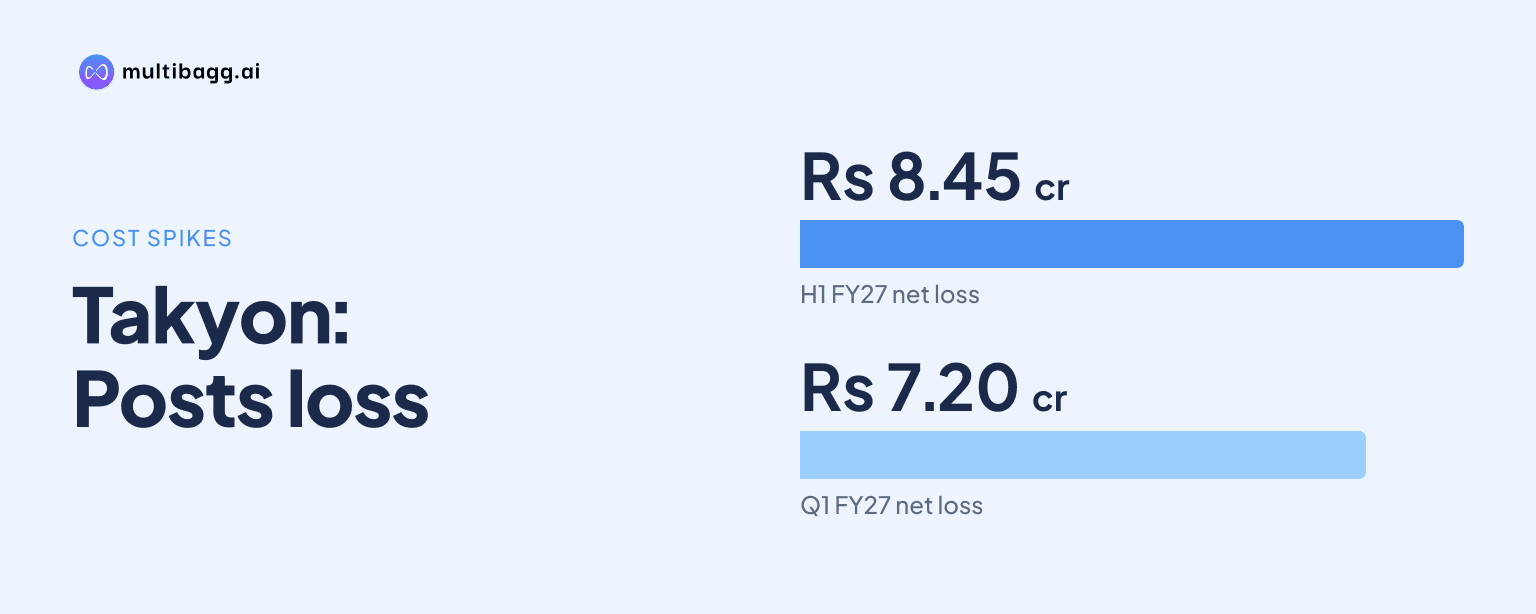
Takyon Networks Ltd posted an Rs 8.45 crore net loss in H1FY27 after component-cost increases pushed cost of goods sold to Rs 31.50 crore, above Rs 30.61 crore of revenue. Management said older fixed-price government and public-sector contracts left the company unable to recover higher procurement costs.
Know Takyon Networks inside out
Results, valuation, peers and who's buying, in one view.
Why did Takyon Networks make a loss in H1FY27?
Takyon Networks made a loss because it executed older fixed-price contracts after the cost of memory, storage and network equipment rose above the assumptions used in its bids. H1FY27 revenue was Rs 30.61 crore, while earnings before interest, tax, depreciation and amortisation, or EBITDA, was negative Rs 7.95 crore, yielding a negative EBITDA margin of 25.95%.
The direct pressure was visible in cost of goods sold of Rs 31.50 crore, exceeding H1FY27 revenue by Rs 0.89 crore before employee, project-delivery and administrative expenses. Management attributed approximately 80% of this cost issue to project-level overruns and approximately 20% to execution delays on a couple of projects.
Takyon Networks reported a negative net-profit margin of 27.35% and negative earnings per share of Rs 5.90 in H1FY27. Management said fixed employee, delivery and administrative costs had a larger effect on margins because government and public-sector undertaking, or PSU, billing is generally weighted towards the second half.
How did Takyon Networks' loss change between Q1 and Q2?
Takyon Networks' net loss narrowed to Rs 1.25 crore in Q2FY27 from Rs 7.20 crore in Q1FY27 as revenue increased to Rs 20.65 crore from Rs 9.96 crore. Management said the main operational losses occurred in Q1, when the older order book was affected by increased component and service costs.
In Q2FY27, management said gross margins were present but fixed costs still produced a loss. The change from Q1 to Q2 suggests the largest reported project-cost impact was concentrated in the first quarter, although the company did not report quarterly EBITDA or cost-of-goods-sold figures.
Execution timing also reduced first-half revenue. Takyon Networks said longer original equipment manufacturer, or OEM, lead times delayed deliveries on several projects, moving associated billing into H2FY27 rather than indicating a loss of orders.
What exposed Takyon Networks to component-cost inflation?
Takyon Networks was exposed because its government and PSU work is largely fixed-price and does not generally contain price-escalation clauses. Management said it had to absorb procurement-cost increases on awarded projects because abandoning contracts could risk blacklisting.
The company said its government and PSU sales cycle can take five to six months, while OEM price quotations during the affected period were valid for only 15 to 30 days. Management said delivery could take about 90 days and described component-price increases of 30% to 40% a month, with some costs rising by as much as 300%.
Management gave an example of a CCTV camera rising to Rs 12,000 from Rs 4,000. Takyon Networks said it generally cannot purchase equipment before receiving confirmed orders because tenders are competitive, creating a gap between the supplier price used at bidding and the eventual procurement price.
Got a follow-up? Ask IRIS
What is Takyon Networks doing to protect margins and cash?
Takyon Networks is tightening bid selection, procurement controls, execution tracking and collections to limit future cost exposure. Management said it is seeking projects and products where it has more concrete information on potential price gaps, rather than aiming to expand gross margins from the prior year.
The company said OEMs are now offering price validity of 45 to 60 days, compared with 15 to 30 days during the period of rapid inflation. It has also introduced milestone-based monitoring of delivery and billing for every order, with delays flagged for management review.
On working capital, Takyon Networks reported receivable days of 178 days at September 30, 2026, down from 228 days at March 2026. Management said its age-wise receivables review, follow-up on overdue amounts, overhead rationalisation and tighter discretionary-spending approvals are intended to improve cash conversion.
Can Takyon Networks improve in H2FY27?
Management expects a materially stronger H2FY27, supported by an undisputed order book of Rs 46.65 crore as of November 15, 2026. It expects close to Rs 36 crore of that order book to be executed and billed in H2FY27, with the balance flowing into FY28.
Takyon Networks secured approximately Rs 22 crore of new orders between April and September 2026, then received more than Rs 35 crore of fresh orders in the following 45 days. The later additions included Rs 10 crore from railways and Rs 20 crore from a leading energy-exchange platform, while management said close to Rs 6 crore had already been billed in that period.
The order book remains weighted towards government and PSU customers, but management aims for enterprise customers to contribute roughly 10% to 11% of sales in H2FY27, compared with a share close to single digits. Its enterprise push includes a Delhi and National Capital Region vertical, cybersecurity, power-sector work and banking, financial services and insurance, or BFSI, bids in western India.
Conclusion
Takyon Networks' H1FY27 outcome shows how fixed-price public-sector projects can turn procurement volatility into direct losses when supplier quotations expire before equipment is delivered. The shift from a Rs 7.20 crore Q1FY27 loss to a Rs 1.25 crore Q2FY27 loss indicates that the reported cost overrun was concentrated earlier in the half, while fixed costs continued to affect profitability.
The next results will show whether close to Rs 36 crore of the Rs 46.65 crore order book converts into H2FY27 billing as management expects. Other disclosed markers include whether receivable days improve from 178 days, enterprise sales approach the 10% to 11% H2FY27 target, and 45-to-60-day OEM price validity reduces the mismatch between tender pricing and procurement costs.

