










Tata Steel India deliveries rose 16% despite monsoon headwinds
Key highlights
- Tata Steel India deliveries rose 16% quarter on quarter in the quarter ended September 30, 2026, versus 7% production growth.
- Ready-to-use construction solutions grew 32% year on year in Tata Steel's second quarter of FY2027.
- Tata Tiscon sales increased 13% year on year and reached about 500,000 customers over the preceding 12 months.
- Tata Steel reported 26% year-on-year growth in higher-end automotive and special-product sales.
powered by IRIS
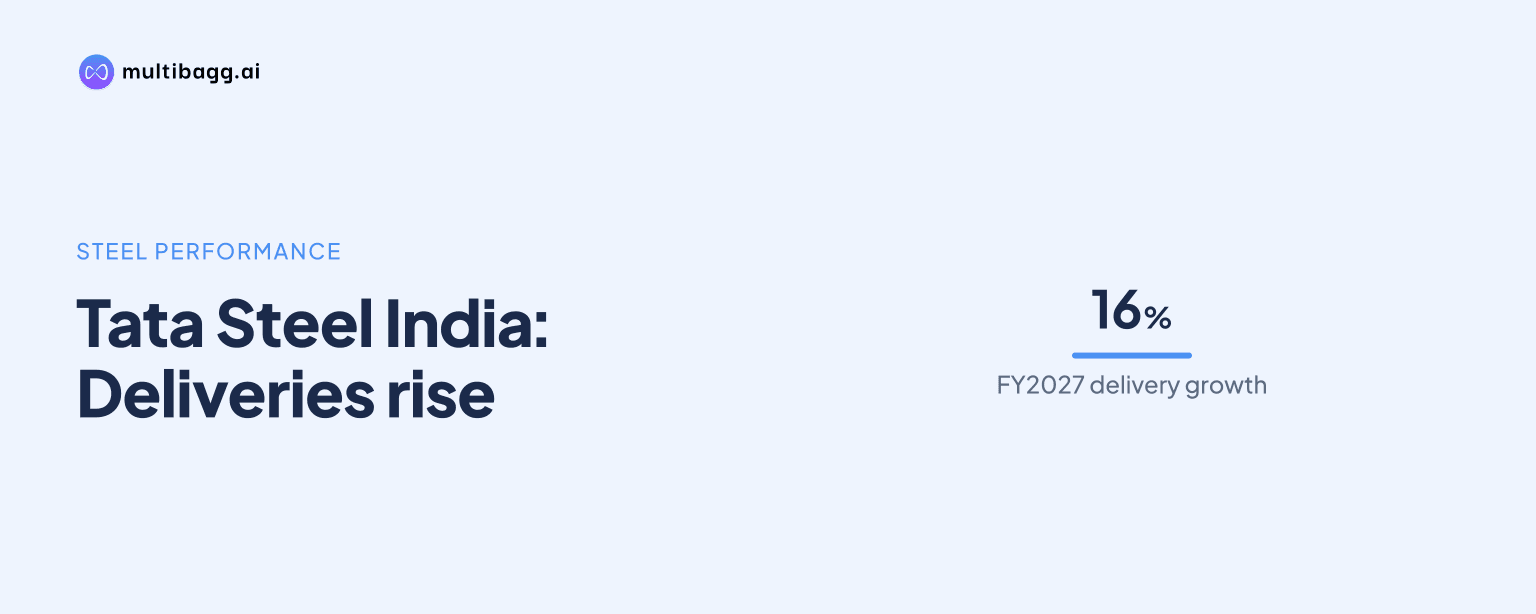
In the quarter ended September 30, 2026, Tata Steel Limited increased India deliveries 16% quarter on quarter, ahead of 7% production growth, as ready-to-use construction solutions rose 32% year on year and Tata Tiscon sales increased 13%. Management attributed the monsoon-quarter performance to demand, market reach and product mix.
Know Tata Steel inside out
Results, valuation, peers and who's buying, in one view.
How fast did Tata Steel grow India deliveries in the monsoon quarter?
Tata Steel grew India deliveries 16% quarter on quarter in the second quarter of financial year (FY) 2027, compared with 7% growth in production. Management said the difference reflected healthy demand and its ability to translate market opportunities into deliveries despite monsoon-related headwinds for construction activity.
The comparison shows that shipments expanded faster than output during the quarter, although the transcript does not disclose India delivery or production tonnage. Tata Steel said its market reach, product mix and customer focus supported traction across selected segments during a seasonally softer period.
Tata Steel also reported that consolidated earnings before interest, tax, depreciation and amortisation (EBITDA) margin improved by close to 90 basis points, from 15% in the first quarter to 16% in the second quarter. Management said this occurred despite inflation in freight, coking coal, zinc and other shipping-related costs after the conflict in West Asia disrupted trade routes.
The 16% delivery increase is a volume measure, not a disclosed measure of India revenue, pricing or segment profitability. Management nevertheless linked the India strategy to maximising volumes while increasing the value intensity of its product portfolio, including retail, downstream and construction-solution offerings.
Which Tata Steel products drove higher-value sales growth?
Tata Steel reported 26% year-on-year growth in higher-end sales within Automotive & Special Products, alongside the 32% rise in ready-to-use construction solutions. The automotive vertical secured approval for its CR IFHS340 grade for skin panels and developed a chrome-free galvannealed product for two-wheeler fuel tanks.
The company also said it was progressing customer approvals for specialised suspension and transmission applications. These developments indicate that the 26% sales increase included products developed with customers for specified end uses, rather than only a broader rise in automotive steel shipments.
In construction, Tata Steel said its portfolio includes Sm@rtFAB, ReadyBuild cut-and-bend products, bore-pile cages and plate fabricated sections. Management said these offerings move beyond primary steel supply by addressing construction requirements, and that the portfolio was gaining market acceptance during the second quarter.
Tata Steel launched India’s first certified mesh masonry reinforcement as an alternative to conventional reinforced-concrete beams. The transcript does not provide sales volumes, revenue or margins for Sm@rtFAB, ReadyBuild or fabricated sections, so the reported 32% growth does not quantify the financial contribution of individual construction-solution products.
Got a follow-up? Ask IRIS
How important is Tata Tiscon to Tata Steel's India reach?
Tata Steel said Tata Tiscon sales rose 13% year on year and that its distribution network reaches nearly 97% of India’s districts. In the 12 months preceding the second-quarter call, Tata Tiscon sold about 2.7 million tonnes to around 500,000 customers.
That reach gives Tata Steel access to dispersed retail demand alongside its industrial customer base. Management also said its digital platforms extend market access from districts to pin codes, though it did not provide a digital-sales value, a share of Tata Tiscon volumes sold online or a target for digital penetration.
The retail business is linked to the company’s capacity plan. Tata Steel said the recently commenced 4.8 million tonnes per annum (MTPA) expansion project would support further retail growth, while one rebar mill is expected to begin production before the wider steelmaking complex is commissioned.
Tata Tiscon’s 13% growth was below the 32% increase reported for ready-to-use construction solutions, but both categories expanded during the monsoon quarter. This comparison suggests Tata Steel’s construction-related growth covered both a nationwide retail brand and a broader portfolio of fabrication and ready-to-use offerings.
What other India businesses added to Tata Steel's product push?
Tata Steel said Tinplate sales grew 17% year on year and Tata Steel Colors sales increased 49% year on year in the second quarter. Those gains accompanied the 26% increase in higher-end automotive and special-product sales, extending the company’s portfolio push into packaging, coated steel and vehicle applications.
The company also secured its first low-carbon-steel order at a green premium from its Ludhiana facility. Tata Steel cited progress in oil and gas and shipbuilding, including supplies for Sagar Manthan, an ocean research vessel being built under the Government of India’s Deep Ocean Mission, but did not disclose order value, volume or the premium level.
Cost inflation remained an important backdrop to this product expansion. Management said oil and freight rates had risen about 40% since the West Asia conflict began, while Chinese steel exports remained above 10 million tonnes a month, affecting global trade flows and logistics costs.
For the first half of FY2027, Tata Steel reported consolidated revenue of Rs 1.26 lakh crore and EBITDA of Rs 20,035 crore, equal to an EBITDA margin of about 16%. Management said consolidated EBITDA increased 21% year on year, or Rs 2,160 per tonne, supported by its India business, cost management and capital allocation.
Conclusion
Tata Steel’s second-quarter India performance shows deliveries growing faster than production while construction solutions, retail, automotive, packaging and coated products all recorded year-on-year gains. The 32% increase in ready-to-use construction solutions and 49% rise in Tata Steel Colors sales indicate that the company’s India growth plan extends beyond primary steel volumes into products with more direct access to end markets.
The next milestone is the 4.8 MTPA expansion project, which management said is on track for commissioning in FY2030 and should support retail growth. Investors will also watch the planned earlier start of one rebar mill and the proposed amalgamation associated with the project, which management said remained subject to a final National Company Law Tribunal hearing scheduled for later in November.