










Tata Steel extends Netherlands talks as key risks persist
Key highlights
- Tata Steel extended the Netherlands Joint Letter of Intent by five months to 1 March 2027.
- Netherlands EBITDA increased to €720 lakh in Q2 FY2027 from €40 lakh in Q1 FY2027 after the Direct Sheet Plant restart.
- The Direct Sheet Plant has about 1.4 million tonnes of annual processing capacity and represents roughly 18% of Netherlands volumes.
- Tata Steel produced about 1.52 million tonnes of liquid steel and delivered about 1.30 million tonnes in the Netherlands in Q2 FY2027.
powered by IRIS
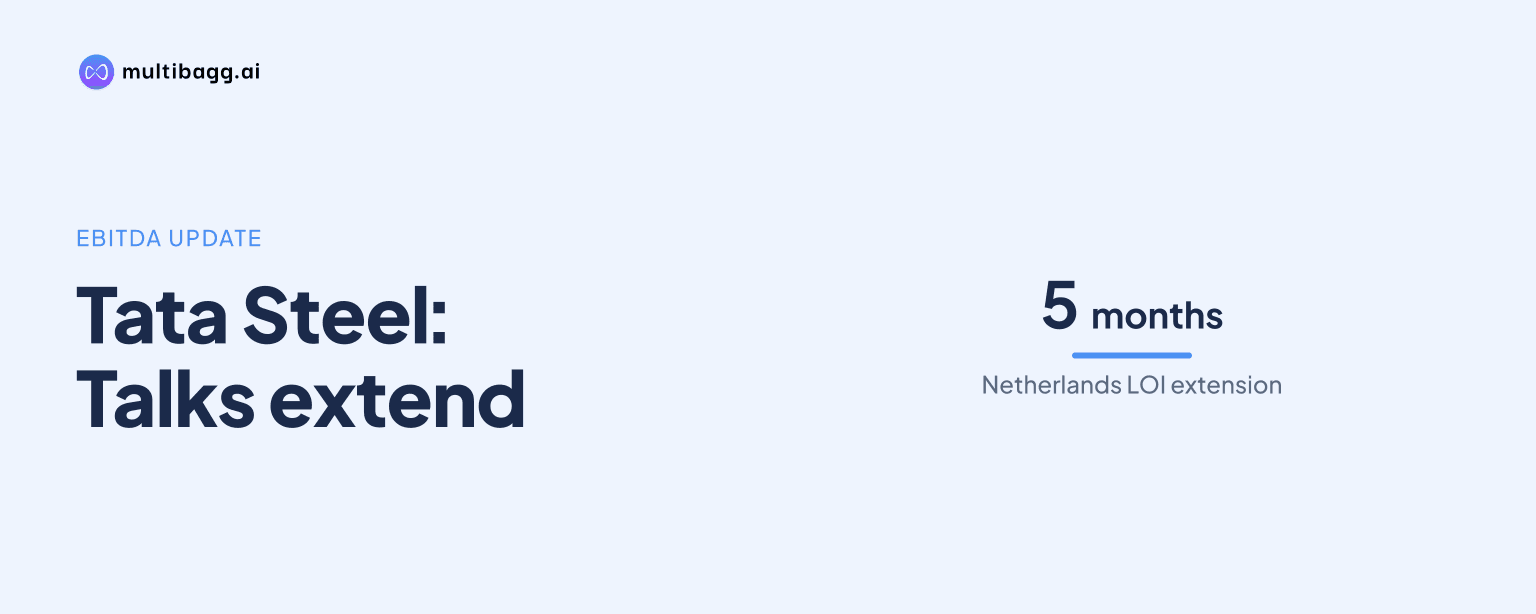
Tata Steel Limited extended its Netherlands Joint Letter of Intent to 1 March 2027 because coke-plant closure sequencing, slag management, energy affordability, permits and capital requirements remain unresolved, even as Netherlands EBITDA rose to €720 lakh in the second quarter of FY2027 from €40 lakh in the first quarter.
Know Tata Steel inside out
Results, valuation, peers and who's buying, in one view.
Why did Tata Steel extend the Netherlands agreement to March 2027?
Tata Steel extended the Joint Letter of Intent by five months because the company, the Government of the Netherlands and the Province of North Holland need more time to establish a framework for decarbonisation and the long-term competitiveness of the IJmuiden site. The agreement, first signed in September 2025, now has a revised maturity date of 1 March 2027.
Tata Steel said its engineering and technical work has further developed the direct reduced iron-electric arc furnace, or DRI-EAF, pathway. DRI is iron made by removing oxygen from ore without a blast furnace, while an electric arc furnace, or EAF, uses electricity to make steel. The DRI-EAF route remains the reference case in the Joint Letter of Intent, but Tata Steel is also assessing strategic alternatives and sequencing options.
Management did not describe the extension as a final investment decision or a settled transition plan. It said the eventual pathway will depend on external factors and their effect on future cash flows and competitiveness at a site that produced about 1.52 million tonnes of liquid steel in the second quarter of FY2027.
What issues remain unresolved at Tata Steel Netherlands?
Tata Steel said the timing and sequencing of proposed closures of Coke & Gas Plants 2 and 1 remain unresolved in discussions with the regulator and the Province of North Holland. The company has provided technical assessments and said any closure must be conducted safely, responsibly and with operational control, but it gave no closure date on the 7 November 2026 earnings call.
Steel-slag management is also unresolved after temporary disruption to slag off-take caused additional stockpiling at IJmuiden. Tata Steel said it is examining technical measures, alternative storage and disposal solutions, and stakeholder engagement. It did not quantify the stockpile or set a timetable for restoring normal off-take.
Tata Steel identified long-term energy affordability, capital requirements, permitting timelines and the wider investment framework as further determinants of the economics of both the existing business and the proposed decarbonisation route. These factors are external to the company, and management said their timing and outcome remain difficult to predict.
The company is also monitoring the European Union Emissions Trading System, or EU ETS, and the Carbon Border Adjustment Mechanism, or CBAM. EU ETS is the European carbon-pricing system, while CBAM applies a carbon-related adjustment to certain imports. Tata Steel said these regulatory developments could influence the Netherlands operating environment.
How did Tata Steel Netherlands perform after the Direct Sheet Plant restarted?
Tata Steel Netherlands improved in the second quarter after its Direct Sheet Plant, or DSP, restarted in early August 2026 under agreed regulatory terms. The DSP had lost almost all of its first-quarter output and represents about 1.4 million tonnes of annual processing capacity, or roughly 18% of Netherlands volumes.
The DSP was operating at rated capacity at the time of the call, subject to periodic review. Tata Steel said its technical measures had materially reduced Chromium-6 emissions and kept them below prescribed limits. Management said the restart improves product mix, raises efficiency across the integrated production chain and lowers conversion costs, rather than merely restoring volume.
Tata Steel reported Netherlands liquid steel production of about 1.52 million tonnes and deliveries of about 1.30 million tonnes in the second quarter. The gap between production and deliveries was about 0.22 million tonnes. Management expects the second half of FY2027 to be better than the first half, supported by DSP availability, improved plant stability and contract-price negotiations.
For the full year, management said Tata Steel should target production of around 6.5 million tonnes and deliveries of around 6 million tonnes in the Netherlands. Achieving those levels would require the final two quarters to return towards normal average quarterly performance after the DSP disruption in the first quarter.
Got a follow-up? Ask IRIS
Why has Tata Steel not changed the Netherlands carrying value?
Tata Steel has not recognised a change in the carrying value of its Netherlands business because the Board and management said they cannot reliably determine the range of possible outcomes or assign probabilities to them. The company said a carrying-value change before the outstanding issues are resolved would not faithfully represent its position.
The uncertainty concerns factors that could materially affect future cash flows, including the coke-plant closure process, slag arrangements, energy costs, investment requirements and permits. Tata Steel’s second-quarter EBITDA improvement to €720 lakh does not resolve those longer-term questions because it followed the operational restart of the DSP.
Management said Tata Steel will continue monitoring developments and reassess the position as key uncertainties are resolved. It expects greater clarity by 1 March 2027, the revised maturity date of the Joint Letter of Intent, when it expects discussions to establish a clearer strategic direction and allow a more definitive long-term assessment.
How does the Netherlands outlook differ from Tata Steel UK?
Tata Steel said the Netherlands is not facing the same import-inventory issue reported in the United Kingdom. In continental Europe, management said quotas had already reduced imports and CBAM is approaching, supporting Netherlands prices and volumes. In the UK, imports averaged about 0.74 million tonnes a month from April through July 2026, 22% above 2025 levels.
UK flat-steel inventories rose to roughly 0.87 million tonnes by September 2026, nearly 60% above normal levels and equivalent to almost three months of demand, according to Tata Steel. The company said UK deliveries were about 0.4 million tonnes in the second quarter, compared with the 0.5 million to 0.6 million tonnes per quarter it said are needed to approach break-even.
Tata Steel expects contract-price negotiations to support a better fourth quarter for both European businesses. Management said Netherlands and UK prices are increasing through negotiations for packaging and automotive contracts, while the UK recovery also depends on old import inventories being cleared, which it expects mostly by March and in some categories by June.
Conclusion
Tata Steel’s Netherlands transition remains an unresolved industrial, regulatory and investment process rather than a completed decarbonisation programme. The DSP restart repaired a significant first-quarter operational disruption and lifted second-quarter EBITDA from €40 lakh to €720 lakh, but it did not settle the issues that will determine IJmuiden’s long-term cash flows and competitiveness.
The next date to watch is 1 March 2027, when the extended Joint Letter of Intent is due to mature and Tata Steel expects greater clarity. Management also retained its FY2027 cost-transformation target of about Rs 7,000 crores, including initiatives in India and the Netherlands, after reporting about Rs 1,800 crores of savings in the first half.