










Tata Steel Sees UK Near Breakeven in the Fourth Quarter
Key highlights
- Tata Steel expects UK operations to come close to breakeven in the fourth quarter if sales recover toward 0.5 million to 0.6 million tonnes a quarter.
- UK flat-steel inventories were about 0.865 million tonnes in September, nearly 60% above normal levels.
- UK imports averaged 0.738 million tonnes a month from April to July 2026, 22% above the 2025 level.
- Tata Steel expects third-quarter UK realisations to rise by about £28 to £30 per tonne from the second quarter.
powered by IRIS
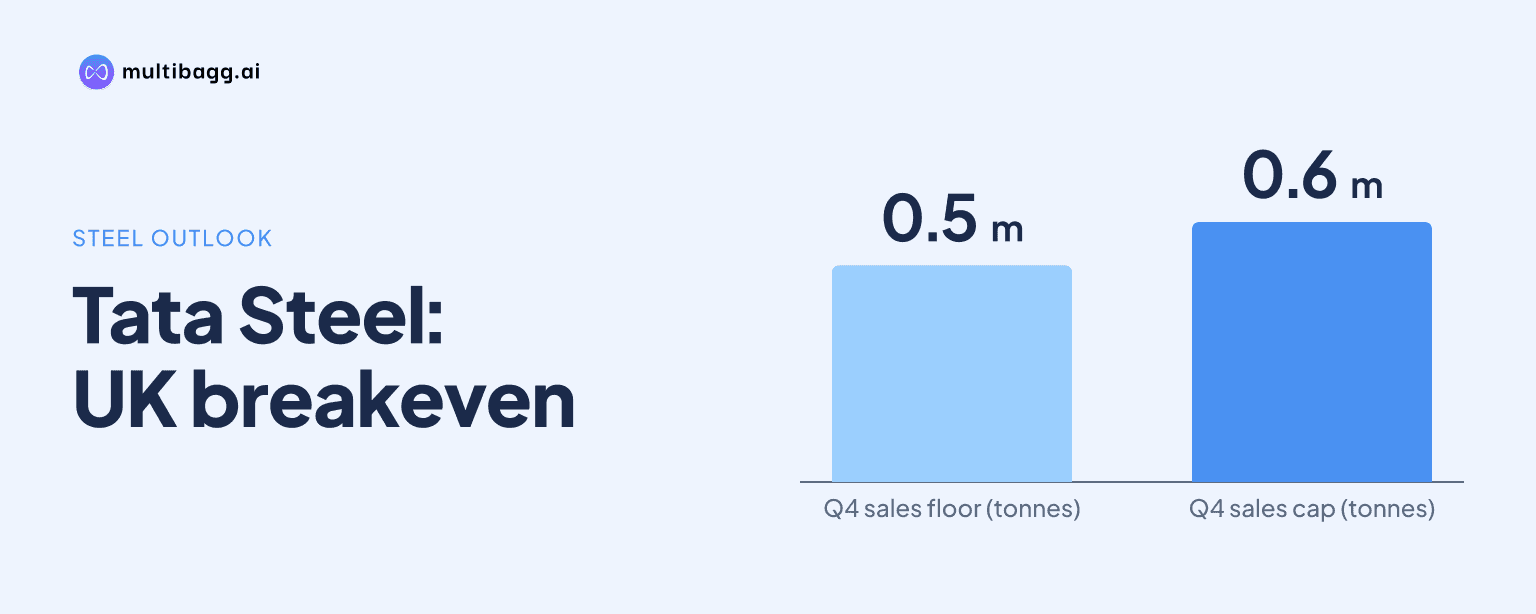
Tata Steel Limited expects its UK operations to come close to breakeven in the fourth quarter, provided excess import stocks are largely cleared by March and quarterly deliveries rise from about 0.4 million tonnes toward 0.5 million to 0.6 million tonnes. Management said high inventory, rather than steel prices, is limiting UK throughput.
Know Tata Steel inside out
Results, valuation, peers and who's buying, in one view.
Why does Tata Steel expect UK operations to near breakeven in the fourth quarter?
Tata Steel expects UK operations to near breakeven in the fourth quarter because it expects import inventories to be substantially liquidated by March, allowing deliveries to recover toward 0.5 million to 0.6 million tonnes a quarter. UK deliveries were about 0.4 million tonnes in the second quarter, against the 0.6 million tonnes a quarter that management said it wants to sell.
The expected recovery is principally volume-led. Management said prices and spreads were already favourable, but the UK business could not absorb its fixed-cost base while volumes remained at about two-thirds of the intended 0.6 million-tonne quarterly level. Tata Steel has removed almost £40 crore of fixed costs, but said residual fixed costs remain material at current throughput.
Management described the fourth-quarter outcome as conditional, rather than guaranteed. It said the UK has faced several execution setbacks, and some inventory-heavy product categories may not normalise until June of the following year. The immediate assumption is that most stocks will leave the market by March, enabling sales volumes to begin recovering in the fourth quarter.
How large is the UK import inventory overhang?
The UK import overhang reached about 0.865 million tonnes of flat-steel inventory in September, nearly 60% above normal levels and equal to almost three months of demand. Imports averaged 0.738 million tonnes a month between April and July 2026, 22% above the 2025 level, reducing the market available to domestic producers.
Tata Steel said the inventory increase reflected import orders booked before 14 March that were permitted to enter the UK through the July-to-September quarter. Changes to quotas are helping the market rebalance, according to management, but the liquidation process has taken longer than initially expected. Domestic automotive and construction activity was also expected to decline by 2% to 4% in the current calendar year.
The second-quarter inventory effect occurred despite an improvement of about £72 per tonne in UK net realisations from the first quarter. This contrast explains management’s focus on volumes: higher realised prices did not offset the cost impact of selling about 0.4 million tonnes a quarter instead of the targeted 0.5 million to 0.6 million tonnes.
Got a follow-up? Ask IRIS
What pricing support does Tata Steel expect before the fourth quarter?
Tata Steel expects third-quarter UK realisations to rise by about £28 to £30 per tonne from the second quarter, which management said should reduce losses before the anticipated fourth-quarter volume recovery. It attributed the expected improvement to price increases and contract renegotiations in stronger market conditions.
Annual contracts for packaging, automotive and other customers were being negotiated during the quarter, but management said their full benefit would come only from the first quarter of the next financial year. It nevertheless expects the contract outcomes to be reflected in fourth-quarter realisations. UK prices were then above European prices, though management said volume availability remained the more important issue.
The Netherlands offers a contrasting operating backdrop. Tata Steel’s Netherlands earnings before interest, tax, depreciation and amortisation, or EBITDA, rose from €40 lakh in the first quarter to €7.2 crore in the second quarter after the Direct Sheet Plant restarted in early August. The plant has annual processing capacity of about 1.4 million tonnes, or roughly 18% of Netherlands volumes.
Management said Europe did not face the UK’s import-inventory problem because quotas had already reduced imports there. It expects the Netherlands to report a better third and fourth quarter than the first half, supported by Direct Sheet Plant operations and pricing. The UK, by contrast, needs both higher realisations and the clearance of stock already in the domestic market.
How does Tata Steel assess the UK business beyond standalone losses?
Tata Steel assesses the UK business as part of an integrated India-to-UK value chain while its electric arc furnace project is under construction. It currently sends a significant share of steel substrate from India to the UK for rolling, finishing and downstream sales, meaning the UK entity’s standalone EBITDA does not capture all of the group economics.
Management said the Indian production stage generated about Rs 8,000 of EBITDA per tonne on the volume supplied to the UK, while subsequent UK rolling, finishing and downstream activity generated about Rs 5,000 to Rs 6,000 per tonne in the preceding quarter. On that combined basis, management put the economics of the same coil at about Rs 13,000 to Rs 14,000 per tonne.
That calculation will change once the planned 3.2-million-tonne-per-annum electric arc furnace, or EAF, is operating. Tata Steel said major enabling works had been completed, key contracts awarded and the Llanwern pickle line fully ramped up. Future UK profitability would then depend on EAF steelmaking costs as well as the economics of rolling and finishing.
The transition still involves external trade and infrastructure issues. Tata Steel said slabs shipped from India to the UK are exempt from duty, but UK exports to the European Union face quota restrictions; the UK had historically sold about 0.7 million to 0.8 million tonnes into Europe. Management is engaging with the UK government on quotas, public procurement, energy prices, investment conditions and National Grid connectivity.
Conclusion
Tata Steel’s fourth-quarter UK breakeven expectation depends on a return in deliveries, not simply higher steel prices. The business is selling about 0.4 million tonnes a quarter while management says 0.5 million to 0.6 million tonnes is needed for breakeven, and the difference reflects the 0.865-million-tonne flat-steel inventory overhang reported in September.
The next test is whether most imported stocks clear by March, as management expects, or whether affected categories continue into June. Investors can also watch the 3.2-million-tonne-per-annum EAF project, annual contract pricing, UK-EU trade discussions, energy costs and grid-connection progress, which management identified as factors in the UK site’s longer-term competitiveness.