










UFLEX film prices rose as West Asia disrupted supply in Q2
Key highlights
- UFLEX’s 18-micron BOPP market-price indicator reached Rs 185 per kg in September 2026, compared with Rs 124 per kg in September 2025.
- Packaging-film sales volume rose 3.0% year on year in Q2 FY27, while total film production increased 12.5% to 135,778 metric tonnes.
- UFLEX reported Q2 FY27 normalized EBITDA of Rs 758.8 crore, up 94.8% year on year, with a 15.6% margin.
- UFLEX said West Asia disruption caused MEG shortages, raising Virgin PET Chip input costs and constraining finished-goods availability.
powered by IRIS
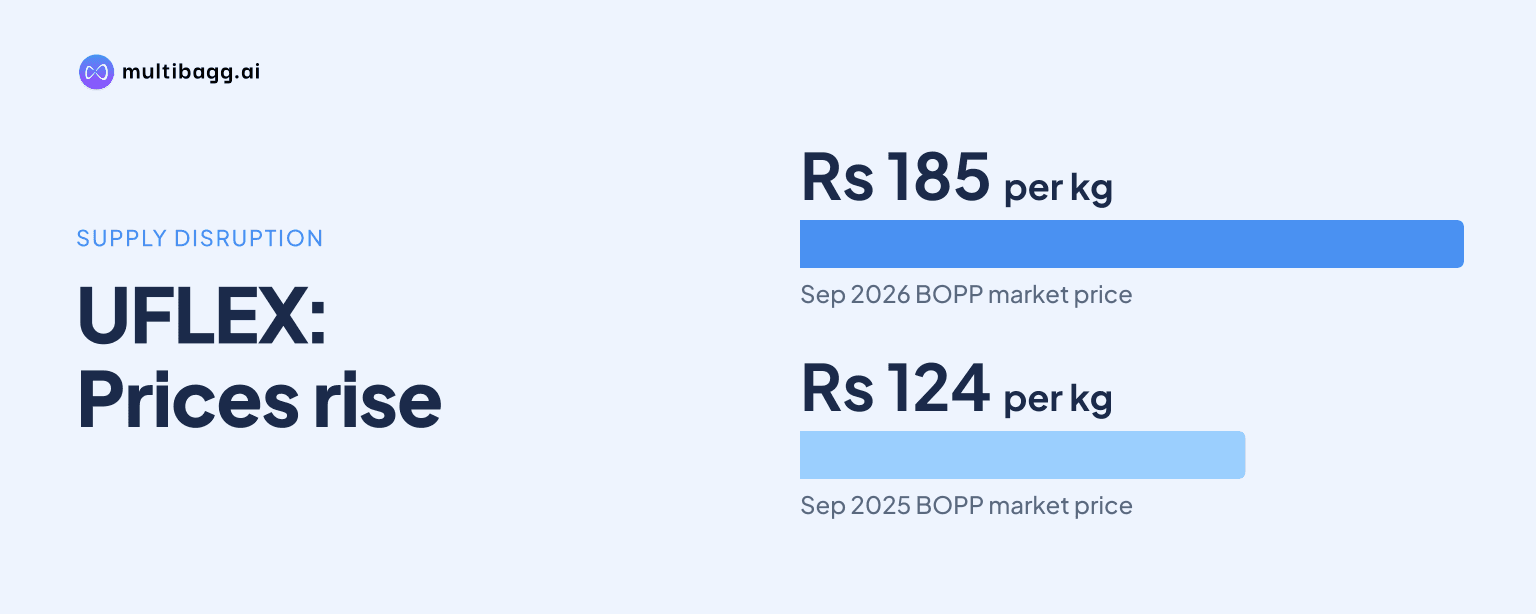
UFlex Limited reported that West Asia disruption lifted packaging-film and feedstock market prices in Q2 FY27, with the 18-micron BOPP film indicator reaching Rs 185 per kg in September 2026, compared with Rs 124 per kg a year earlier. The company said the disruption also caused monoethylene glycol shortages and changed customer purchasing patterns.
Know Uflex inside out
Results, valuation, peers and who's buying, in one view.
How much did UFLEX packaging-film prices rise in Q2 FY27?
UFLEX’s 18-micron plain biaxially oriented polypropylene, or BOPP, film market-price indicator rose from Rs 172 per kg in July 2026 to Rs 185 per kg in September 2026. The September level was Rs 61 per kg above the Rs 124 per kg recorded in September 2025, before the indicator eased to Rs 178 per kg in October 2026 and Rs 172 per kg on November 14, 2026.
The 12-micron plain biaxially oriented polyethylene terephthalate, or BOPET, film indicator also remained above the prior-year level during the quarter. It averaged Rs 151 per kg in July 2026, Rs 140 per kg in August and Rs 141 per kg in September, compared with Rs 93 per kg in July and August 2025 and Rs 97 per kg in September 2025.
UFLEX said these figures are average market prices from market intelligence, rather than its actual selling or purchase prices. The BOPP series had stood at Rs 123 per kg in July 2025, while BOPET moved from Rs 109 per kg in October 2025 to Rs 151 per kg in July 2026, showing the change in market conditions before BOPET moderated in August and September.
Which raw materials did the West Asia disruption affect?
UFLEX said the West Asia crisis caused shortages of monoethylene glycol, or MEG, raising input costs for Virgin PET Chips and tightening finished-goods availability. Its pricing presentation describes broad-based increases in MEG, purified terephthalic acid, or PTA, melt and Brent crude during the Q2 FY27 environment.
The supplied pricing series lists MEG at Rs 70.26 per kg, PTA at Rs 106.99 per kg and melt at Rs 116.70 per kg at their displayed high points. Europe Brent crude reached USD 123.90 per barrel in the same series, compared with an earlier displayed low of USD 63.20 per barrel. UFLEX notes that the PTA and MEG figures are average import-index prices and exclude import duty, terminal handling charges and local freight.
UFLEX identified its integrated Panipat operations and domestic PTA and MEG sourcing from Indian Oil Corporation Limited as mechanisms that provided feedstock security and supply continuity. The company said higher realisations of solid-state polymerised, or SSP-grade bottle-grade, chips supported Virgin PET Chip sales growth, even as MEG shortages increased input costs and constrained available finished-goods volumes.
Got a follow-up? Ask IRIS
How did higher prices change packaging-film demand and imports?
UFLEX said packaging-film demand gained traction in Q2 FY27 as customers replenished inventory and imports declined. This followed purchase deferrals in Q1 FY27 after West Asia crisis-driven price spikes, linking the recovery in Q2 demand to earlier customer inventory decisions.
India’s fast-moving consumer goods, or FMCG, sales volume grew 3.6% year on year in the September quarter, according to the presentation. Rural volume grew 3.6%, marginally ahead of urban growth of 3.5%, after overall FMCG volume had declined 2.0% in AMJ’26, the April-to-June period, before returning to 3.6% in JAS’26, the July-to-September period.
Inflation increased alongside this recovery in FMCG volume. The presentation shows the consumer price index at 5.3% in July 2026, 7.7% in September and 8.9% in October, while food inflation rose from 4.8% to 5.8% and then 6.1% over those months.
Regional demand conditions were mixed. UFLEX Europe sales rose 31% year on year despite summer holidays, a softer local market and greater import competition, while Middle East and Africa demand recovered after a Q1 FY27 inventory build-up and July destocking. In the United States, food and beverage volumes fell 0.3% year on year and non-food consumer packaged-goods volumes contracted 1.9%, although UFLEX said nearshoring and transit disruption supported local sourcing.
What were the volume and earnings effects for UFLEX?
UFLEX’s packaging-film sales volume increased 3.0% year on year in Q2 FY27, while total sales volume rose 1.5% to 163,532 metric tonnes. Packaging films represented 78.9% of sales volume, while packaging solutions represented 21.1% and reported a 3.9% year-on-year decline.
Packaging-film volume growth was led by the Middle East and Africa at 8.2% year on year, followed by the Americas at 5.9% and India at 0.5%. India’s film sales volume was also 12.1% higher quarter on quarter, a contrast with the overall production picture, where total packaging-film output was almost unchanged sequentially.
Total packaging-film production was 135,778 metric tonnes per quarter in Q2 FY27, compared with 135,873 metric tonnes in Q1 FY27 and 120,644 metric tonnes in Q2 FY26. India produced 35,372 metric tonnes, up 15.8% quarter on quarter, and Mexico produced 17,102 metric tonnes, up 10.4%; Egypt produced 26,043 metric tonnes, down 11.7% from Q1 FY27.
Management reported normalized earnings before interest, tax, depreciation and amortisation, or EBITDA, of Rs 758.8 crore in Q2 FY27, up 94.8% year on year. It attributed the increase to higher realisations, product mix and spread expansion; the normalized EBITDA margin rose 550 basis points to 15.6%, while total income increased 26.1% to Rs 4,869.4 crore.
Packaging Films and PET Chips accounted for 83% of the Rs 1,008.4 crore incremental revenue reported in Q2 FY27. UFLEX also reported normalized profit after tax after non-controlling interest of Rs 210.6 crore, up 682.8% year on year, while total sales volume increased by a lower 1.5%, distinguishing the reported earnings growth from physical volume growth.
Conclusion
The presentation depicts a Q2 FY27 market in which West Asia disruption increased packaging-film and raw-material market prices, reduced import availability and prompted inventory replenishment after Q1 purchase deferrals. The BOPP market-price indicator reached Rs 185 per kg in September 2026, while UFLEX reported 3.0% growth in packaging-film sales volume and normalized EBITDA of Rs 758.8 crore.
The next disclosed operational milestone is commissioning of the Egypt aseptic project in H2 FY27, with planned annual capacity of 12 billion carton packs and residual capital expenditure of Rs 151.6 crore. UFLEX also schedules the Dharwad brownfield BOPP line for FY27-28, after spending Rs 295.4 crore on that project through Q2 FY27.