










Unicommerce says B2B mix, not B2C pricing, lowers yield
Key highlights
- Unicommerce said 45% to 50% of clients use B2B and quick-commerce workflows, which have lower per-item realisation because items move in bulk.
- Unicommerce reported Q2 FY27 consolidated revenue of Rs 59.1 crore, up 15% year on year from Rs 51.4 crore.
- UniReco and UniCapture contributed 2.5% of Uniware revenue and were used by more than 150 clients.
- Unicommerce said it is onboarding 120 to 150 clients each quarter, compared with 85 to 90 around listing.
powered by IRIS
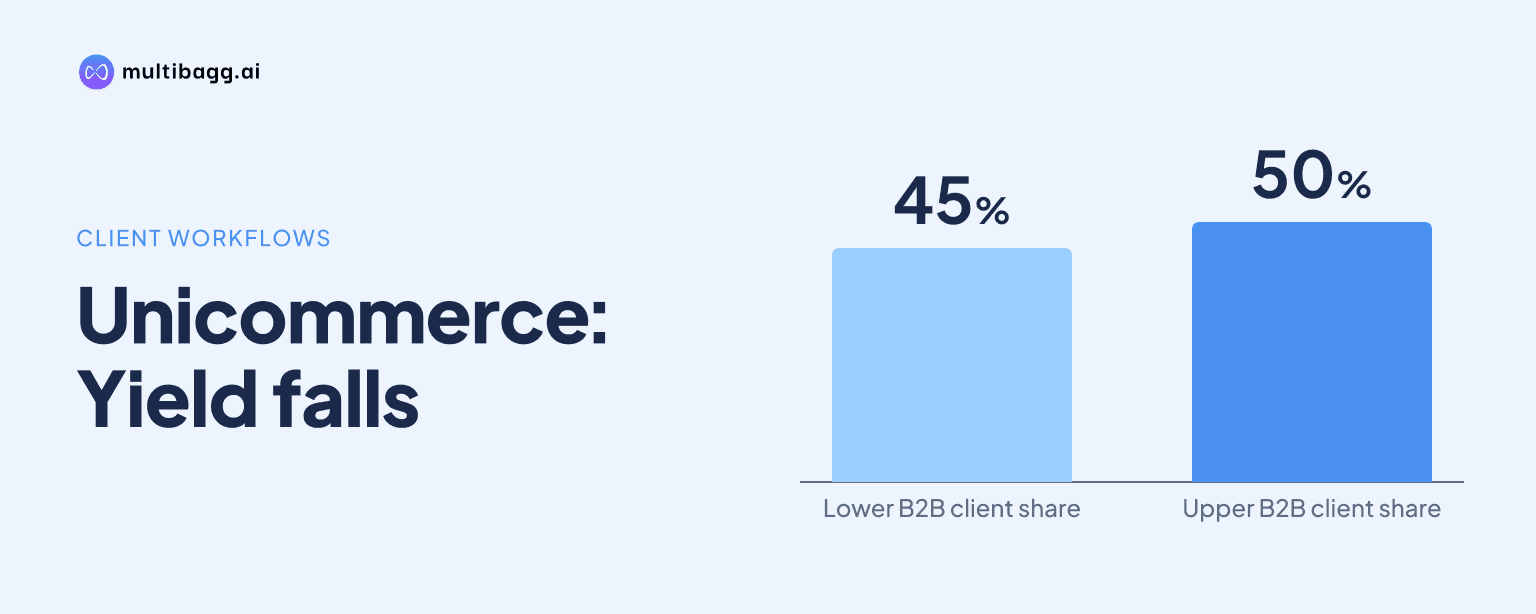
Unicommerce says its Q2 FY27 rate per transaction reflects a changing mix, not lower business-to-consumer (B2C) pricing: business-to-business (B2B) and quick-commerce workflows used by 45% to 50% of clients process bulk items at lower per-item realisation. Management said B2C realisation remained stable, but the combined metric is no longer comparable with earlier B2C-focused periods.
Know Unicommerce eSolutions inside out
Results, valuation, peers and who's buying, in one view.
Why is Unicommerce's rate per transaction lower?
Unicommerce says the reported rate per transaction is lower because its platform now handles different workflows with different unit economics. At listing, its transaction mix was predominantly B2C. As quick commerce expanded, Unicommerce added B2B and quick-commerce capabilities, creating a more heterogeneous transaction mix than the earlier B2C-led base.
The difference is driven by bulk processing. Management said B2B and quick-commerce items move in bulk, resulting in lower realisation per item than a B2C transaction. It did not disclose separate B2B or quick-commerce revenue and volume shares, but called their transaction-volume contribution reasonable given that 45% to 50% of its client base uses these offerings.
Management said B2C realisation has been stable over the past two years. Its position is that the lower blended rate reflects an added revenue line with lower per-item realisation, rather than a reduction in B2C pricing. It therefore does not consider rate per item a like-for-like measure after the increase in B2B and quick-commerce activity.
Which measures does Unicommerce use instead of transaction yield?
Unicommerce says it tracks net revenue retention (NRR), new-client acquisition and profits instead of transaction yield. NRR measures revenue development from existing customers, while client acquisition captures expansion of the customer base. Management said these measures better reflect a platform that now serves B2C, B2B and quick-commerce workflows.
The company said its quarterly onboarding pace increased to 120 to 150 clients from 85 to 90 around the time of listing. It reported consolidated revenue of Rs 59.1 crore in Q2 FY27, up 15% year on year from Rs 51.4 crore in Q2 FY26, and said stronger client acquisition supported five quarters of improving growth.
Management also linked lower average revenue per account (ARPA) to the faster addition of long-tail customers, which take six to nine months to ramp. It cited quarterly ARPA of about Rs 2.4 lakh in Q2 FY27 versus about Rs 2.9 lakh in Q2 FY26, while saying sequential ARPA remained in a similar range and it did not foresee a declining trajectory.
Got a follow-up? Ask IRIS
Can UniReco and UniCapture lift Unicommerce account revenue?
Unicommerce says UniReco and UniCapture are intended to increase account monetisation as adoption rises. More than 150 clients use the products, which were launched less than a year before the Q2 FY27 call, and they contributed 2.5% of Uniware revenue. Management said both products were built through investments made in FY24 and 2025.
For a Uniware customer adopting both modules, management said current pricing discovery can lift realisation to 1.5 to 1.7 times the base level. It expects that range to stabilise at 1.2 to 1.3 times as the modules mature. This is management's expected pricing range, rather than an average realised uplift across all customers.
UniReco was used by 7% to 8% of clients and UniCapture by 5% to 6% at the time of the call. Management said both are relevant to most marketplace sellers and expects them to contribute more than 10% of revenue over two to three years as product features and attachment rates expand.
DNA, Unicommerce's artificial intelligence-powered platform, was in beta with about 10 to 15 customers in Q2 FY27 and was being offered free. Management said it was collecting feedback on customer use cases and would establish a monetisation strategy only after making DNA more comprehensive.
How does the mix shift fit Unicommerce's growth plan?
Unicommerce is pursuing growth through new clients, wider module adoption and broader product coverage rather than by normalising transaction yield. Management forecast more than 15% Uniware growth from Q4 FY27, supported by client acquisition and adoption of UniReco and UniCapture. Customers can start with order management and subsequently add warehouse, logistics, marketing, reconciliation and image or video-capture products.
International expansion is another growth lever, although management said India would remain the dominant revenue contributor. International revenue reached 6%, from 2% to 3% at listing, and management said that business had become profitable within two years after being loss-making at listing. It expects international contribution to reach early double digits in a steady state, rather than 40% or 50%.
The product expansion coincides with planned investment in product development, talent, sales and marketing. Consolidated adjusted earnings before interest, tax, depreciation and amortisation (adjusted EBITDA) fell to Rs 10 crore in Q2 FY27 from Rs 11.4 crore a year earlier, and margin declined to 17% from 22.2%. Management said incremental investment should moderate from Q3 FY27, supporting operating leverage in H2 FY27.
Conclusion
Unicommerce's central message is that lower reported transaction realisation does not indicate a B2C price reduction. The metric now includes a substantial base of bulk B2B and quick-commerce activity, while management reported stable B2C realisation. Revenue growth of 15% to Rs 59.1 crore in Q2 FY27 and onboarding of 120 to 150 clients per quarter show the company is prioritising customer additions and platform breadth.
The next disclosed milestones are Shipway's targeted adjusted EBITDA break-even in Q3 FY27, its targeted profit after tax profitability from Q4 FY27, and management's forecast of more than 15% Uniware growth from Q4 FY27. Investors can also monitor attachment rates for UniReco and UniCapture, the stated two-to-three-year target of more than 10% revenue contribution from those modules, and DNA's eventual monetisation plan after beta feedback.