










V-Mart LimeRoad loss ratio falls to 8% on 55% growth
Key highlights
- V-Mart said LimeRoad revenue increased 55% while losses declined 32%.
- LimeRoad’s loss ratio fell to 8% of revenue from almost 18%.
- V-Mart stores fulfilled 58% of LimeRoad online orders through its 613-store network.
- V-Mart said 41 lakh LimeRoad digital customers reached physical touchpoints within 15 days.
powered by IRIS
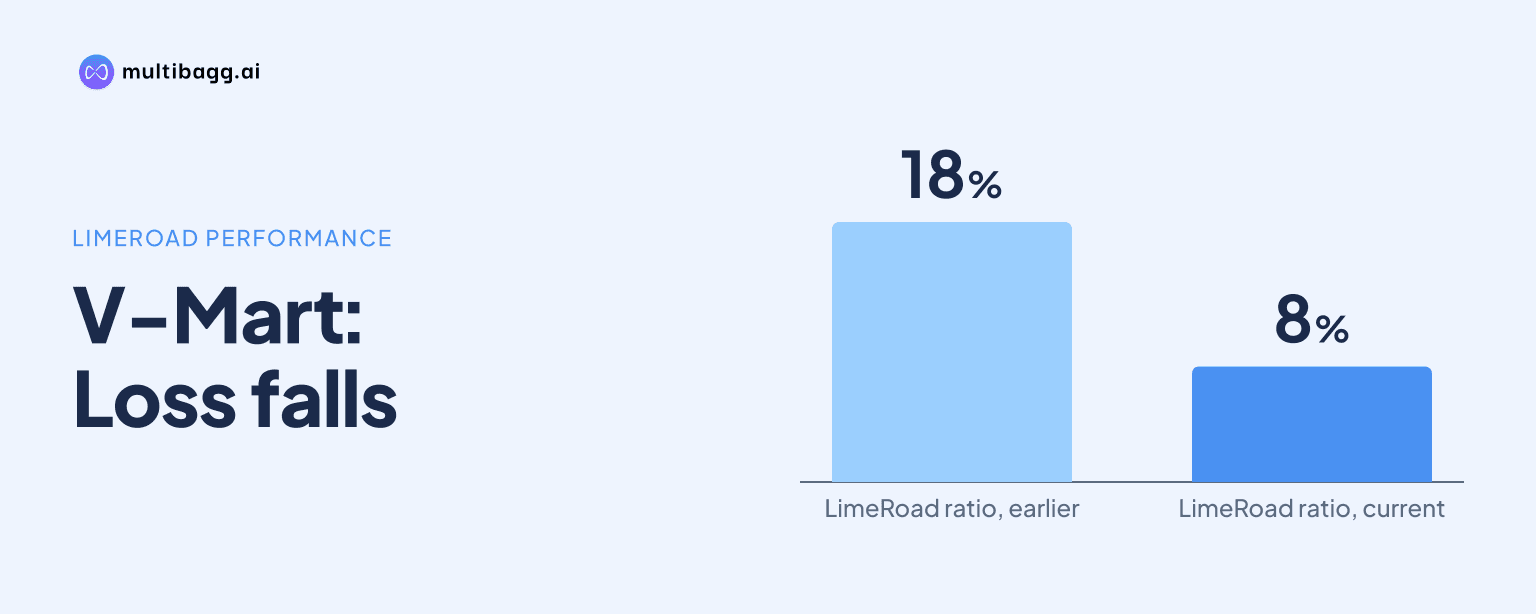
V-Mart Retail Limited said on its November 4, 2026, 2Q FY27 earnings call that LimeRoad revenue rose 55% while losses fell 32%, bringing the loss ratio to 8% from almost 18%, as 58% of online orders were fulfilled from V-Mart store inventory.
Know V-Mart Retail inside out
Results, valuation, peers and who's buying, in one view.
How did V-Mart reduce LimeRoad’s loss ratio?
V-Mart reduced LimeRoad’s loss ratio by expanding revenue while lowering reported losses. Management said LimeRoad’s top line grew 55% this year and losses declined 32%, reducing losses as a proportion of revenue to 8% from almost 18%. It did not disclose LimeRoad’s absolute revenue, loss amount or a target date for break-even.
The change follows a period in which V-Mart had reported modest or negative LimeRoad revenue growth while consolidating the operation and seeking to control losses. The 2Q FY27 update differs because it combines a 55% increase in revenue with a 32% reduction in losses. Management presented that result as evidence that its omnichannel model is beginning to improve the economics of the acquired platform.
Management said the business is moving towards sustainability, but that is management’s assessment rather than a disclosed profitability outcome. The reported loss ratio remains the clearest financial measure: it fell by about 10 percentage points while LimeRoad grew, rather than falling solely because the company reduced activity or spending.
How does V-Mart fulfil LimeRoad orders from stores?
V-Mart fulfils 58% of LimeRoad online orders from inventory held in physical V-Mart stores. Management said all 613 stores participated in this model during 2Q FY27, allowing the retailer to use merchandise already positioned within its existing store network rather than maintain a separate inventory pool for every digital order.
The mechanism is V-Mart’s endless-aisle strategy, under which store inventory can serve online demand. Management said this reduced the need for separate warehouse costs and limited additional inventory risk. The company did not quantify savings from warehousing, delivery or inventory, but explicitly identified store-led fulfilment as a driver of LimeRoad’s lower losses.
The wider retail network provides the operating base for that approach. V-Mart opened 23 stores in 2Q FY27 and ended the period with 613 stores in 351 cities. It opened 38 stores and closed two in the first half, meaning each new location can potentially add another inventory node and customer touchpoint for LimeRoad’s omnichannel operations.
V-Mart’s inventory data also shows the context in which the model is operating. Inventory days fell to 90 in 2Q FY27 from 97 a year earlier, even as inventory increased 12% year on year because festive stock was held entirely in the second quarter. These figures cover the group’s retail operations, not LimeRoad separately, but show lower inventory days despite seasonal stock-building.
Got a follow-up? Ask IRIS
Did LimeRoad browsing lead customers to V-Mart stores?
V-Mart said 41 lakh customers who engaged digitally on LimeRoad converted to its physical touchpoints within 15 days of browsing. Management described this as the purpose of its omnichannel effort: LimeRoad is intended to generate online sales while also connecting customers with nearby physical stores in V-Mart’s local catchments.
Digital users grew 37% as V-Mart expanded its endless-aisle offer. Management also said customers transacting across online and offline channels had a higher annual purchase value from V-Mart stores, although it did not disclose the purchase value, the uplift over single-channel customers, or the proportion of the 41 lakh customers who completed a purchase.
The 41 lakh figure measures customers reaching physical touchpoints after digital engagement, not a published sales conversion rate. That distinction matters because V-Mart did not report how many customers made store visits, how many purchased products, or how much LimeRoad-originated offline sales contributed to group revenue during 2Q FY27.
V-Mart’s physical business recorded revenue growth of 18% in 2Q FY27, while reported like-for-like growth was 3%. Management said like-for-like growth was 11% after adjusting for a 19-day festival shift, with Navratri beginning on October 11 this year compared with September 22 a year earlier. The shifted festive demand moved significant selling into the third quarter.
What does V-Mart’s expansion plan mean for LimeRoad?
V-Mart’s plan to open at least 90 to 100 stores in FY27 could expand the network available for LimeRoad order fulfilment and digital-to-store engagement. The retailer had already opened 38 stores in the first half, including 23 in 2Q FY27, and management said sales per square foot across the network rose 5% despite a 15% store-area addition over the previous year.
Management also pointed to the Unlimited format in South India as an expansion opportunity. Unlimited’s year-to-date sales per square foot was Rs 681, up 15%, while its 2Q FY27 earnings before interest, tax, depreciation and amortisation margin was 11.6%, compared with 10.5% a year earlier. V-Mart’s own format reported an 8.8% margin for the quarter.
LimeRoad’s asset-light description should be read alongside V-Mart’s continuing group investment. Net capital expenditure was Rs 85 crore in the first half, compared with Rs 60 crore a year earlier, for new stores, refurbishments, a new Gurgaon office and technology investments. V-Mart did not specify how much of the Rs 85 crore was attributable to LimeRoad.
Short-term borrowings stood at Rs 190 crore at the 2Q FY27 quarter end, compared with Rs 100 crore at March-end. Management attributed the increase to festive inventory, higher capital expenditure and faster vendor payments, and said there was no long-term debt. These borrowings relate to group working capital rather than a disclosed LimeRoad funding requirement.
Conclusion
V-Mart’s LimeRoad update links lower losses to a store-led operating model: the platform’s revenue rose 55%, its losses fell 32%, and 58% of online orders were supplied from existing store stock. The 41 lakh customers reaching physical touchpoints within 15 days also show that management is using LimeRoad as a bridge between digital browsing and the physical retail network.
The next disclosure to watch is whether the 8% loss ratio narrows further as V-Mart pursues at least 90 to 100 new stores in FY27. Management has not provided LimeRoad revenue guidance, an order target or a break-even timetable, while the festival shift of 19 days puts more of the seasonally important demand into 3Q FY27.