










V-Mart targets 5% to 6% ASP growth amid cost pressure
Key highlights
- V-Mart is targeting 5% to 6% average selling price growth, with around 5% expected to be passed to consumers.
- V-Mart's second-quarter gross margin was 33.5%, compared with 33.6% a year earlier.
- V-Mart's inventory days fell to 90 from 97 year on year despite a 12% increase in inventory.
- V-Mart reached 613 stores across 351 cities after opening 23 stores in the second quarter.
powered by IRIS
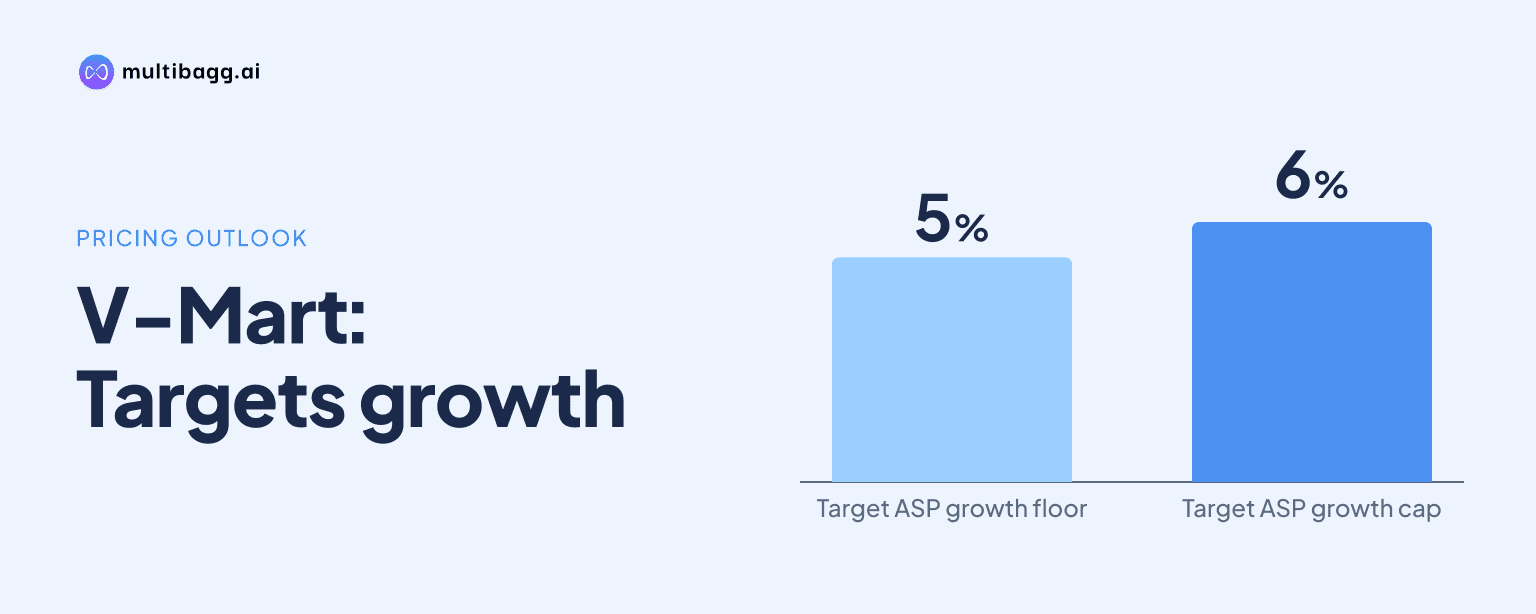
V-Mart is targeting 5% to 6% average selling price growth while seeking to contain input-cost pressure, after reporting second-quarter gross margin of 33.5%, compared with 33.6% a year earlier. Management said only a limited price increase was taken during the quarter, as it balances vendor efficiencies, customer demand and competitive conditions.
Know V-Mart Retail inside out
Results, valuation, peers and who's buying, in one view.
How much price growth is V-Mart targeting?
V-Mart is targeting 5% to 6% growth in average selling price, or ASP, and management said it expects about 5% to be passed on to consumers. Management added that its strategy changes could result in somewhat higher ASP improvement, but described the overall target range as 5% to 6%.
The approach is not to transfer the entire rise in raw-material costs to customers at once. Management said a full pass-through would create a steep increase for consumers and recalled a poor response when pricing rose sharply in 2022-23. V-Mart is instead using vendor negotiations and internal efficiency measures while seeking to limit the impact on margins.
Management said the margin outcome could range from a compromise of 0.5 percentage point to an addition of 0.5 percentage point, depending on conditions. This was management's description of how it is managing the trade-off, rather than formal margin guidance.
Has V-Mart already raised apparel prices?
V-Mart said apparel ASPs were flat year on year in the second quarter despite the expectation of 5% to 6% ASP growth over time. Management attributed the flat quarterly ASP to better full-price sell-throughs and only a limited price increase during the period.
The quarter was also affected by a 19-day shift in the festive calendar. Navratri began on October 11 this year, compared with September 22 in the previous year, moving the festive period from the second quarter into the third quarter. Management said this timing affected sales patterns and gave it more days to dispose of seasonal stock before winter merchandise launches.
Gross margin was 33.5% in the second quarter, against 33.6% a year earlier, while rupee gross margin increased 18% in line with sales growth of 18%. The comparison shows that the gross-margin rate was largely maintained despite cost pressure, but management declined to describe the quarter as a bottoming point for gross margin.
Can V-Mart protect margins without reducing customer demand?
V-Mart said customer basket-size growth is not very high despite inflation, even though higher ASPs have created some movement in basket values. Management said the number of customers coming out to buy could decline if consumer sentiment remains lower, making a steep price pass-through harder to implement.
Demand indicators in the second quarter were mixed. Reported same-store sales growth was 3%, while like-for-like growth adjusted for the festival shift was 11%. Footfalls rose 36% and memo count increased 15%, although management said the prior-year footfall base contained anomalies that are being streamlined and suggested conversion closer to 35% as a more relevant metric going forward.
V-Mart said festive trading had been positive but below its own target. Management did not disclose October same-store sales growth, saying it does not have a policy of reporting mid-month figures. For the full year, management reiterated an estimated total sales-growth range of around 17% to 20%.
Got a follow-up? Ask IRIS
Where does competition add to V-Mart's pricing challenge?
V-Mart sees the highest competitive intensity in hinterland markets across Odisha, Bengal, Bihar, Jharkhand and Uttar Pradesh. Management said East India-based, North India-based, Mumbai-based and national retailers are adding stores in these markets, making them larger battlegrounds than other regions.
This regional competition matters because V-Mart is seeking ASP growth while management says consumer sentiment may be lower. The stated response is to acquire more customers through store-level activities while maintaining a value proposition, rather than relying solely on a broad pricing increase.
Store expansion continues alongside this competitive environment. V-Mart opened 23 stores and closed one in the second quarter, reaching 613 stores across 351 cities. It opened 38 stores in the first half against two closures and remains committed to opening at least 90 to 100 stores in the current financial year.
Management said new stores are generally constrained to 7,000 to 8,000 square feet, with about 7,500 square feet its average sweet spot. This format is part of V-Mart's expansion model and reflects management's effort to fit stores to local properties while pursuing further additions.
What efficiency measures are offsetting V-Mart's cost inflation?
V-Mart is using procurement planning, vendor partnerships, inventory allocation and supply-chain operations to offset cost pressure. Management said it is refining the breadth and depth of product options, size mix, procurement timing and production turnaround time to improve store availability and seasonal responsiveness.
Inventory days fell to 90 from 97 year on year, even as inventory value increased 12% because festive stock was held entirely within the second quarter. Management said per-store inventory was lower year on year, despite the current year's festive stock not having partly sold through by September as it had in the previous year.
V-Mart also said it paid vendors nine days earlier, supported by cash-flow management, while treating vendor relationships as important to the growth of a value retailer. Short-term borrowings were Rs 190 crore at the quarter end, compared with Rs 100 crore at March end, which management attributed to festive inventory stocking, higher capital expenditure and faster vendor payments. Management said V-Mart had no long-term debt.
Net capital expenditure was Rs 85 crore in the first half, compared with Rs 60 crore a year earlier, mainly for new stores, refurbishments, a new office and technology investments. On a pre-Ind AS basis, V-Mart's profit before tax loss narrowed to Rs 26 crore from Rs 28 crore, while management said actual interest outgo was flat at about Rs 6 crore.
Post-Ind AS earnings before interest, tax, depreciation and amortisation, or EBITDA, margin was 9.0%, compared with 8.9% a year earlier. V-Mart format EBITDA margin was 8.8%, while Unlimited reported 11.6%, up from 10.5%; management said almost 55% of Unlimited stores are newer locations with lower rentals than legacy stores.
Conclusion
V-Mart's stated pricing plan is a measured 5% to 6% ASP increase rather than an unrestricted pass-through of inflation. The second-quarter result showed broadly stable gross margin at 33.5% versus 33.6%, supported by limited price increases, full-price sell-through, vendor work and inventory discipline. However, management's comments also point to constrained basket-size growth and intense competition in several core hinterland markets.
The next factors to watch are festive sales, customer acceptance of ASP increases and the pace of store openings. Management said festive trading was positive but below target, estimates total sales growth of around 17% to 20%, and plans at least 90 to 100 new stores in the current financial year after opening 38 in the first half.