










V-Mart operating cash flow falls 40% as inventory rises
Key highlights
- V-Mart’s operating cash flow fell to Rs 140.21 crore from Rs 232.67 crore in the six months ended September 30, 2026.
- Inventory increased by Rs 202.88 crore to Rs 1,190.41 crore at September 30, 2026.
- Profit before tax increased to Rs 38.82 crore from Rs 29.33 crore in the six-month period.
- Cash and cash equivalents were Rs 12.96 crore at September 30, 2026, versus Rs 19.53 crore at March 31, 2026.
powered by IRIS
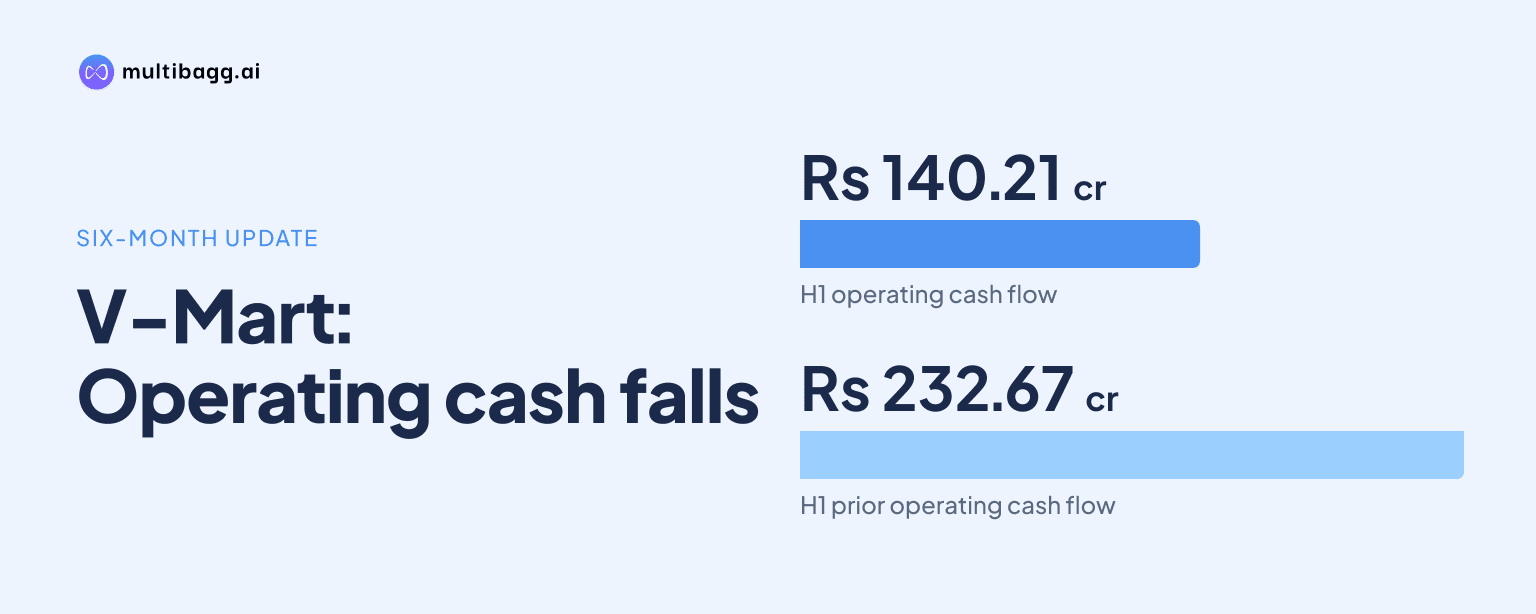
V-Mart Retail Limited generated Rs 140.21 crore in net operating cash flow for the six months ended September 30, 2026, down 40% from Rs 232.67 crore a year earlier, as inventories increased by Rs 202.88 crore. The cash decline occurred although profit before tax rose to Rs 38.82 crore from Rs 29.33 crore.
Know V-Mart Retail inside out
Results, valuation, peers and who's buying, in one view.
Why did V-Mart’s operating cash flow decline?
V-Mart’s operating cash flow declined because inventory and other asset increases absorbed more cash than the improvement in operating profit before working-capital changes. Net cash generated from operating activities was Rs 140.21 crore in the six months ended September 30, 2026, compared with Rs 232.67 crore in the corresponding 2025 period, a fall of Rs 92.46 crore.
Operating profit before working-capital changes increased to Rs 249.16 crore from Rs 206.61 crore, up Rs 42.55 crore. The reconciliation included Rs 172.70 crore of depreciation and amortisation, compared with Rs 139.02 crore a year earlier, and Rs 40.51 crore of finance costs, compared with Rs 35.69 crore.
The principal working-capital outflow was the Rs 202.88 crore increase in inventories, against an increase of Rs 57.28 crore in the previous six-month period. Income tax paid, net of refunds, also rose to Rs 15.06 crore from Rs 3 crore, reducing the amount retained as operating cash.
How much did V-Mart’s inventory increase?
V-Mart’s inventory increased by Rs 202.88 crore in the six months ended September 30, 2026, reaching Rs 1,190.41 crore at September 30 from Rs 987.53 crore at March 31, 2026. The cash-flow statement records that movement as an increase in inventories, making it an operating-cash outflow.
The increase was Rs 145.60 crore greater than the Rs 57.28 crore inventory increase recorded in the corresponding six months of 2025. At September 30, inventory was V-Mart’s largest current-asset line, ahead of other current assets of Rs 232.01 crore and other financial assets of Rs 44.73 crore.
Revenue from operations rose to Rs 2,041.80 crore in the 2026 six-month period from Rs 1,692.09 crore a year earlier. Purchases of stock-in-trade increased to Rs 1,550.58 crore from Rs 1,165.65 crore, while the income statement also reported a negative Rs 202.88 crore change in inventories, compared with negative Rs 57.28 crore a year earlier.
Which working-capital items partly offset V-Mart’s inventory outflow?
V-Mart partly offset the inventory outflow through increases in trade payables and other financial liabilities, although those movements did not cover inventory and other-asset cash absorption. Trade payables increased by Rs 109.27 crore in the six months ended September 30, 2026, compared with a Rs 106.81 crore increase in the previous-year period.
Other financial liabilities increased by Rs 53.64 crore, versus Rs 7.69 crore a year earlier, while employee benefit obligations increased by Rs 2.74 crore against Rs 0.79 crore. These three inflows totalled Rs 165.65 crore, but V-Mart also recorded a Rs 50.08 crore increase in other assets and a Rs 5.96 crore increase in financial assets and loans.
Total current liabilities were Rs 1,471.07 crore at September 30, 2026, compared with Rs 1,196.04 crore at March 31, 2026. Borrowings rose to Rs 189.95 crore from Rs 100.01 crore, and dues to creditors other than micro and small enterprises rose to Rs 410.79 crore from Rs 275.10 crore.
Got a follow-up? Ask IRIS
Did V-Mart’s higher profit convert into higher cash generation?
V-Mart reported higher first-half profit, but it did not convert into higher operating cash generation because of the larger working-capital investment. Profit before tax increased 32% to Rs 38.82 crore from Rs 29.33 crore, while profit for the period increased to Rs 30.87 crore from Rs 24.73 crore.
Earnings before interest, taxes, depreciation and amortisation, or EBITDA, increased to Rs 246.70 crore from Rs 197.68 crore. V-Mart defines EBITDA as profit or loss before exceptional item and tax, less other income, with finance costs and depreciation and amortisation added back.
The Retail Trade segment reported a Rs 53.02 crore result for the six months, compared with Rs 47.11 crore a year earlier. The Digital Marketplace segment recorded a Rs 5.61 crore loss, narrower than the Rs 8.76 crore loss in the corresponding 2025 period.
How did V-Mart’s investing and financing flows affect cash?
V-Mart’s cash and cash equivalents declined by Rs 6.51 crore over the six months, to Rs 12.96 crore at September 30, 2026 from Rs 19.53 crore at the start of the period. Net cash used in investing activities was Rs 63.80 crore, compared with Rs 59.71 crore used in the previous-year six-month period.
Purchases of property, plant and equipment, including intangible assets, capital work in progress and capital advances, rose to Rs 81.46 crore from Rs 58.51 crore. Purchases of investments were Rs 223.49 crore and proceeds from their sale were Rs 236.60 crore during the 2026 period.
Financing activities included Rs 89.94 crore of net proceeds from short-term borrowings, compared with net repayments of Rs 47.85 crore a year earlier. V-Mart paid Rs 128.93 crore towards lease-liability principal, Rs 28.66 crore towards lease interest, Rs 11.84 crore in finance costs and Rs 7.95 crore in dividends.
Conclusion
V-Mart’s six-month results show higher reported profit alongside lower operating cash flow. The Rs 202.88 crore inventory increase, together with Rs 50.08 crore absorbed by other assets, outweighed the Rs 42.55 crore rise in operating profit before working-capital changes and reduced operating cash flow by Rs 92.46 crore year on year.
The filing does not disclose a separate management target or plan for inventories. The next financial results will show whether inventory, which stood at Rs 1,190.41 crore on September 30, 2026, changes relative to revenue and whether operating cash flow recovers as working-capital movements develop.