










V-Mart Unlimited EBITDA margin exceeds core format in 2Q FY27
Key highlights
- Unlimited’s 2Q FY27 EBITDA margin was 11.6%, compared with 8.8% for V-Mart.
- Unlimited’s year-to-date sales per square foot was Rs 681, up 15%.
- V-Mart revenue grew 18% in 2Q FY27, while management estimated adjusted like-for-like growth of 11%.
- V-Mart ended 2Q FY27 with 613 stores across 351 cities after 23 openings and one closure.
powered by IRIS
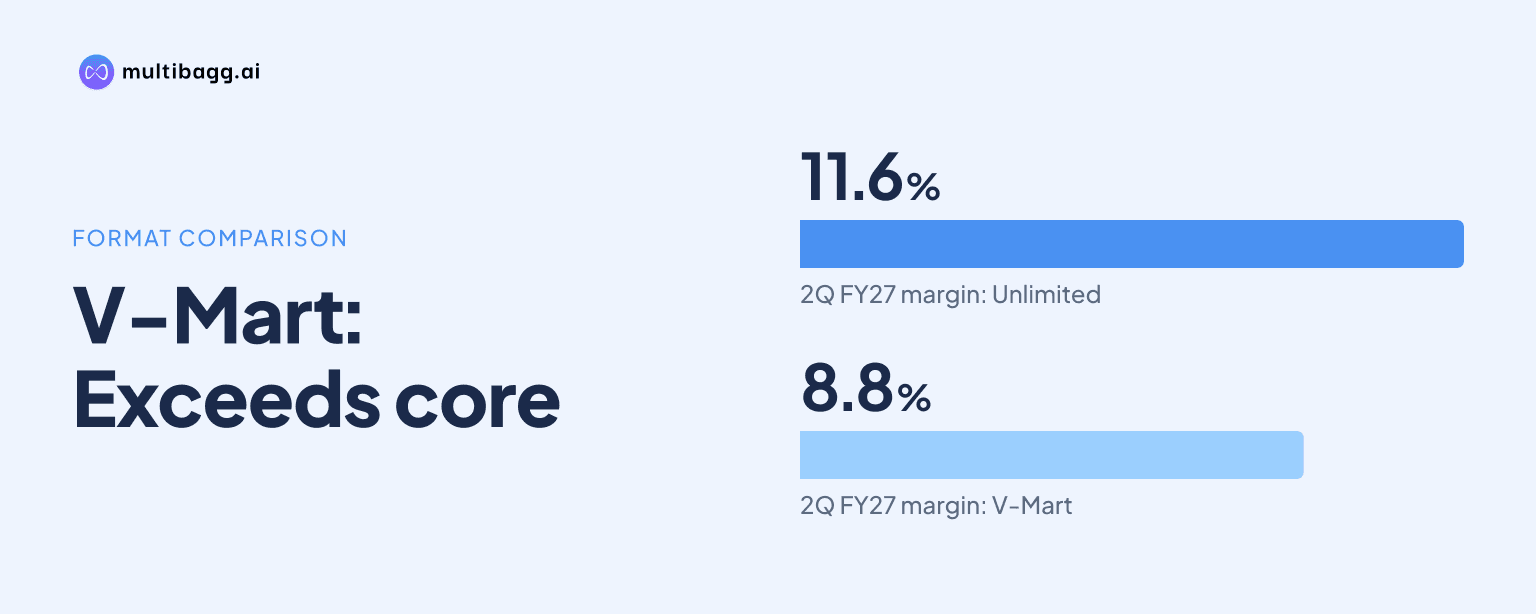
V-Mart Retail Limited’s Unlimited format reported an 11.6% earnings before interest, tax, depreciation and amortisation (EBITDA) margin in 2Q FY27, above V-Mart’s 8.8%. Unlimited’s year-to-date sales per square foot reached Rs 681, up 15%, as newer South India stores delivered materially better productivity than acquired legacy outlets.
Know V-Mart Retail inside out
Results, valuation, peers and who's buying, in one view.
How did V-Mart’s Unlimited format overtake the core format on margin?
Unlimited overtook V-Mart because its 2Q FY27 EBITDA margin reached 11.6%, compared with 8.8% for the V-Mart format. Management also said Unlimited was ahead of V-Mart on a year-to-date basis at the pre-Indian Accounting Standards (pre-Ind AS) level, marking progress in an acquired business whose profitability had been questioned by analysts for three to four years.
Unlimited’s 11.6% margin compared with 10.5% in 2Q FY26, an increase of 1.1 percentage points. V-Mart did not disclose the prior-year margin for its core format in the call, so the supplied remarks do not show its year-on-year change. The reported 2Q FY27 gap between Unlimited and V-Mart was 2.8 percentage points.
At the company level, post-Ind AS EBITDA rose 20% year on year in 2Q FY27, with margin at 9.0% against 8.9% a year earlier. On a pre-Ind AS basis, EBITDA rose 32% and margin was 0.6%. Management said the second quarter is seasonally the smallest quarter and that the festive calendar shift affected the timing of sales.
Why is South India lifting V-Mart’s Unlimited format?
South India is lifting Unlimited because its year-to-date sales per square foot reached Rs 681, up 15%, and stores opened during the past two years delivered materially better productivity than acquired legacy stores. Management said the average productivity should improve further as newer stores become a larger part of the Unlimited store base.
Management said the Unlimited market in South India was almost matching V-Mart’s sales per square foot and had delivered higher profitability. It attributed the result to changes implemented by front-end and back-end teams over the past three to five quarters, but did not quantify the individual effects of merchandising, sourcing, operations or other changes.
Management sees scope to open more Unlimited stores in South and West India, including Tier 2, Tier 3 and selected Tier 4 towns. It said South India has higher per-capita income and customers able to purchase better products and more items. This was management’s assessment of the opportunity rather than a disclosed store-opening target.
What did V-Mart’s 2Q FY27 sales and store data show?
V-Mart’s revenue grew 18% in 2Q FY27, while reported same-store growth was 3% and management estimated like-for-like growth of 11% after adjusting for the festival shift. Navratri began on 11 October in the current year versus 22 September a year earlier, moving a larger part of festive and wedding demand from the second quarter into the third quarter.
Customer activity increased during the quarter, with footfalls up 36% and memo count up 15%. Management cautioned that the prior-year footfall base had anomalies that were being streamlined and said conversion metrics closer to 35% would be more relevant going forward. Apparel average selling prices were flat year on year, supported by better full-price sell-through and limited price increases.
V-Mart opened 23 stores and closed one during 2Q FY27, taking the network to 613 stores across 351 cities. The 23 openings represented a 15% addition to store area, according to management. V-Mart said it was seeking similar or better sales per square foot from new stores than from like-for-like stores, without providing a company-wide productivity figure.
Got a follow-up? Ask IRIS
How did V-Mart protect margins during the festival shift?
V-Mart protected its margin because employee costs rose 15%, below the 18% revenue increase, while other expenses increased 18%, in line with revenue. Gross margin was 33.5%, compared with 33.6% in 2Q FY26, while rupee gross margin rose 18%. Management said the employee-cost savings produced a modest improvement in the expense ratio.
The company reduced inventory days by nine days through allocation models, inventory-quality work and supply-chain planning. Management did not disclose the opening or closing inventory-days level. It said the work aimed to shorten the time between store sales and supply decisions and improve product availability during changing seasonal demand.
V-Mart also paid vendors nine days earlier while managing cash flow. Management said working-capital days could appear higher as a result, but described faster payments as part of supplier partnerships needed to support growth. The call did not state a working-capital-days figure or a cash-flow target.
What is LimeRoad contributing to V-Mart’s performance?
LimeRoad contributed through approximately 55% top-line growth and a roughly 32% reduction in losses in the period discussed by management. Its loss ratio fell to 8% of revenue from about 18%. Management presented LimeRoad and Unlimited as the two acquisitions increasingly contributing to growth and performance.
The stated mechanism was omnichannel fulfilment: digital users grew 37%, and 58% of online orders were fulfilled from physical V-Mart store inventory across all 613 stores. Management said this approach avoided separate warehouse costs and inventory risk. It did not disclose LimeRoad’s absolute revenue or loss amount.
Management also said 41 lakh LimeRoad customers who engaged digitally converted to V-Mart physical touchpoints within 15 days of browsing. Customers using both online and offline channels had higher annual purchase value, according to management. The call did not disclose the purchase-value difference between omnichannel and single-channel customers.
Conclusion
Unlimited’s 11.6% EBITDA margin against V-Mart’s 8.8% in 2Q FY27 indicates that the acquired format has moved beyond its earlier profitability gap. The 15% increase in Unlimited’s year-to-date sales per square foot to Rs 681 connects the margin outcome to newer South India stores, while V-Mart’s 18% revenue growth and 33.5% gross margin show that the wider business held its operating metrics during a disrupted seasonal quarter.
The next test is 3Q FY27, when management expects demand displaced by the 19-day festive-calendar shift to be reflected, including Puja-led demand in the East. Management’s plan to consider more openings in South and West India, the continued mix shift toward newer Unlimited stores, and LimeRoad’s ability to sustain its 8% loss ratio are the disclosed developments to watch.