










V-Mart targets 90-100 openings after productivity gain
Key highlights
- V-Mart reached 613 stores in 351 cities after 23 openings and one closure in the second quarter.
- V-Mart plans at least 90 to 100 new stores in the current financial year after 38 first-half openings.
- Network sales per square foot rose 5% despite a 15% increase in store area over the past year.
- Unlimited's year-to-date sales per square foot was Rs 681, up 15%, while its second-quarter EBITDA margin was 11.6%.
powered by IRIS
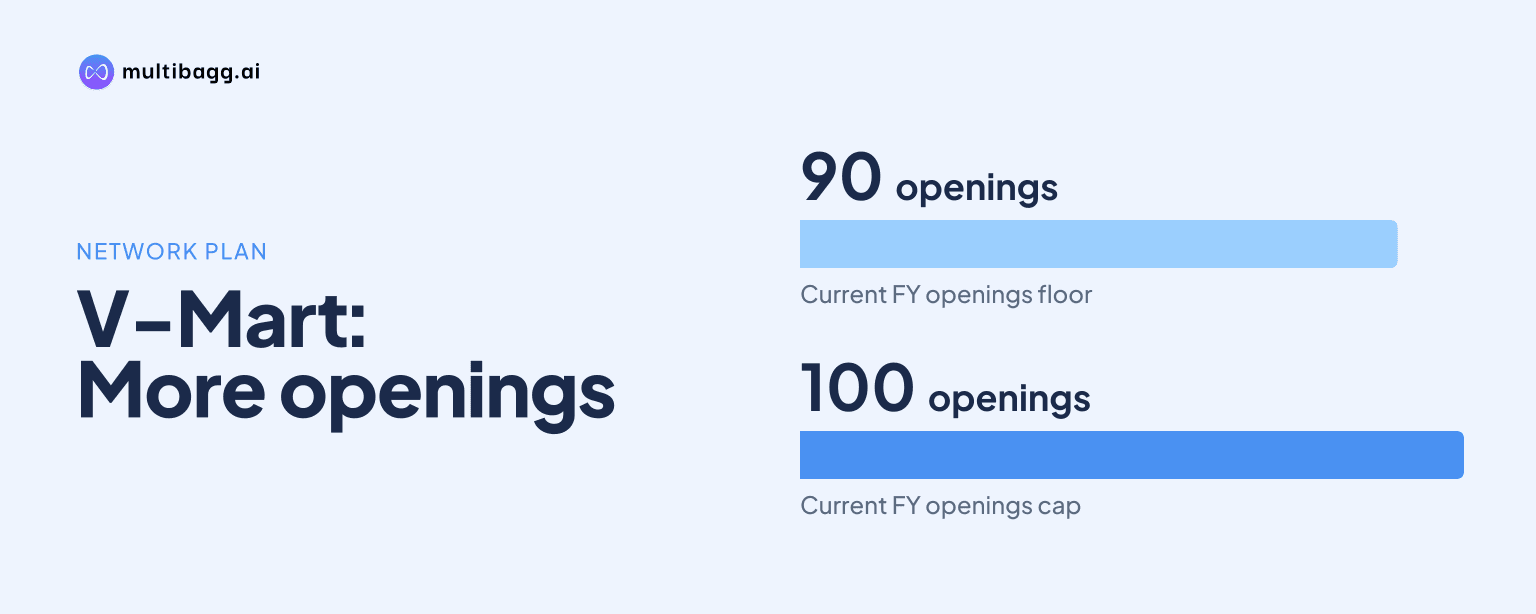
V-Mart plans to open at least 90 to 100 stores in the current financial year after reaching 613 stores across 351 cities in the second quarter, when network sales per square foot rose 5% despite a 15% increase in store area over the preceding year. Management cited that productivity gain as support for continued expansion.
Know V-Mart Retail inside out
Results, valuation, peers and who's buying, in one view.
How many stores will V-Mart open this financial year?
V-Mart is committed to opening at least 90 to 100 new stores in the current financial year. It opened 23 stores and closed one in the second quarter, while first-half activity totalled 38 openings and two closures, taking the network to 613 stores and past the 600-store milestone.
The current pace follows a faster phase of network building. Management said V-Mart took about 10.5 to 11 years to reach its first 100 stores, while the latest 100-store addition took 14 months. Anand Agarwal said he aims to meet the challenge of 100 openings a year going forward, although the stated commitment in the call was for the current financial year.
V-Mart is using a relatively compact format for new locations. Management said stores have generally been sized between 7,000 and 8,000 square feet, with 7,500 square feet its average sweet spot. The size can vary by property, but management described this range as the operating model for expansion.
Can V-Mart add stores while maintaining sales productivity?
V-Mart reported that sales per square foot, or SPSF, increased 5% across the network despite a 15% store-area addition in the past year. Management said new-store ramp-up remained promising and that it seeks similar or better SPSF from new stores than from like-for-like outlets.
Second-quarter revenue increased 18%, while reported same-store growth was 3%. Management said a 19-day festival shift moved Navratri to 11 October from 22 September a year earlier, moving festive demand from the second quarter into the third; on its adjustment, like-for-like growth was 11%.
Footfalls rose 36% and memo count grew 15% during the quarter. Management cautioned that the previous year's footfall base had data anomalies that were being streamlined and said the appropriate conversion metric should be closer to 35%. Apparel average selling prices, or ASPs, were flat year on year, supported by full-price sell-throughs and limited price increases.
Which markets are central to V-Mart's expansion plan?
V-Mart said its Unlimited business in South India is encouraging additional openings in South and West India. Unlimited's year-to-date SPSF was Rs 681, up 15%, with stores opened over the past two years delivering materially better productivity than acquired legacy stores.
Unlimited also recorded a second-quarter earnings before interest, tax, depreciation and amortisation, or EBITDA, margin of 11.6%, up from 10.5% a year earlier. V-Mart's own format delivered an 8.8% EBITDA margin, and management said Unlimited was ahead of V-Mart on a year-to-date basis even before the effects of Indian Accounting Standard 116, or Ind AS 116, lease accounting.
Competition is most intense in the eastern and central-northern hinterland, according to management. It identified Odisha, Bengal, Bihar, Jharkhand and Uttar Pradesh as markets where regional and national retailers are opening stores. V-Mart said competitor openings had affected 70 to 75 of its locations, while more than 150 competing stores had opened in its target markets.
Got a follow-up? Ask IRIS
How is V-Mart financing store expansion and inventory?
V-Mart spent net capital expenditure of Rs 85 crore in the first half, compared with Rs 60 crore in the prior-year period. Management said spending covered new stores, refurbishments, a Gurgaon office and technology investments, including work intended to bring the LimeRoad and V-Mart teams together.
Inventory rose 12% year on year because festive stock was fully held in the second-quarter balance sheet, but inventory days fell to 90 from 97. Management also said per-store inventory was lower year on year, despite the later festival calendar leaving stock unsold at the September period-end.
Short-term borrowings stood at Rs 190 crore at quarter-end, compared with Rs 100 crore at March-end. Management attributed the increase to festive inventory, higher capital expenditure and faster vendor payments, and said it was short-term working-capital use; it also said V-Mart had no long-term debt. Vendor payments were made nine days earlier, according to management.
What does online fulfilment contribute to V-Mart's store model?
V-Mart said LimeRoad's top line grew about 55% while its losses reduced about 32%, taking losses from roughly 18% of revenue to 8%. Management attributed the change partly to omnichannel fulfilment, with 58% of online orders supplied from physical V-Mart store inventory rather than separate warehouses.
All 613 stores were fulfilling online orders during the period, according to management. The approach is intended to use store inventory for digital sales without adding separate warehouse cost or inventory risk. V-Mart said its endless-aisle initiative increased digital users 37%.
Management also said 41 lakh LimeRoad users who engaged digitally converted to V-Mart physical touchpoints within 15 days of browsing. Customers using both channels appeared to have a higher annual purchase value, although management did not quantify the difference. The company described the combined online and offline model as an asset-light route toward making LimeRoad sustainable.
Conclusion
V-Mart's 90-to-100-store plan rests on reported network productivity growth during a period of rapid physical expansion. The company added 15% store area while SPSF rose 5%, and the 613-store network is being supported by compact outlets, a higher-productivity Unlimited business in South India and store-led fulfilment for LimeRoad orders.
The next disclosed test is execution of at least 90 to 100 openings in the current financial year, following 38 first-half additions. Management also expects festival-shifted demand to be reflected in third-quarter results, while its plans include managing a prospective 5% to 6% ASP increase, inventory days of 90 and short-term borrowings of Rs 190 crore after festive stocking.